Robb Report Philippines
    • Log In
    • About Us
    • The Team
    • Contact Us
    • FAQS
    • Privacy Policy
    • Terms and Conditions
    Follow Us On:
    facebook Twitter X Instagram Youtube Tiktok

    © 2026 Robb Report Philippines is published and presented by Modern Media Group, Inc., a subsidiary of AGC Power Holdings Corp. All rights reserved.

Be a member
Home › Food & Drink

Some of the World’s Best Caviar Is From Tblisi. We Went There to Find Out Why.

Chefs Felipe Riccio and Austin Waiter of Houston’s Goodnight Hospitality discover what separates the good eggs from the best.

By Felipe Riccio

August 19, 2026
FacebookXEmailCopy Link
Zach Horst

For most diners, caviar appears at the end of its journey. It arrives chilled and carefully presented, often with a sense of ceremony that can make it feel more like a trophy than something to eat. Between us, we have spent decades in fine dining—tasting, sourcing, and serving caviar in many forms. We understand its rituals and pleasures, but until recently, we had never seen where it comes from.

Earlier this year, we decided to change that. We traveled to Tbilisi, Georgia, to visit Panchenko Caviar House, widely regarded as producers of some of the best you can get. The experience has changed the way we think about buying, using, and explaining this ingredient in our restaurants.

As chefs, we often talk about ingredients with a sense of immediacy: What’s fresh? What’s seasonal? What’s ready now? But caviar forces you to think in years, not weeks.

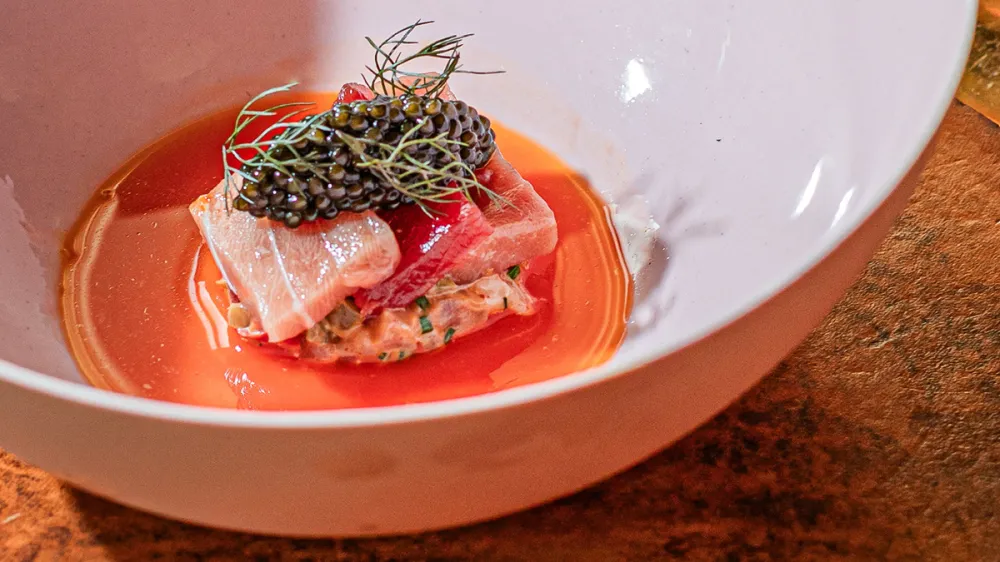
A dollop of kaluga hybrid caviar atop the Marigold Club’s Hokkaido scallop crudo. Zach Horst

At Panchenko, Altima’s source for roe, that’s because the final product is the result of a complex, ongoing cultivation process. We learned that before caviar becomes an object of celebration, it requires a decade or more of careful animal husbandry. Some sturgeon species need up to 20 years before they’re mature enough to harvest. The fish are raised in ponds fed with river water that flows off the Gombori mountains, monitored constantly to ensure proper egg development, and supervised until just the right time arrives for harvesting, salting, and packaging. Once the roe are in their tins, it might be a few more years before the containers can be opened and sampled. Small decisions compound over years. This work depends more on patience than on culinary spectacle.

That often-invisible labor is now the first thing we think about when selecting caviar. And it has changed the way we respond to the question people ask us most frequently: “Which one is the best?”

It is a fair query, but not always the most useful one. Now that we’ve seen the process up close, we frame our answers along the same lines as we talk about wine. The world’s best vintages have taught consumers to think beyond hierarchy. A bottle is interesting because of place, variety, producer, structure, texture, and personal preferences, not simply because it is expensive. Caviar deserves that same attention, even if the descriptors are different.

From left, Altima Caviar C.O.O. Alayna Steinman with chefs Austin Waiter and Felipe Riccio at Panchenko’s Rioni Sturgeon Factory. Panchenko Caviar House

Species matters. So do texture, salinity, richness, minerality, and finish. Some eggs are clean and bright (say, Siberian caviar); others are creamy, nutty, deeply savory, or more persistent (à la golden osetra).

For us, quality begins with balance. The roe should be distinct, not mushy. The finish should be clean, not muddy, metallic, or aggressively fishy. It should taste alive, but also like itself. To achieve this, extra care is taken at the salting stage to ensure that the eggs can develop great texture and flavor and still get preserved. It’s a high-wire act: The only ingredients in the tin are roe and salt, so they have to work together seamlessly.

Just as importantly, the producer should be able to explain the product clearly. We want transparency around species, origin, farming method, harvest, maturation, handling, and storage. A beautiful tin means very little if the chain of care behind it is unclear.

When we talk about caviar in terms of price or prestige only, we reduce a complex ingredient to a Veblen good. When we talk about species, producer, style, and preference, the category becomes more open, more interesting, and ultimately more enjoyable. And this thinking now shapes the way we approach it across our restaurants.

At March, which has held a Michelin star since 2024, caviar must earn its place within the story of a dish. It has to provide salinity, texture, richness, or resonance. If we use it, it’s to make the dish more complete, not just to decorate it.

At the Marigold Club, the caviar service feels celebratory and polished, but never stiff. The goal is generosity: We offer six selections from four sturgeons and five countries. We want our guests to feel that they’re being led into something special rather than being quizzed on whether they already understand it.

At Montrose Cheese & Wine, caviar becomes something a guest might take home—and in that case, education matters even more. Which size tin makes sense? What should it be served with? How should it be stored? The goal is to make it approachable without stripping away its sense of occasion.

In each setting, the sourcing story is only as valuable as our ability to share it clearly. Our responsibility is to make caviar understandable and enjoyable, not just expensive. Sometimes that means giving guests exactly what they already know they love. Sometimes it means pushing them just a little further than they expected to go.

This article originally appeared in Robb Report US.

FAQs

Great caviar should have distinct, firm roe, balanced salinity, and a clean finish. The eggs should taste fresh and expressive rather than mushy, metallic, muddy, or overly fishy.

Chefs consider species, origin, producer, texture, salinity, richness, minerality, and finish rather than relying solely on price or prestige.

Producing caviar can take a decade or longer. Some sturgeon species may require up to 20 years to mature before their roe can be harvested.

Siberian caviar can offer a cleaner, brighter profile, while golden osetra is often prized for its creamy, nutty, deeply savory flavors and longer finish.

Look for a producer that clearly identifies the sturgeon species, origin, farming practices, harvest and maturation process, handling, and storage. Transparency is one of the strongest indicators of careful sourcing.

Access to this content is reserved for members only. Please purchase a membership to unlock this content.

Be A Member Already a member? Sign IN. If you need assistance, please email [email protected]

Exclusive Events

Notice
There are no upcoming events.

E-Magazine

Read Now

LATEST IN Food & Drink

Profiles

Ana Lorenzana de Ocampo Knows What Manila Wants to Eat

By Bryle Suralta September 01, 2026
A 12-seat Edomae omakase at Grand Hyatt Manila.
The Good Life: Editors' Picks

The Good Life: Editors’ Picks of the Week

By Robb Report Philippines August 28, 2026
Brontë dining room Levanto
Dining

The Australian Way: Brontë Brings Australian Fine Dining to Makati

By Kimberly Delgado August 24, 2026
Po & Pilar Miko Calo
Dining

Miko Calo Cooks Her Grandmother’s Table at Po & Pilar

By Nicholas Ong August 24, 2026