Instant Change, Lasting Power: the Patek Philippe Calatrava 5328G





Patek Philippe has long made a habit of letting its craftsmanship speak for itself. The independent, family-owned Geneva maison often unveils creations that quietly integrate technical breakthroughs without the need for fanfare. You might admire the refined elegance of a watch’s dial, or note the glint of a finely textured case, without realizing you’re looking at something profoundly innovative.
This year, as always, Patek PhilippePatek PhilippeA Swiss watchmaker founded in Geneva in 1839 and widely regarded as among the most prestigious in the world, known for complications, hand finishing, and its slogan about passing watchesGo to Patek Philippe Glossary’s unveiling was among the most anticipated at the Watches and Wonders fair. And once again, the house did not disappoint. Of particular note is the latest addition to the storied Calatrava line: the Reference 5328G-001, a watch that demonstrates just how far Patek will go to achieve perfection, often in ways that are nearly invisible to the casual eye.
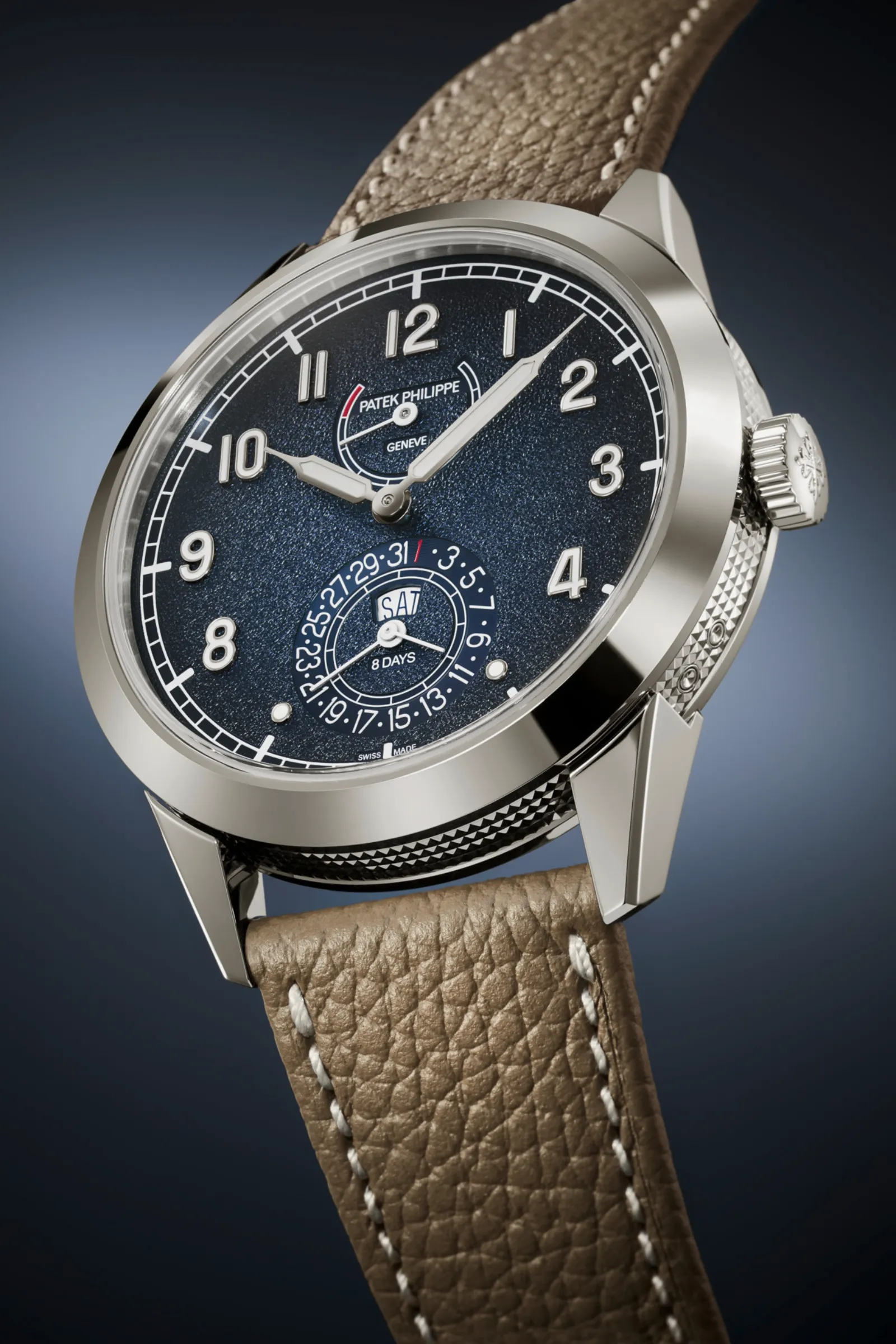
At first glance, it’s a picture of classic restraint. The dial features a subtle gradient rim, with two subdials above and below the central time-telling hands. Above, a semicircular indicator displays the power reserve of this manually wound watch, which boasts an eight-day power reserve. Below is a two-handed subdial, with the shorter hand acting as a constantly moving small seconds indicator. The longer hand points to the date, and inside the subdial is an indication of the day of the week.
The layout is graceful and serene. But the mechanics beneath are anything but ordinary. The eight-day designation hints at something more: a new caliber, the 31-505 8J PS IRM CI J, developed to house the eight-day power reserve and a revolutionary complication. It elevates the traditional day-date display into something truly special.

Most watches with this type of indication need to spread out the movement of those indicators to a few minutes before and after the midnight change because those mechanisms use so much power. The new Calatrava’s day and date indications change instantaneously, rather than in slow, staggered steps. Achieving this kind of precision and synchronicity demands immense energy, which Patek has solved with a clever dual-barrel system that stores and delivers power with remarkable efficiency. So while most watchmakers would have concentrated on one or the other, Patek PhilippePatek PhilippeA Swiss watchmaker founded in Geneva in 1839 and widely regarded as among the most prestigious in the world, known for complications, hand finishing, and its slogan about passing watchesGo to Patek Philippe Glossary decided to conquer both. And most people would never realize it.
What most people would see is the clean and balanced look of the dial, with its two main hands and its textured face. Many collectors can spot a Calatrava across an aisle because of the level of detail that draws your eye without telling you why. The movement and dial are housed in a 41 mm white-gold case, with the guilloché hobnail pattern expected of the Calatrava family.

The house also patented a new triple fold-over clasp in matching white gold. The watch is delivered with a navy-blue calfskin leather strap with a fabric pattern installed, as well as an additional grainy taupe strap.
This new wristwatch is an excellent view into the soul of the Geneva watchmaker. It is, in many ways, a very classic watch from one of Patek Philippe’s most traditional model families—a family that includes both the simplest and most complex pieces. This model brings horological complications forward in a wristwatch that can be used on a daily, more casual basis, as opposed to complications that can only be worn on the grandest of occasions.