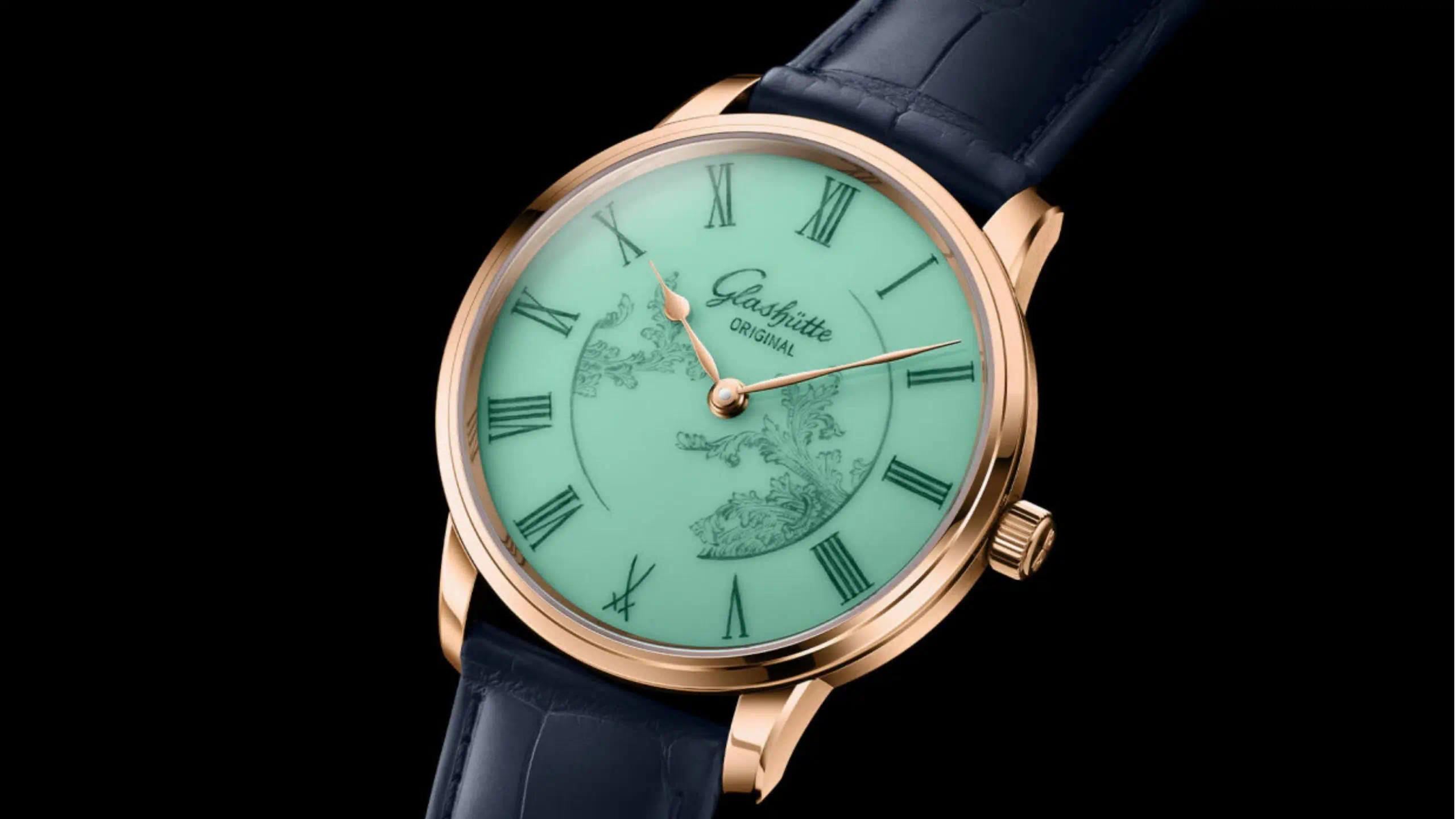
Two Cities, One Watch: Inside Glashütte Original’s Porcelain-Dial Collaboration With Meissen
Glashütte Original and Meissen, two of Germany’s oldest craft houses, released the Senator Meissen in October 2025: a limited-edition trio of watches with hand-painted porcelain dials fired at 1,400°C, built around Glashütte’s Calibre 36-16 automatic movement. The collection marked Glashütte Original’s 180th anniversary as a watchmaker and Meissen’s 315th year as Europe’s first porcelain manufactory. Prices run from $30,300 to $36,400, with the rarest edition limited to just eight watches worldwide. Here’s what makes it one of the most unusual dial stories in watchmaking and why I found it irresistible to dive into.
I’ll admit I’m coming to this a little late, having only properly clocked it this year (pun intended) at the Lucerne Watch Week at the Ayala Museum, where of course Glashutte Original’s most recent (and gorgeous) launches were displayed. I’d gone in curious about Glashütte Original mostly because of what it isn’t: in the industry, “fine watchmaking” is so often shorthand for “Swiss,” and yet, here was a storied, German manufacture holding its own.
I saw a photo of a watch with minute imperfections on its dial. Perhaps it was from my long-standing weakness for china and heritage porcelain houses or my years in the art world, but I instantly recognized that those “imperfections,” rarely seen in a watch dial were made by a brush; I also recognized the “Crossed Swords” Meissen trademark at the dial’s six o’clock.
I struck up a conversation with Christine Ling, Glashütte Original’s Brand Director in Taiwan, Hong Kong, and the Philippines, who explained that yes, it was a fully porcelain dial, in collaboration with Meissen. For a watch brand to reach for that material, rather than lacquer or metal, felt like exactly the kind of intelligent, unexpected collaboration that gets me excited.
Porcelain is a material built for museum vitrines, not wrists. Dials have to be thin, and porcelain is so easily breakable, brittle, and unforgiving of error. That’s precisely what made Glashütte Original’s collaboration with Meissen rather audacious.
The pairing makes more sense than it first appears. Glashütte and Meissen are both small Saxon towns roughly 30 minutes from Dresden, and both have spent centuries turning their names into shorthand for German craft—one in mechanical horology, the other in ceramics. Glashütte Original marked 180 years of watchmaking in 2025; Meissen, founded in 1710, is the oldest porcelain manufactory in Europe, predating even Sèvres and heavily inspired houses that followed it. The two brands framed the project as “A Tale of Two Cities,” leaning into that shared geography and shared obsession with craft.
The dials, made the hard way
Each dial starts as a wafer-thin sheet of porcelain, kilned at a searing 1,400°C so it comes out flat and sturdy enough to be set into a case without cracking. Only once that base survives the kiln do Meissen’s painters begin decorating, applying lettering, Roman numerals, and ornamental motifs entirely by hand, with additional firings at 900°C between layers to build up color and depth. Because the lettering isn’t printed, no two dials are identical; each carries small variations from the artist’s brushwork.
The collection comes in three variants. Two “Mystic Maison” editions (150 pieces each, in white or celadon green) feature Rococo-inspired ornamental patterns in soft grey. The third, a “Collage” edition limited to just eight watches, reproduces a riot of animals, flowers, and fruit lifted from Meissen’s Dekorwelten crater vase, arguably the most visually ambitious dial Glashütte Original has ever put into production.
A rarer material than it looks
Here’s where it’s worth pausing on a common mix-up. Most watches described online as having “porcelain dials,” especially vintage American railroad pocket watches from the late 1800s and early 1900s, are actually something else: vitreous enamel fired onto a metal disc, usually copper. Collectors have called this “porcelain enamel” for so long that the shorthand stuck, but it isn’t porcelain at all. True porcelain is fired kaolin clay with no metal backing whatsoever, and it behaves completely differently on the workbench: more brittle, less forgiving, and next to impossible to produce at watch-dial scale without cracking or warping in the kiln.
This isn’t Glashütte Original’s first attempt. The brand and Meissen first collaborated on porcelain-dialed Senator models back at Baselworld 2008, including a time-only version and even a tourbillon, before letting the partnership lapse. Beyond Glashütte Original, Vacheron Constantin produced pocket watches with true porcelain dials in the early 20th century, and today, Japan’s Credor, Seiko’s high-horology line, sources hand-painted porcelain dials from Hata Mantoen Co., a historic porcelain house in Saga Prefecture. It’s a short list, and part of the reason is that almost no porcelain manufactory anywhere is set up to produce dials at that scale, which is why Glashütte Original didn’t look to Switzerland at all; it looked next door.
What’s under the dial
The mechanics hold up their end. Each Senator Meissen runs on the in-house Calibre 36-16, a bi-directional automatic movement with a 100-hour power reserve and a silicon balance spring for resistance to magnetic fields and temperature swings. Through the sapphire caseback, the finishing is classic Glashütte: a three-quarter plate with fine ribbing, a hand-engraved balance bridge, a sunburst-finished winding chain, and a skeletonized rotor in 21-karat gold bearing the brand’s double-G emblem.
The cases are 18-karat red gold, 40mm across and just 10.23mm thick: slim enough that the low-profile movement lets the dial, rather than the case, carry the design. Each watch features a strap made from Louisiana Alligator leather.
Where and how much
The Mystic Maison editions are priced at $30,300; the eight-piece Collage edition runs $36,400. All three have been available since October 9, 2025, through Glashütte Original boutiques and select authorized retailers worldwide.
For collectors who track dial-making as closely as movement finishing, the Senator Meissen is one of those collaborations that are as surprising as much as a “Why wasn’t this done before?” moment. It’s also a genuine test of what porcelain can survive, and what two 300-year-old crafts still have to say to each other.
Glashütte Original is officially distributed in the Philippines by Lucerne Luxe.
FAQs
It’s a limited-edition watch collection released in October 2025, made in collaboration with MEISSEN, Europe’s oldest porcelain manufactory. The watches use hand-painted porcelain dials instead of the metal or lacquer dials typically found in fine watchmaking.
The two “Mystic Maison” editions are priced at $30,300 each. The rarer eight-piece “Collage” edition costs $36,400.
Three variants exist: 150 pieces each of the white and celadon-green “Mystic Maison” editions, and just 8 pieces of the “Collage” edition — making it one of the most limited releases in Glashütte Original’s current lineup.
The in-house Calibre 36-16, a bi-directional automatic movement with a 100-hour power reserve and a silicon balance spring, visible through a sapphire caseback finished with traditional Glashütte details like a three-quarter plate and hand-engraved balance bridge.
The collaboration marks two anniversaries at once: Glashütte Original’s 180th year of watchmaking and Meissen’s 315th year as a porcelain manufactory. Both brands are named after neighboring Saxon towns near Dresden, and the project was framed around that shared regional heritage of German craftsmanship.