Patek Philippe’s Golden Ellipse: The Mathematics of Beauty, On the Wrist




The golden ratio—phi, or approximately 1.618—is the point at which two unequal parts of a line relate to each other in the same proportion as the whole line relates to the larger part. Euclid recorded it around 300 BCE. The Fibonacci sequence converges on it. Renaissance masters worked with it. Le Corbusier built an entire system of architectural proportion around it. What makes phi unusual as a basis for beauty is that it requires no prior knowledge from the observer. The eye recognizes the proportion as right, without being able to say why. That feeling of inevitability in the absence of explanation is, arguably, as precise a definition of beauty as we have.
In 1968, Patek Philippe translated this principle into a watch case. The Golden Ellipse, the manufactureManufactureA watchmaking term for a company that designs and produces most of its movements and components in-house, rather than relying on outside suppliers. Being a true manufacture signals deep expertise,Go to Manufacture Glossary’s first entirely new collection since the Calatrava of 1932, was conceived by Jean-Daniel Rubeli, then Patek’s head of design, who had previously designed similar elliptical cases for Audemars Piguet. He built the Patek proportions directly from the golden ratio: the height approximately 1.618 times the width. The context matters: advances in mass production during the 1960s meant cheaper watches could increasingly imitate luxury timepieces. Henri Stern, then-president of Patek and Thierry Stern’s grandfather, needed a design whose distinction was structural rather than decorative. The answer? Proportion itself.
There are two accounts of how the shape came to be. Patek’s marketing maintained it was derived from the Golden Rule. Jean-Pierre Frattini, then a casemaker at the manufactureManufactureA watchmaking term for a company that designs and produces most of its movements and components in-house, rather than relying on outside suppliers. Being a true manufacture signals deep expertise,Go to Manufacture Glossary, recalled that Georges Delessert, director of the electronics department, said the initial concept came from the shape of an American highway junction seen from an airplane window. Frattini himself reconciled both: even if the road junction sparked the idea, the design process was necessarily informed by the Golden Rule. The original dial added another layer of distinction— a cobalt blue produced by dial maker Singer through vacuum plating in which cobalt and 24-karat gold were vaporized and condensed onto an 18-karat gold base, a process so novel the Swiss government’s Precious Metals Bureau demanded clarification on every step. By the end of the 1970s, the collection had grown to 65 versions. A design governed by mathematics had proven it had no expiration date.
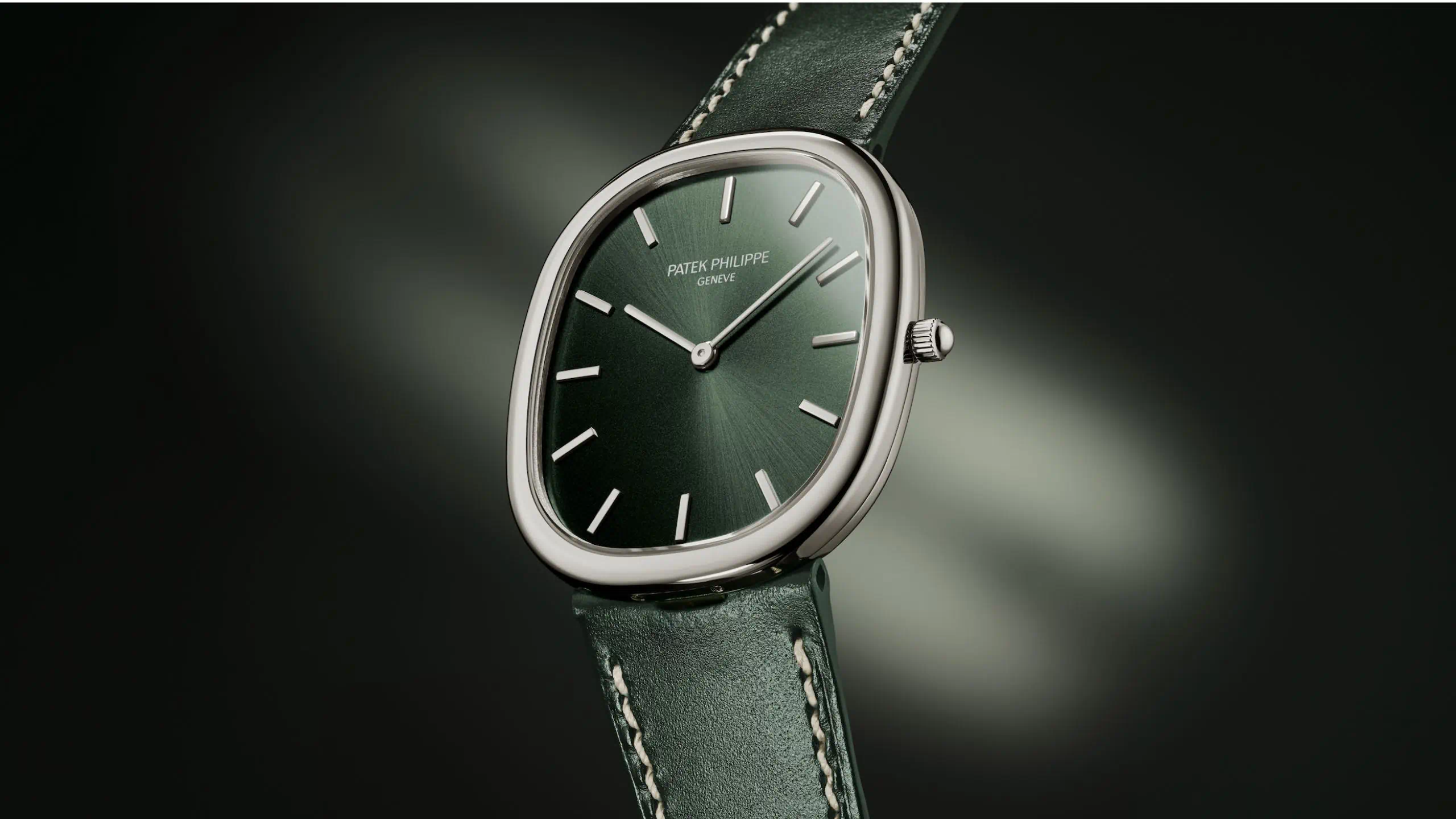
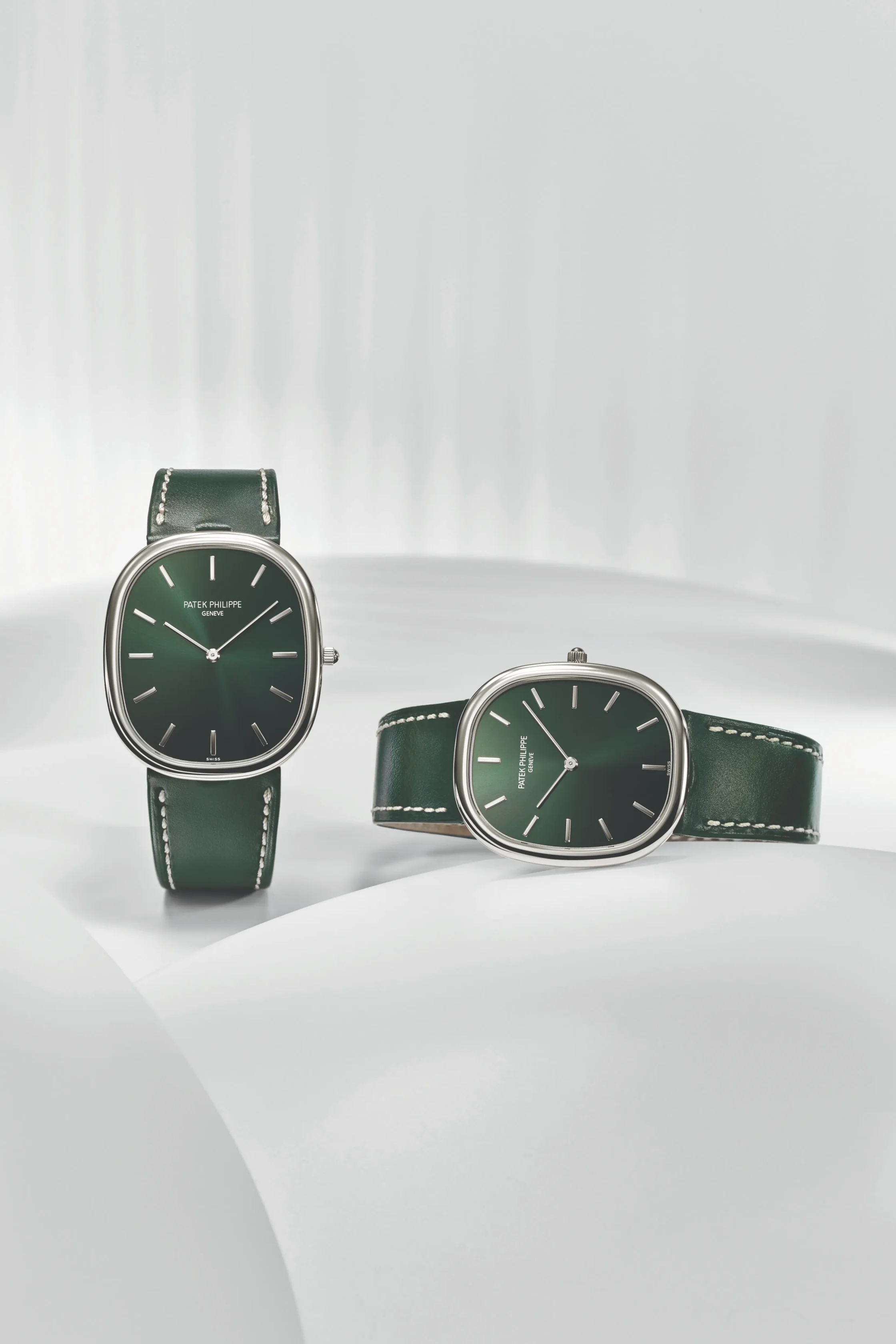
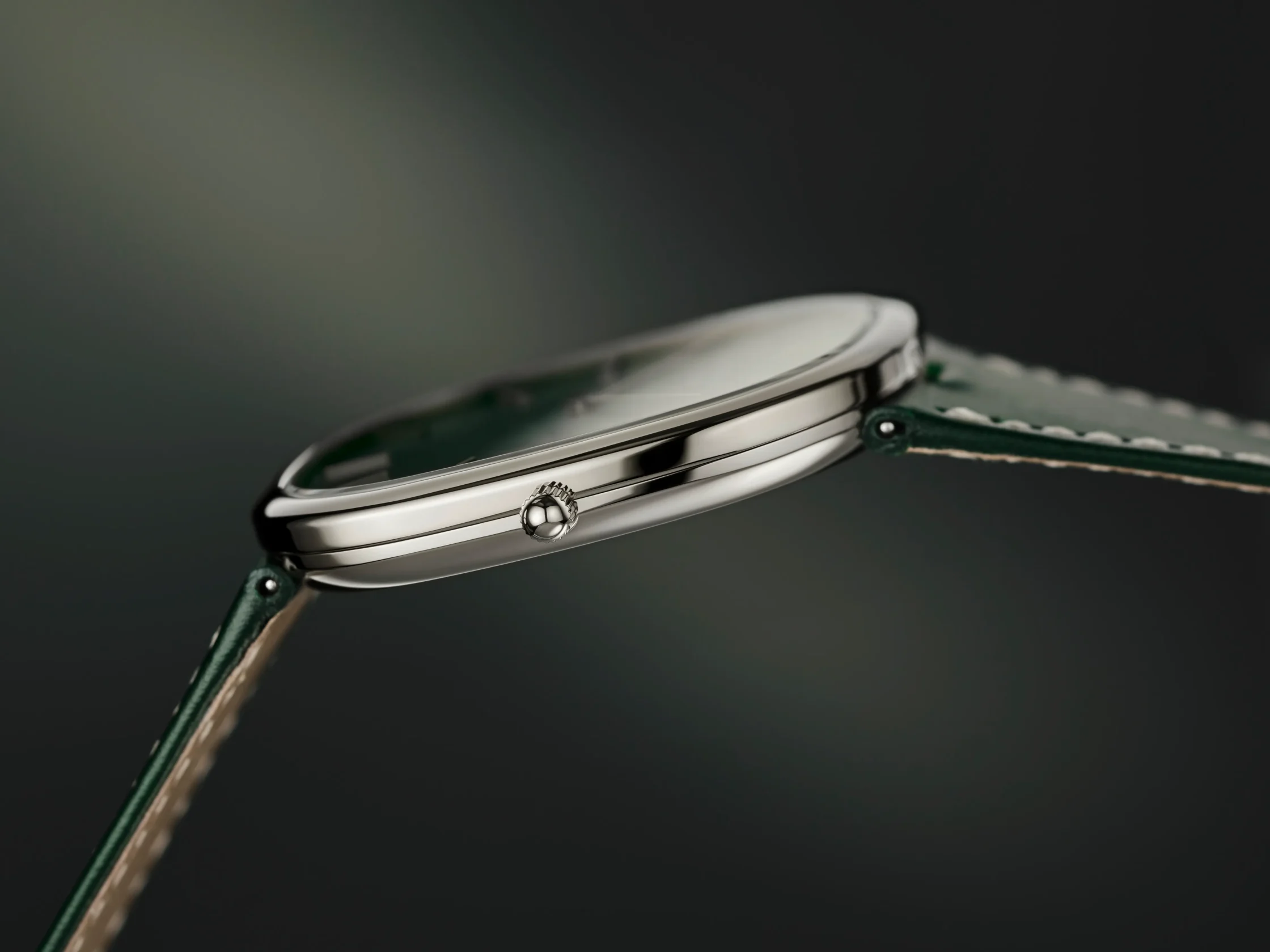
The two references at Watches and Wonders 2026—the 5738G-001 and the 3738/100G-014, both iterations featuring a deep green hue—are the current expression of that same idea. Both are white gold, both carry a sunburst olive green dial with cheveu-style hands and baton hour markers, and both run on Caliber 240, the ultra-thin self-winding movement first introduced in the Golden Ellipse Ref. 3738 in 1977, at 2.53mm thick, with an off-center 22-karat gold minirotor and a 48-hour power reserve. Both share the same 5.9mm case thickness, the thinnest in the current Patek collection. The sole difference is the case footprint: the 5738G-001 at 34.5 by 39.5mm; the 3738/100G-014 at 31.1 by 35.6mm.
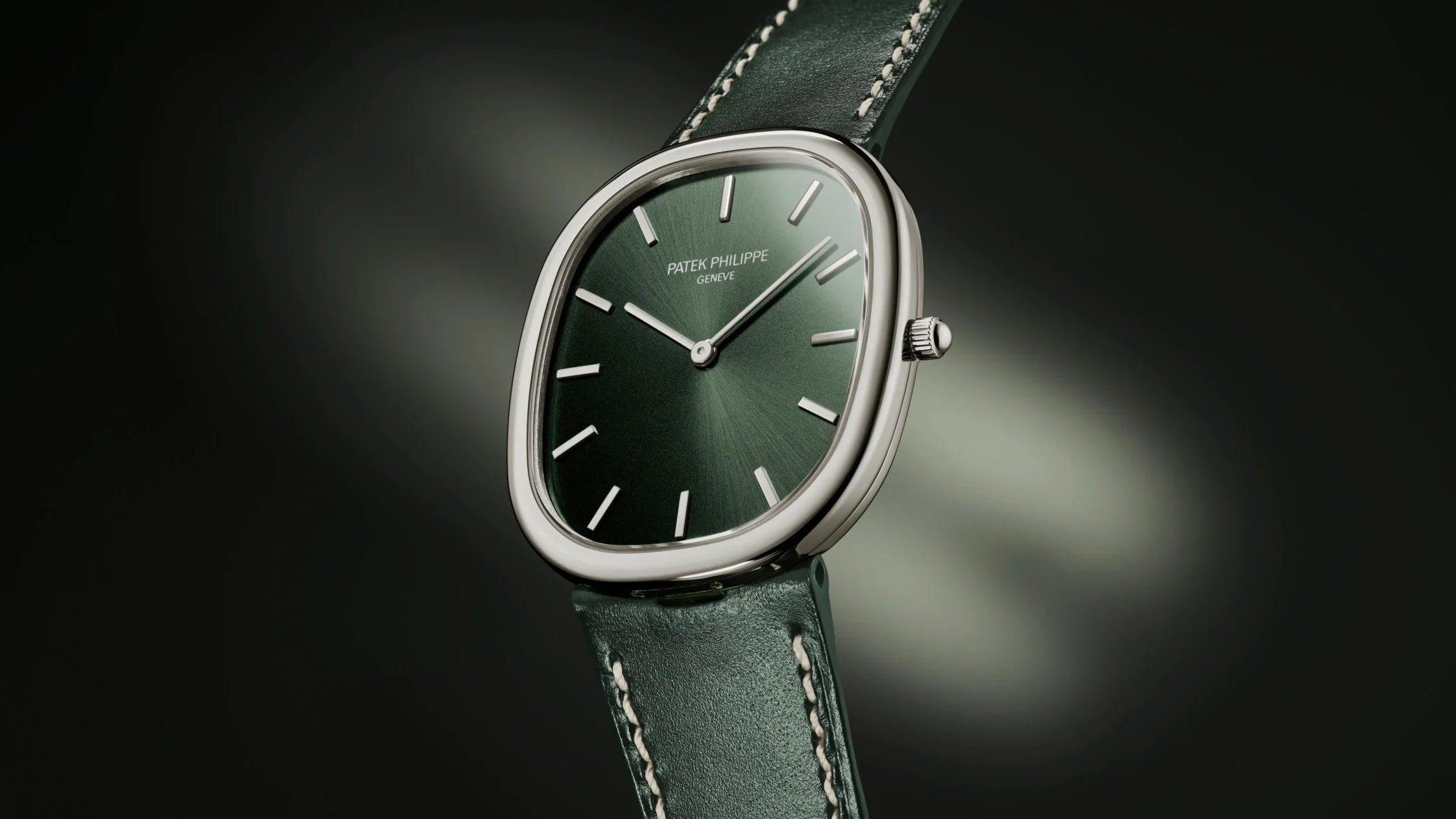
The choice between them is a question of proportion in a personal sense: the relationship between the watch and the wrist it will spend its life on. The Golden Ellipse was built on the premise that beauty lives in relationship—between numbers, between forms, between an object and the person who wears it. Fifty-eight years on, that premise remains as sound as the mathematics behind it.
Patek PhilippePatek PhilippeA Swiss watchmaker founded in Geneva in 1839 and widely regarded as among the most prestigious in the world, known for complications, hand finishing, and its slogan about passing watchesGo to Patek Philippe Glossary Golden Ellipse Ref. 5738G-001, white gold, 34.5 x 39.5mm and Ref. 3738/100G-014, white gold, 31.1 x 35.6mm, price available upon request. Available through authorized Patek Philippe retailer, Lucerne Luxe.