Everything You Need to Know About the Rolex Day-Date




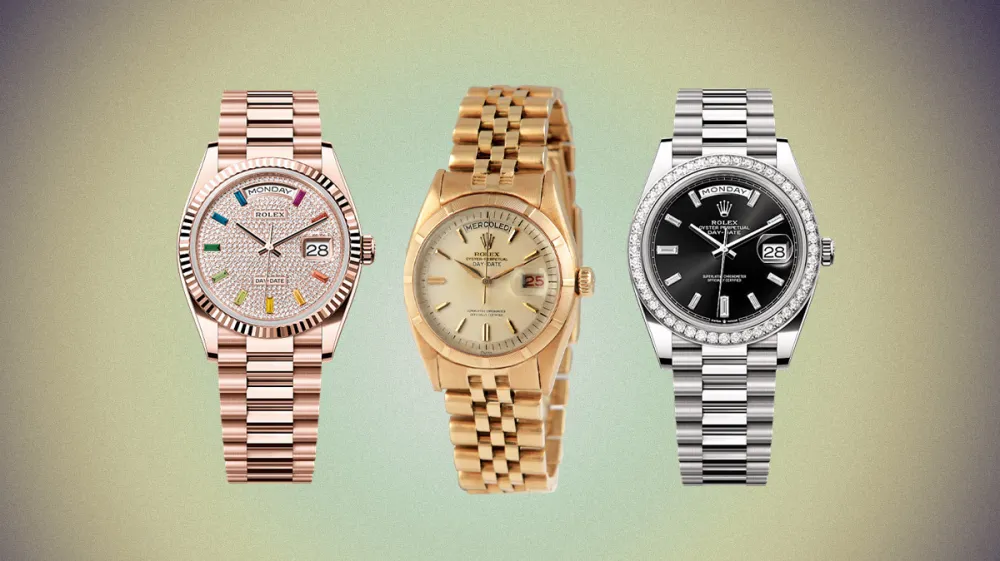
Rolex, one of the most recognizable luxuryLuxuryA lifestyle defined by exceptional quality, craftsmanship, exclusivity, and sophistication, encompassing the finest products, services, and experiences that represent the highest standards of refinement and excellence.Go to Luxury Glossary brands in the world, crafted a legacy based upon the marriage of two relatively simple yet hugely important technologies: Namely, the Oyster case and the Perpetual automatic movement with 360-degree winding rotor. It was the simple watches that resulted from this marriage—the Oyster Perpetual itself, the Explorer, the Submariner, and others —that cemented the brand’s reputation as a maker of reliable, robust, and highly accurate tool watches.
Nevertheless, Rolex did dip its toes into more complicated watchmaking in the mid-20th century: From chronographs such as the refs. 4113 and 3525 to the triple-calendar moonphase ref. 8171 and Oyster-cased ref. 6062, these creations have become hugely collectible pieces—but no small part of that collectability stems from their rarity, and from the fact that Rolex largely stopped making such complicated fare by the 1950s. But the Swiss marqueMarqueA brand name of a car manufacturer, particularly one associated with prestige, such as Ferrari, Rolls-Royce, or Aston Martin. The term emphasizes a make's heritage and identity beyond product lines,Go to Marque Glossary had a trick up its sleeve—a model simpler than the aforementioned calendar watches that would come to define the brand in the mind of millions of consumers around the world.
In 1956, Rolex debuted the Oyster PerpetualOyster PerpetualA Rolex line first introduced in the 1930s, combining a waterproof Oyster case with a self-winding Perpetual rotor movement. This pairing set the standard for the modern wristwatch, and theGo to Oyster Perpetual Glossary Day-Date, a precious-metal watch with the day of the week displayed in an arc at 12 o’clock; a magnified date window at 3 o’clock; an Oyster waterproof case; and an automatic, chronometer-certified movement. The first automatic, chronometer-certified wristwatch in the world to display the day and date thusly, it was available in several different languages — these would eventually total 26—and was beautifully sized and styled. Soon, its matching “President” bracelet would gain nearly as much fame as the watch itself, lending its name to the entire package and becoming synonymous in the minds of many with opulence and wealth.
The “President” nickname was an apt one: The Day-Date was quickly seen on the wrists of American presidents such as Lyndon B. Johnson, Richard Nixon, Gerald Ford, and Donald Trump. Athletes such as Jack Nicklaus and LeBron James; actors such as Jacob Elordi and Jennifer Aniston; musicians such as John Mayer and Bono—all across the world, celebrities have adopted this gold or platinum timepiece as their own. As the only Rolex model solely available in precious metals, it has a unique place in the Crown’s catalog as a signifier of wealth and status, and is often used as a prop or a trope in television and films for this reason. (For a fun evening, count the number of Day-Dates seen in any given episode of The Sopranos.)
Over the years, a dizzying array of special dials and configurations have been seen on this sparkling model: From burled wood to precious stones to the beautiful colored “Stella” references of the 1970s and 1980s, these Day-Dates are incredibly varied and nuanced, resulting in a veritable collector’s paradise of compelling options. Beginning around $8,000-$10,000 for a vintage four-digit reference on a strap and continuing into “If You Have to Ask” territory for special off-catalog or double-signed references, the Day-Date is most certainly not beginner’s horological fare . . . but if bought correctly, it could very well constitute a one-watch collection.
How to Use This Guide
While attempting to catalog every possible Day-Date configuration from the past 70 years would be a fool’s errand, examining significant references from each generation is eminently doable. Below you’ll find an example reference of each along with a pricing reference for that generation and specifics about its aesthetic and technical considerations. Keep in mind that the earliest generations are fairly rare and accurate pricing information is thus tougher to pin down. Four- and five-digit watches, however, are much more abundant and can be had from knowledgeable dealers. Rolex’s CPO program also forms a convenient entry point into collecting the Day-Date.
Rolex Oyster Perpetual Day-Date Ref. 6510/6511 (1956-1957)
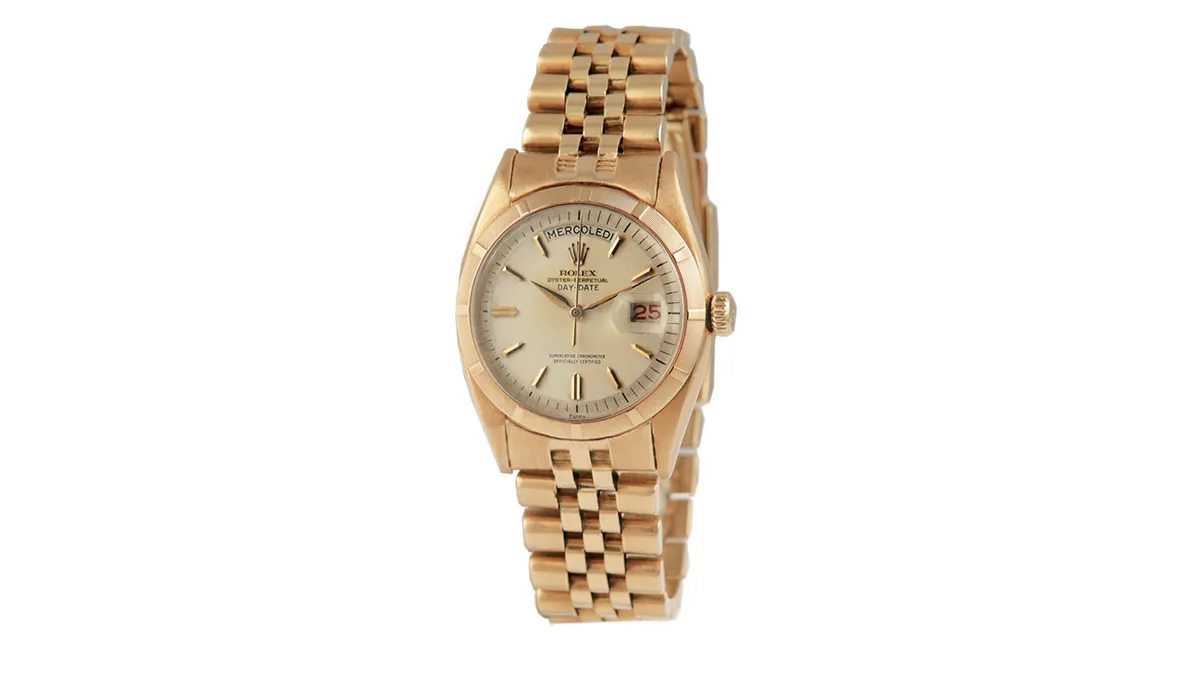
The references 6510 (smooth bezel) and 6511 (fluted bezel) debuted in 1956. Making use of a patented new mechanism, the Day-Date was the world’s first automatic chronometer featuring both the day of the week spelled out in full as well as the date on the dial. Launched on the brand’s Jubilee bracelet —which debuted in 1945 on the Datejust in celebration of the brand’s 40th anniversary—the references 6510 and 6511 featured water-resistant 36 mm Oyster cases in yellow goldYellow GoldA warm, precious alloy of pure gold mixed with copper and silver, used in watches and jewelry for its traditional luxurious look. Yellow gold has returned to fashion in vintage-inspiredGo to Yellow Gold Glossary with either champagne or black dials. The automatic cal. 1055 movement was found sometimes faulty, and was updated in the subsequent reference, the 6611 that debuted one year later in 1957.
Reference: 6510; 6511
Diameter: 36 mm
Movement: Rolex cal. 1055 automatic
Rolex Oyster Perpetual Day-Date Ref. 6611 (~1957-1959)
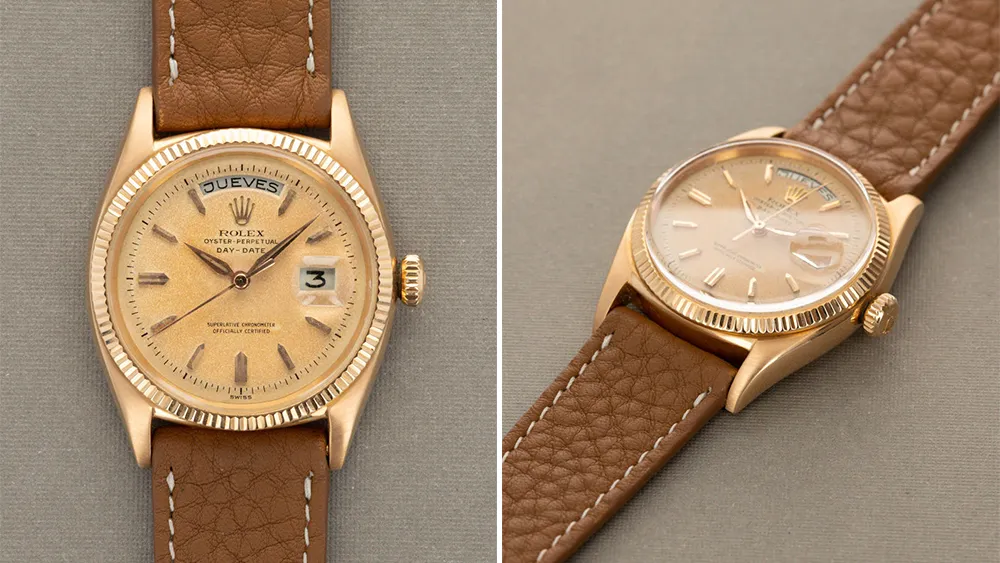
It was the ref. 6611 that was first fitted with the now-famous, precious-metal “President” bracelet—a bracelet that would shortly give the watch itself its unofficial nickname. The ref. 6511 wasn’t terribly far removed from the previous references, though the dial now sloped at the edges in a “pie pan” configuration and the handset changed from alpha to dauphine. The automatic cal. 1055 was upgraded with a Micro-Stella balance and corrected the date advancement issues of the previous generation. A series of just six pieces of ref. 6611 in stainless steel are thought to have been made as prototypes but never put into serial production.
Reference: 6611
Diameter: 36 mm
Movement: Rolex cal. 1055 automatic (w/Micro-Stella balance)
Price on Secondary Market: $12,000+
Rolex Oyster Perpetual Day-Date Ref. 180X Series (~1959-1977)
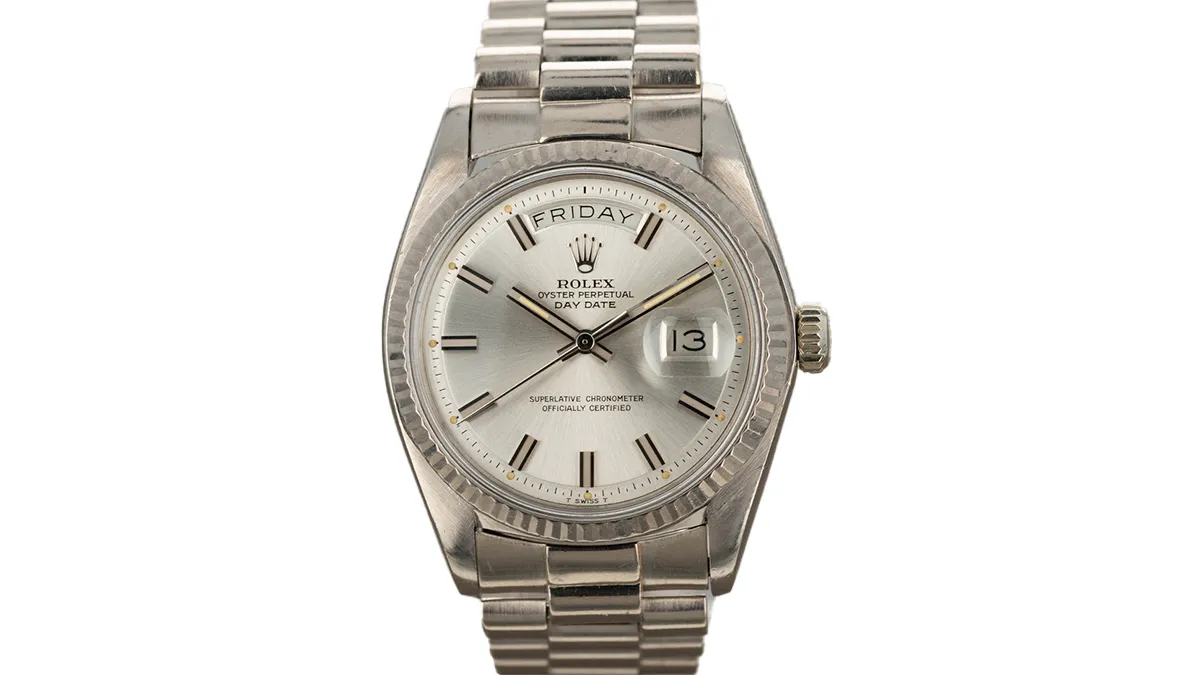
When someone thinks of the Day-Date, they’re invariably picturing a ref. 1803 or similar. Launched at the tail end of the 1950s and produced for some two decades, it was the final Day-Date reference to feature both a pie-pan dial as well as an acrylic crystal—two hallmarks of vintage Day-Date collecting—and the final reference powered by a movement without a quickset function for either the day or the date windows. (This generation also featured hollow-link President bracelets, which contributes further to the vintage feel of the 180X-series watches.) Nevertheless, the 180X did introduce the baton handset now common to all Datejust references. Hacking seconds, meanwhile, was introduced in this series in the early 1970s.
Reference: 180X
Diameter: 36 mm
Movement: Rolex cal. 1555; 1556 automatic
Price on Secondary Market: $14,000
Rolex Oyster Perpetual Day-Date Ref. 180XX Series (~1977-1988)
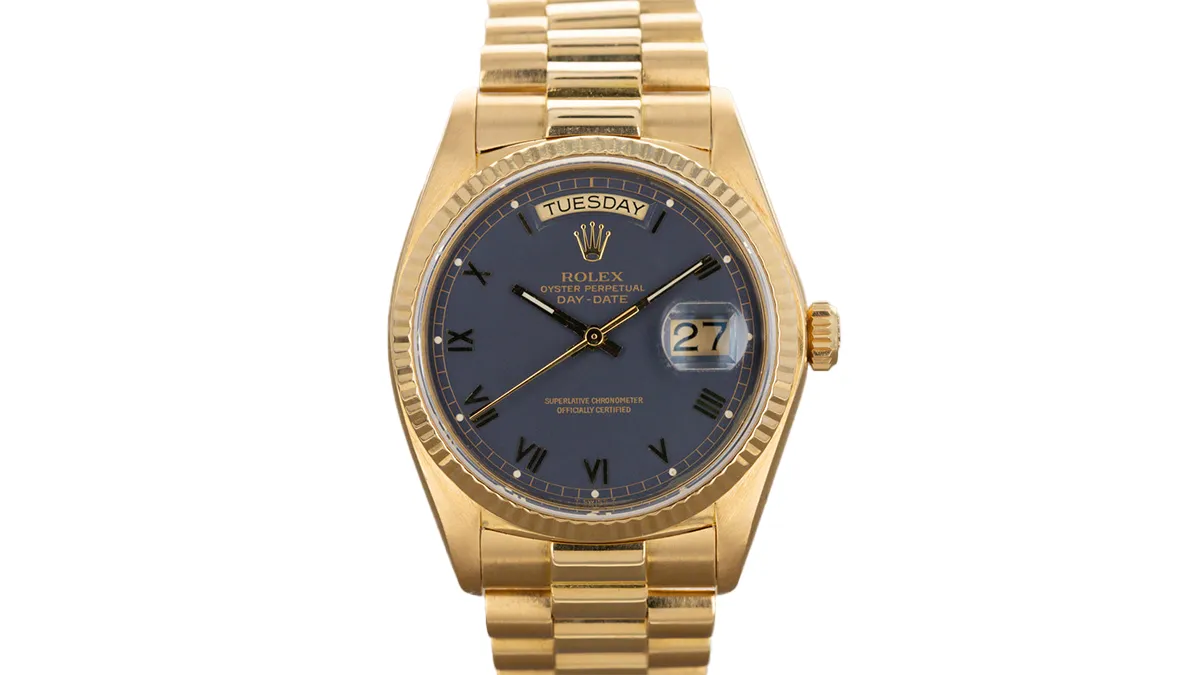
Several notable changes, both aesthetic and internal, marked the transition to the five-digit ref. 18038 and similar watches: The pie-pan dial was retired in favor of a flat variant; the acrylic crystal of previous generations was upgraded to scratch-resistant sapphire; and the new cal. 3055 movement now featured a 4 Hz beat rate, a 48-hour power reserve, and a quickset date function. (Though not a quickset day function—that would come later.) In addition to a classic configuration with yellow gold case, fluted bezel, and champagne dial, the 180XX series also included variants with smooth bezels, diamond-studded dials, and tree bark-like finishes. The President bracelet on this series featured solid end links.
Reference: 180XX
Diameter: 36mm
Movement: Rolex cal. 3055 automatic
Price on Secondary Market: $15,000+
Rolex Oysterquartz Day-Date Ref. 190XX Series (~1977-2004)
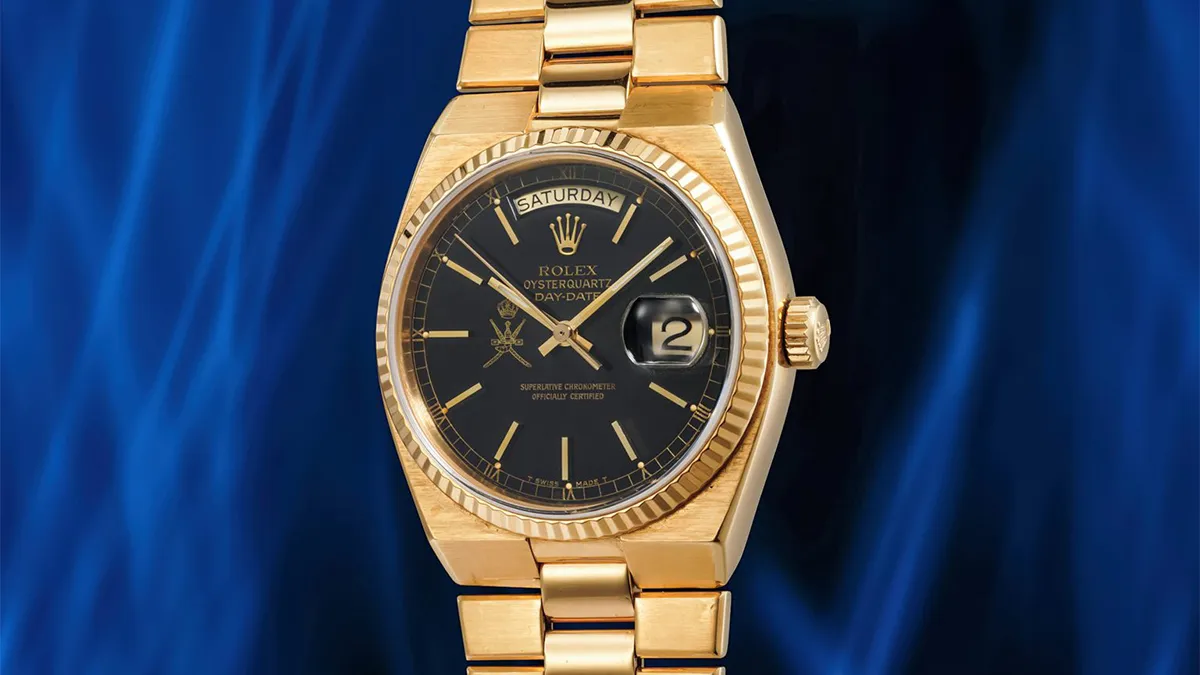
Though Rolex had worked with a consortium of other Swiss makers to develop the Beta 21 quartz movement, it abandoned that project in the early 1970s and developed its own in-house calibers. The cal. 5055 was used in a new Oysterquartz-powered series of yellow and white gold Day-Date references introduced in 1977, of which the ref. 19018 is emblematic: Housed in an angular 36 mm case with a unique integrated bracelet with polished center links, it features a fluted bezel and a dial in either champagne, white, or black. (Special burled wood-dialed versions were also produced.) Startlingly accurate, the thermo-compensated cal. 5055 and its successors were nevertheless sunsetted in 2004 when Rolex transitioned back to an all-mechanical catalog.
Reference: 190XX
Diameter: 36 mm
Movement: Rolex cal. 5055 Oysterquartz
Price on Secondary Market: $15,000+
Rolex Oyster Perpetual Day-Date Ref. 182XX Series (~1988-2000)
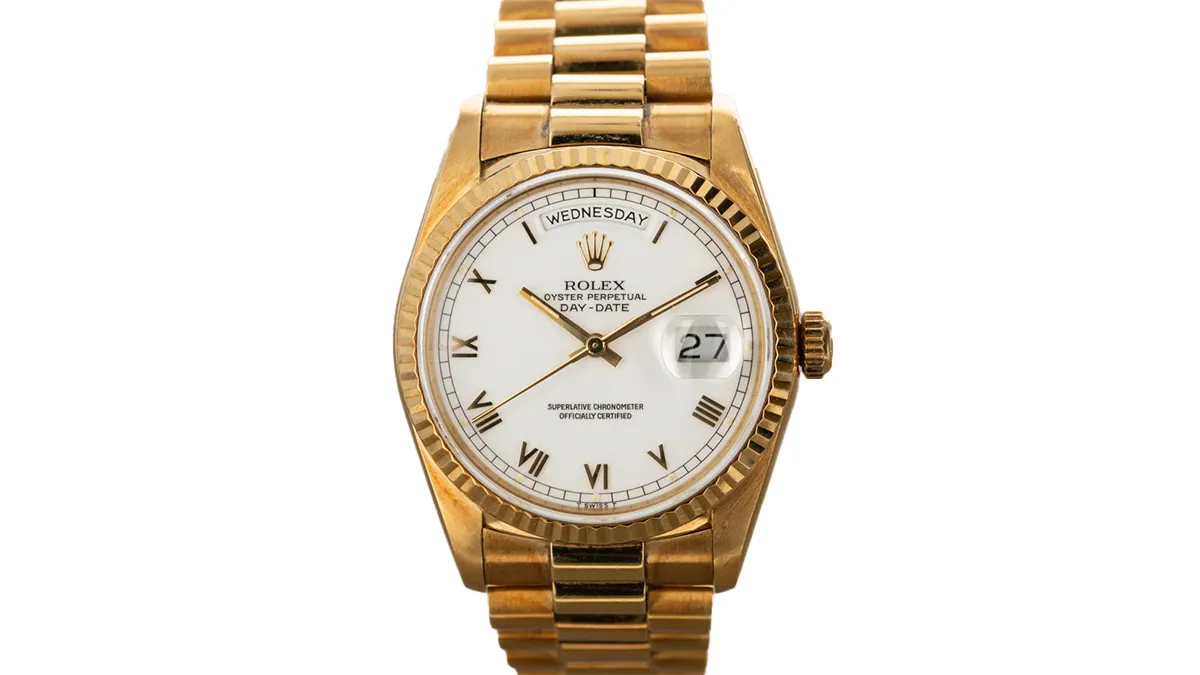
This series, launched as the successor to the 190XX but concurrent with the Day-Date Oysterquartz line, finally featured what came to be known as the “double-quickset” function: The crown could be used to rapidly adjust both the date and the day display, making for rapid setting after the watch had been sitting unwound. By the time this series debuted, the day wheel was available in 26 languages, meaning that myriad different markets all across the world were well served. Though the ref. 18238 constitutes the classic yellow-gold configuration, numerous dial types were available, among which is a handsome, glossy white example with applied indices, an outer railroad minute track, and luminous tritium plots.
Reference: 182XX
Diameter: 36 mm
Movement: Rolex cal. 3155 automatic
Price on Secondary Market: $16,500+
Rolex Oyster Perpetual Day-Date Ref. 118XXX Series (2000-2019)
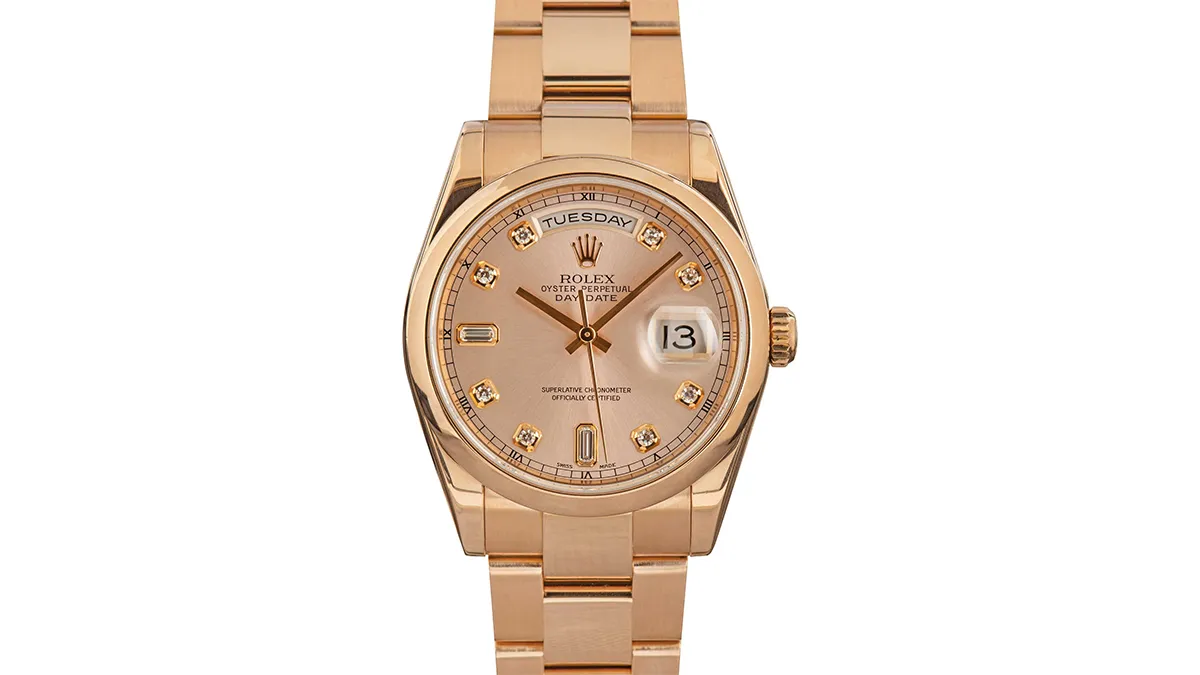
Small changes are what underscore the evolution to the 118XXX-series of Day-Date: The watch’s President bracelet received solid links and a new clasp, while the dial was given an engraved rehaut signed “ROLEX” several times around its perimeter in order to head off counterfeiting. (This series was also available on a matching Oyster bracelet.) The cal. 3155 movement, still in use from the previous generation of Day-Date, was updated in 2015 to Rolex’s own chronometer specification of +/- 2 seconds per day. Furthermore, in 2005 Rolex introduced its proprietary Everose gold, a mix of gold, copper, and platinum that takes on a distinctive pinkish hue—this metal then became available within the Day-Date collection.
Reference: 118XXX
Diameter: 36 mm
Movement: Rolex cal. 3155 automatic
Price on Secondary Market: $25,000+
Rolex Oyster Perpetual Day-Date II Ref. 2182XX (2008-2015)
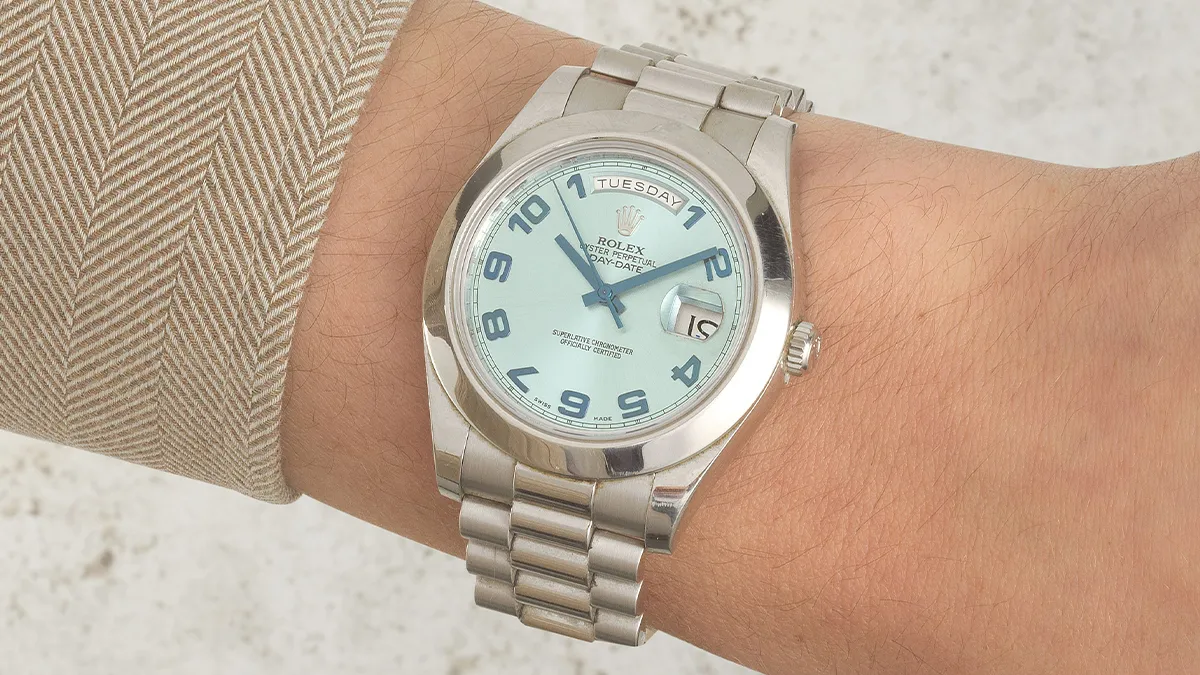
In keeping with the trends in the early 2000s, Rolex introduced a larger version of the Day-Date in 2008. The so-called “Day-Date II” now measured 41 mm in precious metals (yellow, white, and Everose gold or platinum) with a matching President bracelet, giving it significant heft and wrist presence. Powered by the automatic cal. 3156 with 48 hours of power reserve, it featured a slightly more prominent bezel and lugs to maintain proportion with its larger diameter. This short-lived reference was succeeded by a 40 mm model that still lives alongside the standard 36 mm Datejust in the Rolex catalog. The ref. 218206 in platinum is notable for its ice-blue dial option, which was introduced in 2013.
Reference: 2182XX
Diameter: 41 mm
Movement: Rolex cal. 3156 automatic
Price on Secondary Market: $36,000+
Rolex Oyster Perpetual Day-Date 40 Ref. 228XXX (2015-Present)
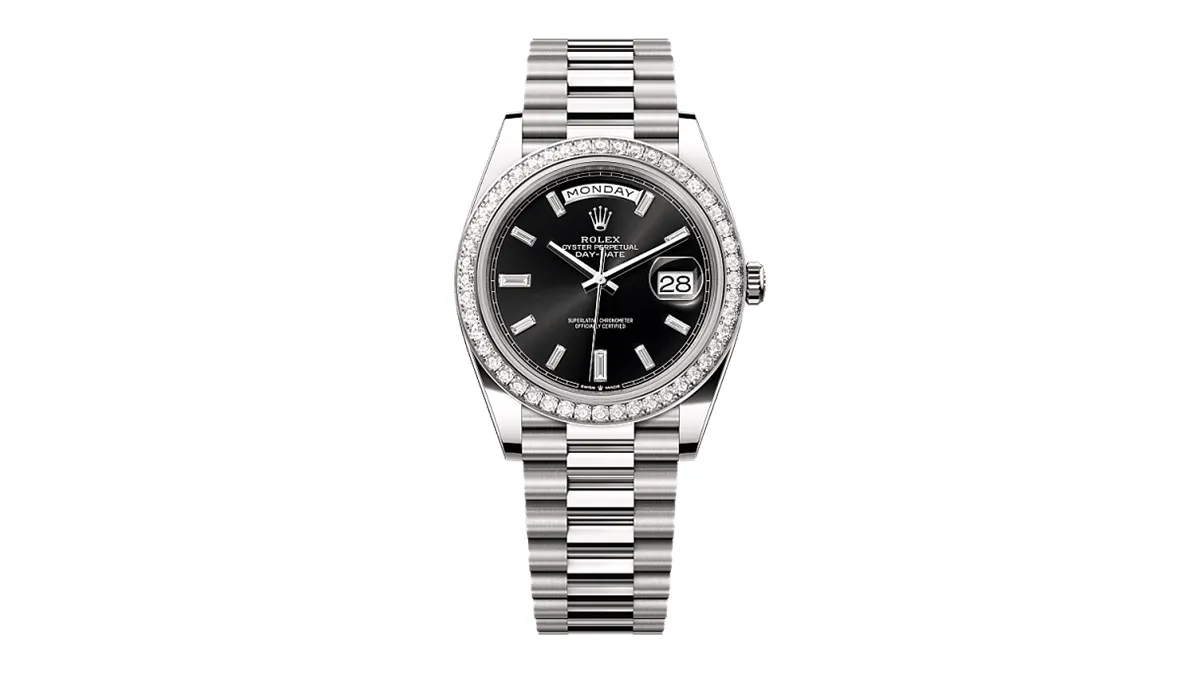
After the relatively short-lived Day-Date II, Rolex introduced the Day-Date 40 in 2015. Its new cal. 3255 presented notable technological innovations including a Parachrom hairspring, Chronergy escapement, and a 70-hour power reserve. The slimmed-down proportions still offer the consumer a larger Day-Date size but brought the bezel and lug proportions more in line with those of the classic 36 mm model. Ceramic spacers in the solid-link President bracelet prevent stretching, while laser-etched dial options offer a wider aesthetic variety to the buyer. Metal options are still the three varieties of gold plus platinum, while fluted and two varieties of diamond-set bezels are available. Dial varieties are myriad, and the date window is available in 26 languages.
Reference: 228XXX
Diameter: 40 mm
Movement: Rolex cal. 3255 automatic
Price: $44,200+
Rolex Oyster Perpetual Day-Date 36 Ref. 1282XX (2019-Present)
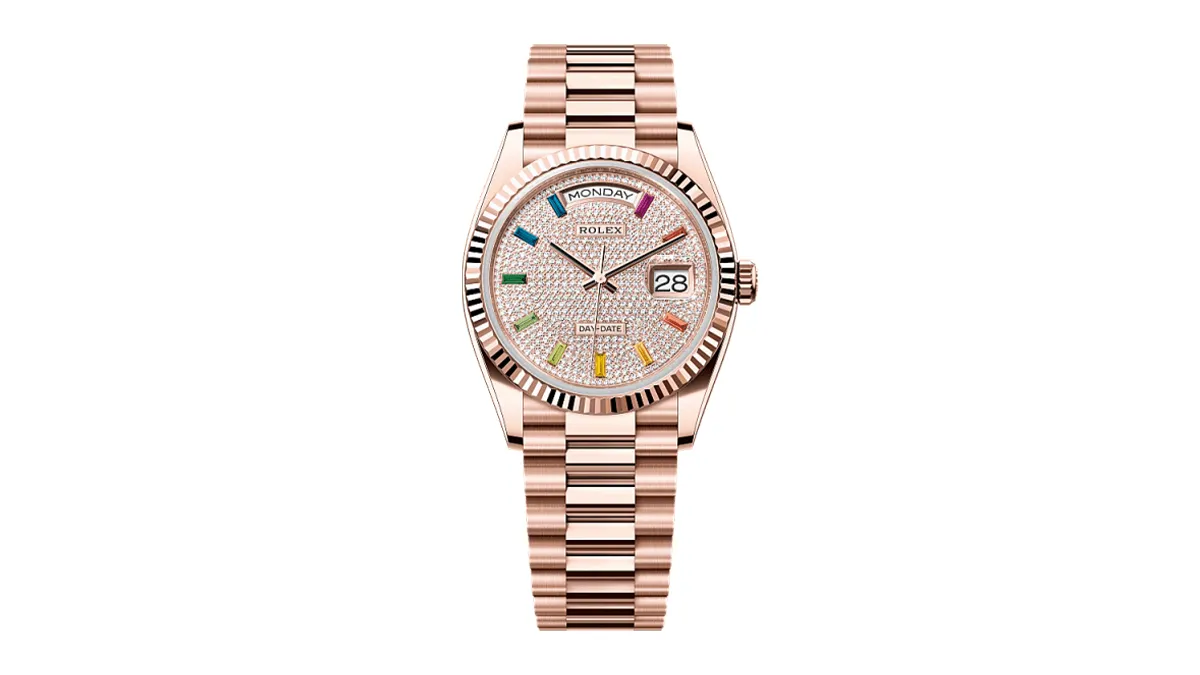
The 1282XX series is the current 36 mm Day-Date, the modern evolution of the original 65XX from the 1950s. Outfitted, like the 40 mm version, with the Rolex cal. 3255 automatic movement, it comes in a wide variety of materials, bezels, dials, and more. Of all the Rolex models, it’s perhaps the most difficult to parse, with all manner of both catalog and off-catalog (i.e. special request) versions cropping up in the market. Today, with the obsession with gem-set and so-called “rainbow” watches, the ref. 128235-0050 strikes a particular chord: Housed in an Everose case with a matching President bracelet, it features a fluted bezel, a fully diamond-paved dial, and 10 baguette-cut rainbow sapphires for hour markers.
Reference: 1282XX
Diameter: 36 mm
Movement: Rolex cal. 3255 automatic
Price: $40,200+
This article originally appeared in Robb Report US.