First Taste: Filipino Gelateria Kariton, Born in Melbourne, Returns to Manila
When one thinks of gelato, one thinks Italy. But at Kariton, the Melbourne-born brand now in Molito, Alabang, the compass points firmly to the Philippines.
Kariton, Tagalog for “cart,” honors the sorbeteros who shaped Filipino ice cream. “Dirty” ice cream, once dismissed, has been reclaimed as a badge of ingenuity. Anchored in hand-cranked traditions that birthed halo-halo, buko pandan, queso, and ube, Kariton steers gelato towards a distinctly Filipino canon. Think champorado, San Fernando’s LBS cheese bread, or pili nut butter & jam in creamy scoops–nostalgic flavors executed with fine-dining discipline.
Kariton itself was a result of ingenuity, resourcefulness, and resilience. Born in Melbourne’s hard lockdown, when restaurants went dark and chefs Minh Duong (of Maha Melbourne) and John Rivera (formerly of Lûmé, and who founded acclaimed Askal Melbourne), found themselves abruptly idle. They resolved to make something that, as Duong put it, “makes people happy,” at a moment when the city most needed it. “And what makes people happy more than gelato?” he said.
It’s a question their first tubs of ube halaya, mango float, and turon gelato answered on contact. The initial week’s drop of 700 tubs sold out, which they hand-delivered to customers that included Erwan Heussaff, temporarily residing in Melbourne with his wife and newborn during the lockdown. “I came back yearly to Melbourne, and when they opened their first brick-and-mortar store in 2022, I was kind of shocked, really,” Heussaff says. “The energy was so high—it was packed at 9 p.m. The menu was in Filipino; there was no vanilla on the menu. I thought: This is a different kind of representation.”
Heussaff says that what hooked him was how front-and-center the culture was, which what made it work and what made it singular in Melbourne. Conversations soon turned to scale. “We had big plans, but if we were going to start anywhere, it had to be the Philippines—to bring it home,” he adds. “We also knew the risk: what plays as ‘Filipino’ abroad is judged differently here, where everyone knows the food.”
They needn’t have worried. Back on home ground, the flavors gained a clear edge. Buko Pandan, Turon, Mango Float, and Durian Chiffon gelato, among others, were sharpened by fresh, local produce rather than frozen or processed stand-ins. Heussaff describes Kariton’s process as “farm to gelato,” and, as exemplified by the ethos of his media platform Featr, he’s connected the brand with small producers and rare ingredients across the Philippines like the highly-regulated pili nut or the elusive dayap. “It’s about connecting people to living culture,” he says. “You don’t just watch a story about dayap or pili nuts; you taste it for yourself.”
Any chef will attest that quality begins with the ingredients. In Rivera and Duong’s hands, those ingredients become gelato that resists dessert’s usual escalation–sweeter, richer, louder–in favor of clarity and balance.
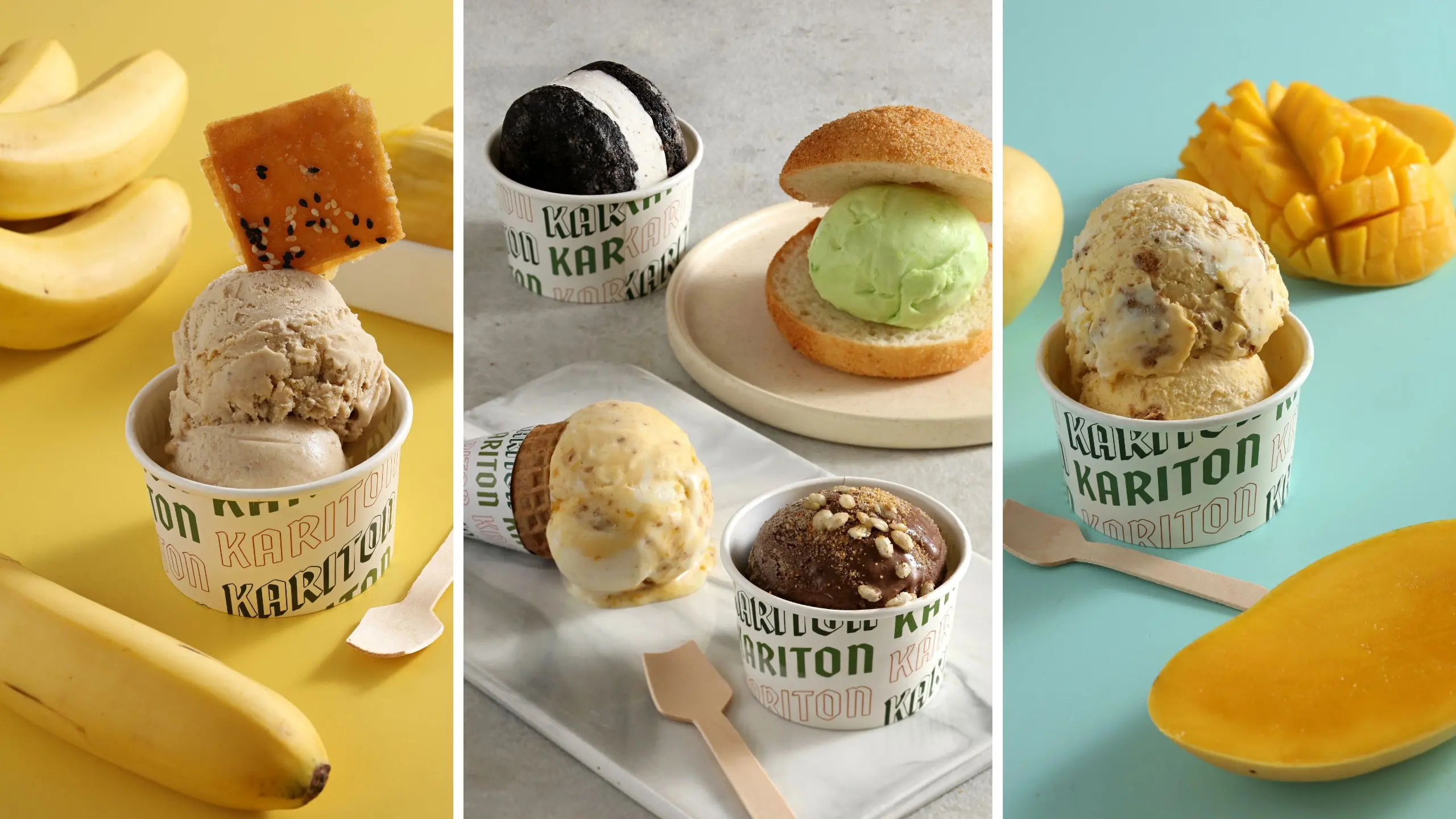
Take Cheesemossa: burnt kesong puti folded into a fior di latte base with crumbs of Pampanga’s LBS cheese bread and shavings of queso de bola. It’s loaded, yet nothing shouts–unctuous, salty-sweet, and decadent, but proportioned so cleanly you keep going back for more. Pili Nutbutterjelly could have slipped into PB&J cliché; instead, red wine and muscat-grape confit add lift and length. Most can’t tell the tweak, but they’ll feel the freshness it brings.
Kariton’s Champorado gelato was one of Chef Minh’s toughest challenges. “You’re talking about rice, chocolate, and salted fish; that’s already a lot,” he says. “You can’t just throw those together. It has to make sense.” After eight trials, he found the missing note. “I used buttermilk. It gave a little tang, the lactic flavor of evaporated milk, without the heaviness.” (Plus, the added hint of dried fish cleverly incorporated through patis and made into butterscotch.) Just when one might consider their tendency towards Filipino flavors to be obvious, it surprises with intelligence and techniques honed in fine-dining kitchens.
With all that’s in-store (literally speaking), it’s easy to overlook the semi-freddo, but don’t skip them. They’re exceptional and also this writer’s favorites. Yemabon layers malted milk semifreddo with a miso-infused yema paste and two salted-egg pâté breton cookies, half-dipped in caramelized white chocolate; Pinoyreo sandwiches vanilla semifreddo between plush chocolate crinkles; Sylvies stack brown-butter semifreddo with cashew praline and a delicate cashew dacquoise, a take on sylvanas. Each one hits a home run.
At Molito, customers drift in, families and friends drawn to the pastel counter. They sample the taho soft serve (a vegan offering of soy soft-serve complete with oolong pearls and arnibal), the Four Seasons sorbet, and the Buko Pandan gelato that tastes somehow truer than the real thing. Somewhere between the cool sweetness and the exacting craftsmanship, they can taste what Kariton set out to do: to turn memory into flavor and make something deeply delicious but distinctly Filipino, one scoop at a time.
Molito Compound Commerce Ave, Muntinlupa, Metro Manila. Click here to visit their Instagram.