Robb Report Philippines
    • Log In
    • About Us
    • The Team
    • Contact Us
    • FAQS
    • Privacy Policy
    • Terms and Conditions
    Follow Us On:
    facebook Twitter X Instagram Youtube Tiktok

    © 2026 Robb Report Philippines is published and presented by Modern Media Group, Inc., a subsidiary of AGC Power Holdings Corp. All rights reserved.

Be a member
Aviation

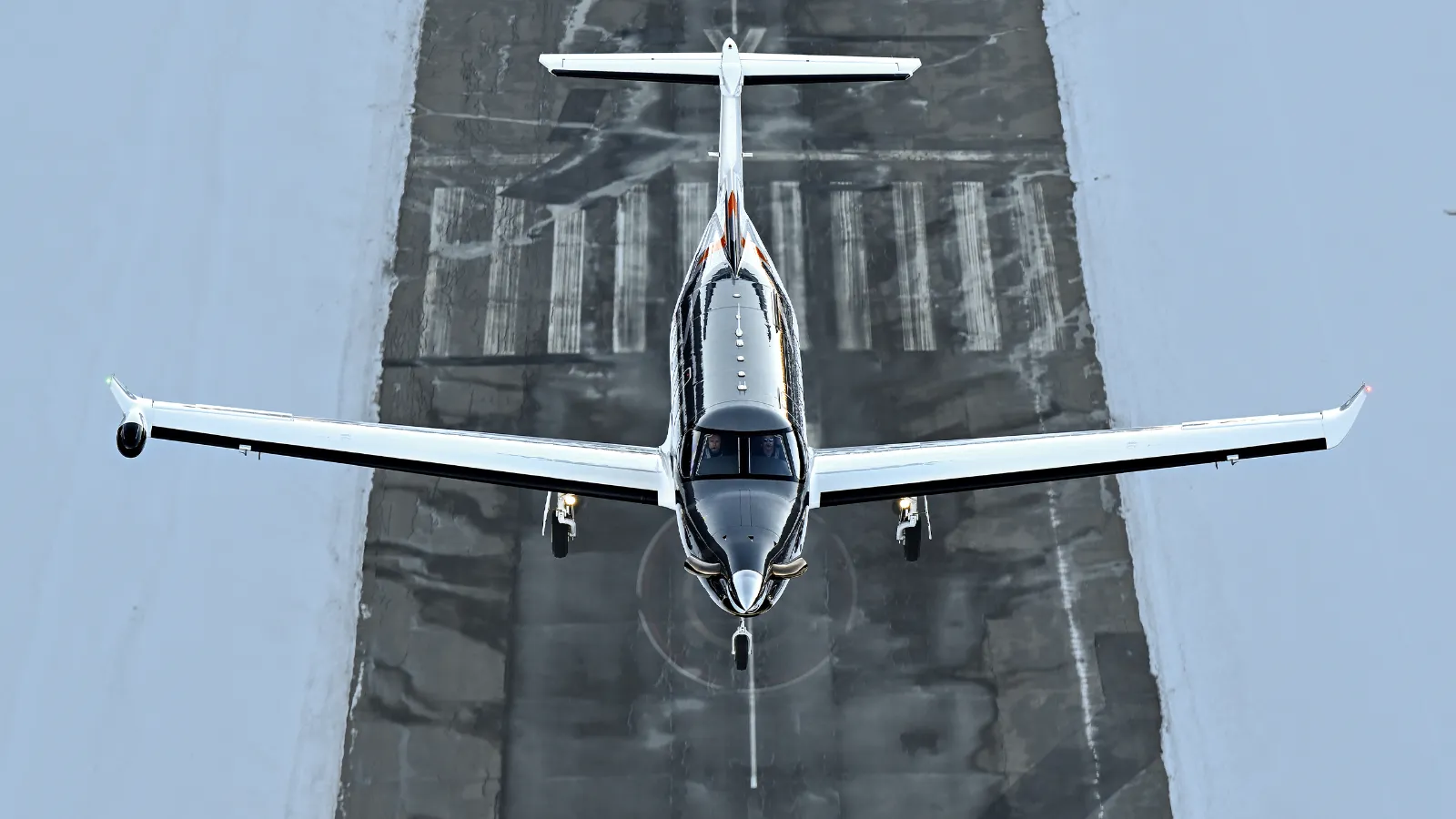
Why the Pilatus PC-12 Pro Is Still the World’s Most Versatile Private Aircraft

For three decades, the Pilatus PC-12 has defined what a private turboprop can be. The new PC-12 Pro adds the technology, design, and safety systems to keep it there.

By Nicholas Ong

10 minutes ago
FacebookXEmailCopy Link
Pilatus

In October 1989, Pilatus stood up at the National Business Aviation Association’s annual convention and announced an aircraft that, by most measures, shouldn’t have worked: a single-engine turboprop with a cabin large enough to do a business jet’s job, capable of landing on grass strips a Gulfstream would never attempt. The assembly of the prototype had already begun in Stans before the announcement, the program having been developed under tight secrecy. The first flight came on 31 May 1991, though certification dragged on after engineers discovered the wings needed lengthening and winglets added to meet performance guarantees; the Swiss authorities signed off in March 1994, the FAA that July.

Pilatus

Pilatus was cautious enough about the idea that early sales efforts targeted utility operators rather than business and passenger customers. Among the first to recognize the aircraft’s potential was the Royal Flying Doctor Service of Australia, which put the PC-12 to work in one of aviation’s harshest proving grounds—remote medical evacuation across the outback—and today operates 32 of them. That the same airframe now also outfits corporate boardrooms is a measure of how far it has travelled from its own origin story.

The Pilatus PC-12 Pro’s cabin boasts top-of-the-line, consequential details that prove that luxury doesn’t have to belong only to twin-engine aircraft. Pilatus

The numbers since are hard to argue with. More than 2,200 aircraft have been delivered, the fleet has logged millions of flight hours, and the PC-12 retains 80 to 85 percent of its value after a decade of ownership (a residual performance that beats comparable turboprops and jets), one of the reasons it tends to sell roughly 40 percent faster on the secondary market. In an asset class where depreciation is simply the price of admission, that record does most of the talking.

Pilatus

What distinguishes the new PC-12 Pro is that Pilatus, has now put real design attention into how the aircraft feels rather than only how it performs. The cabin redesign—reworked cabinetry, larger windows, BMW Designworks interior options—suggests a manufacturer that has noticed its buyers have changed. They are no longer exclusively operators who need an aircraft that won’t fail them on a dirt strip in Queensland. Plenty of them have flown light jets, know what good cabin design feels like, and expect their turboprop to match it.

Pilatus

The avionics are the more consequential update. The PC-12 Pro introduces Garmin’s G3000 Prime flight deck alongside Garmin Emergency Autoland—the first such system fitted to a single-engine turboprop—along with Smart Glide and updated electronic stability protection. Emergency Autoland is not just a luxury flourish, but a safety necessity: in the event of pilot incapacitation, the system can assess weather, fuel state, and the nearest suitable runway, then land the aircraft itself. A new yoke, borrowed from the PC-24 jet, and the upgraded Pratt & Whitney PT6E-67XP engine complete a package that pushes the aircraft further into territory long reserved for twins.

Detailing in the PC-12 Pro. Pilatus

None of it would carry much weight if the underlying aircraft weren’t already proven. But it is, and has been for three decades. Pilatus solved, in 1991, a problem most of the industry hadn’t yet bothered to name: how to deliver the comfort and capability of a jet without the cost, complexity, or crew requirements of flying two engines instead of one. While the Pro doesn’t issue an entirely new answer, it doesn’t have to; it simply confirms that the original idea still holds.

Pilatus
FAQ
Why does the Pilatus PC-12 have only one engine?

The PC-12 uses a single Pratt & Whitney PT6 turbine engine, one of aviation’s most reliable powerplants. Its proven safety record allows the aircraft to deliver lower operating costs without sacrificing capability.

What is new about the Pilatus PC-12 Pro?

The PC-12 Pro introduces Garmin’s G3000 Prime cockpit, Emergency Autoland, Smart Glide technology, redesigned interiors, and upgraded cabin finishes.

How far can the Pilatus PC-12 Pro fly?

The PC-12 Pro has a range of approximately 1,765 nautical miles and a cruise speed of about 290 knots, allowing nonstop flights across much of North America, Europe, and Asia.

Why is the Pilatus PC-12 popular with private owners?

Owners value the PC-12 for its ability to operate from short and unpaved runways while offering a spacious cabin, strong resale values, and lower operating costs than many light jets.

Is the Pilatus PC-12 safer than other turboprops?

The PC-12 has accumulated millions of flight hours worldwide and now features Garmin Emergency Autoland, Electronic Stability Protection, and advanced stall-avoidance systems that further enhance safety.

Access to this content is reserved for members only. Please purchase a membership to unlock this content.

Be A Member Already a member? Sign IN. If you need assistance, please email [email protected]

Exclusive Events

Notice
There are no upcoming events.

E-Magazine

Read Now

LATEST IN Aviation

Aviation

NASA’s New Supersonic Jet Just Broke the Sound Barrier Twice on Test Flights

By Rachel Cormack June 18, 2026
Aviation

Prada Just Unveiled the New Spacesuit NASA ​Astronauts Will Wear to the Moon

By Nicole Hoey June 10, 2026
Singapore Airlines
Aviation

The 10 First Class and Michelin-Cited Chef Collaborations You Need to Know

By Nicholas Ong May 18, 2026
Aviation

When First Class Becomes the Private Jet You Don’t Have to Own

By Nicholas Ong May 07, 2026