A Brief History of Lamborghini SUVs, From the Rambo Lambo to the Urus




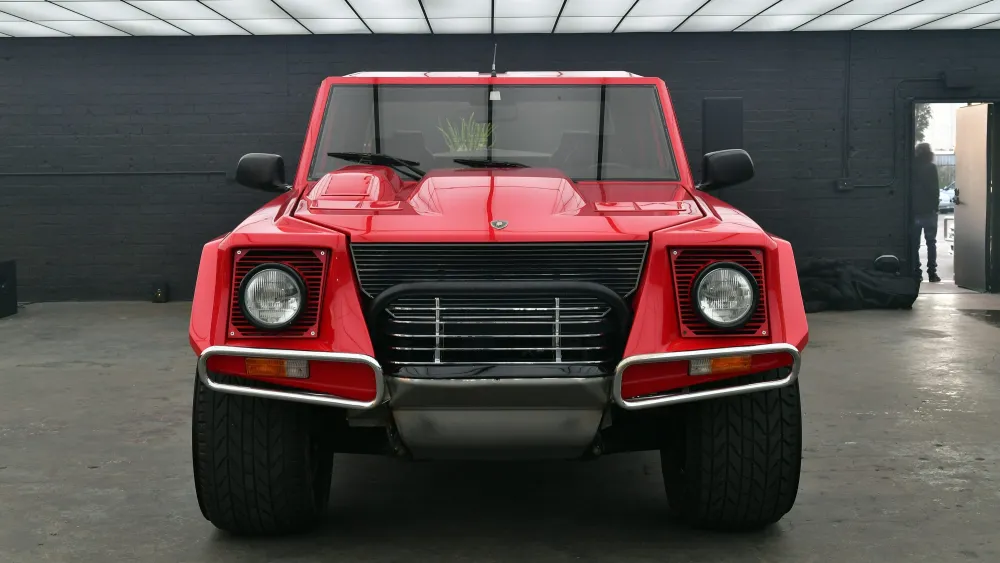
There’s no debate that Lamborghini is best known for building sports cars. In fact, ask the average person on the street, and that’s all they’ll know about the company. But while the low-slung likes of the Miura, Diablo, and Aventador may be the automaker’s most famous products, there’s another category where Lamborghini has a rich history: sport-utility vehicles.
The 62-year-old carmaker has, in fact, been in the SUV business in one form or another for 48 years. And even though not every off-roader ever made in Sant’Agata Bolognese has seen its way into showrooms, every one of its high-riding creations is an unforgettable part of the company’s wild history — and has informed later vehicles to come from Lamborghini.
This is the history of Lamborghini’s SUVs.
1977: The Lamborghini Cheetah Sets the Stage
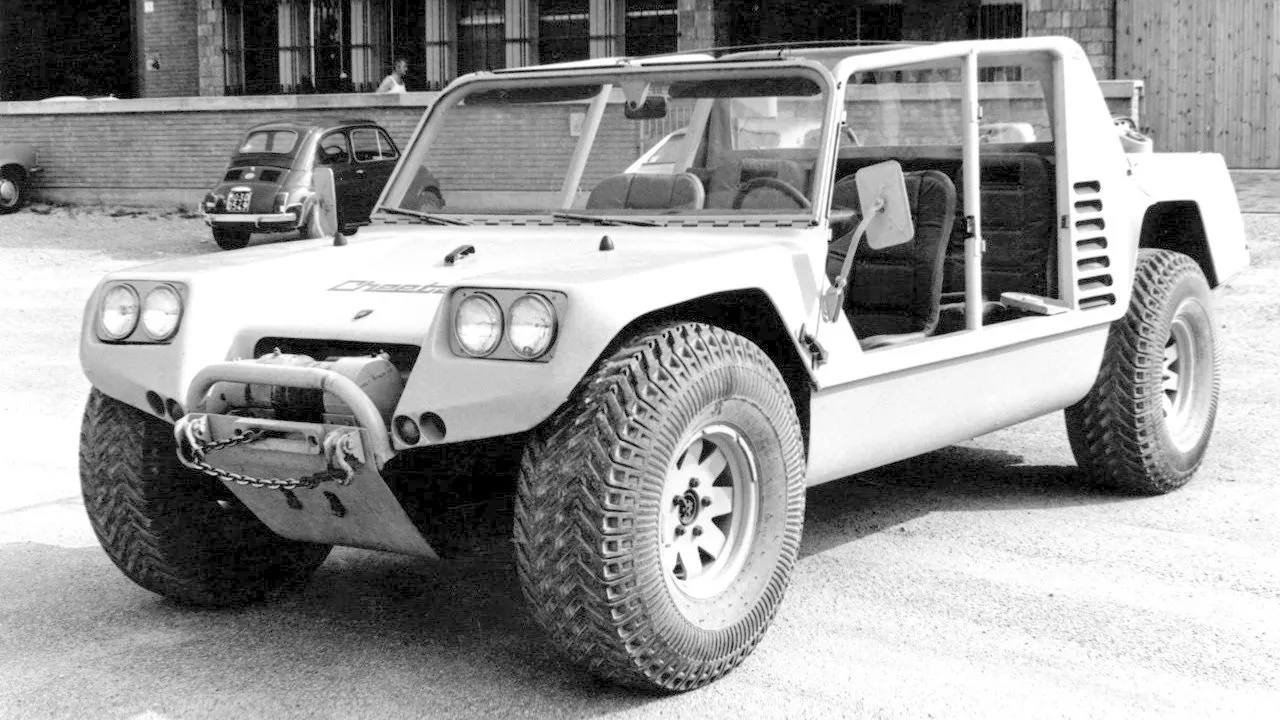
While the SUV craze didn’t truly begin its inexorable rise until the end of the 1980s, Lamborghini’s first dalliance with the category kicked off at least a decade earlier, in the disco era, and it came about in an unusual way for the small Italian carmaker: via the Pentagon.
At the time, the United States armed forces were looking for a new vehicle capable of carrying troops across whatever landscapes wars — be they cold or hot — might throw at America. Casting a wide net, they commissioned a prototype from a company called Mobility Technology International, which came to Lamborghini and subcontracted with them to build the beast.
The resulting Cheetah was, frankly, an ungainly machine, more like an oversized four-wheel ATV than a Ford Bronco or Mercedes G-Wagen. It lacked doors, or much of a roof, and instead of one of Lamborghini’s mighty motors, it was powered by a 5.9-liter V-8 from Chrysler — this well before that company bought Lambo in 1987 — that was placed out by the rear axle, connected to a three-speed automatic. The quad headlamps were the only thing even somewhat recognizable as a Lamborghini piece, looking much like those of the era’s Jarama gran turismo.
It may have been made by the same people building the Countach, but the Cheetah was, well, no cheetah. In spite of its spare body, the truck weighed around 4,500 pounds, which proved too much for the 180-hp eight-pot to move briskly, especially since it had to push all that power through a permanent four-wheel-drive system; the 0-60-mph time was reportedly around 10 seconds. Making matters worse, the tail-biased weight distribution led to bad handling. Making matters even worse: Pentagon contractor FMC threatened to sue when it saw the Cheetah at the 1977 Geneva Motor Show, claiming it was a rip-off of their attempt at a troop truck, the XR331 of 1970.
Whether due to poor performance, legal concerns or other issues, the project was iced, with only one Cheetah prototype ever being built. The contract for the military’s new all-terrain truck would ultimately go to AM General in 1983, resulting in the Humvee and its civilian Hummer iterations. But Lamborghini wasn’t about to let their newfound off-road knowledge languish.
1981: The LM001 Refines the Idea
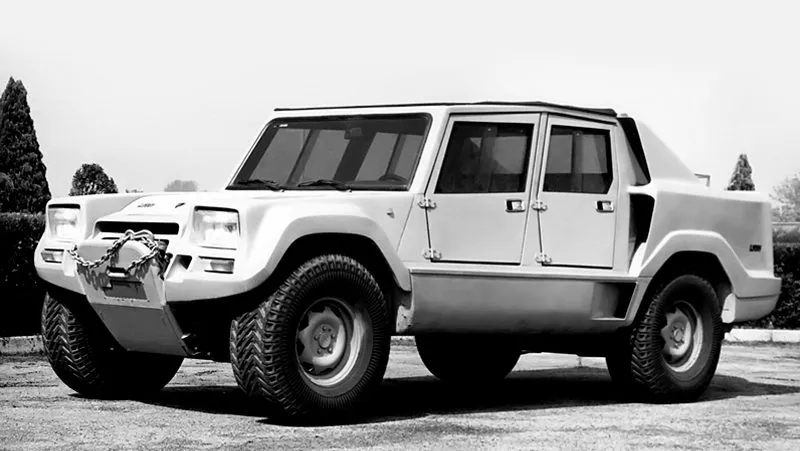
The Lamborghini of the 1970s and 1980 was a scrappy, hungry company, unafraid to fiddle with new ideas. The Cheetah may have gone extinct, but there was enough there to play around with. So, four years after the military machine’s debut at Geneva’s auto show, Lamborghini returned to Switzerland to reveal its civilian successor: the LM001.
The basic platform looked fairly familiar, but it looked significantly more outgoing, with a broader stern boasting big air intakes and new rectilinear headlamps. The Mopar V-8 was out, and an AMC-sourced one was in for the concept, but not to much change; displacement and horsepower remained 5.9 liters and 180 hp. And since the engine was still hanging out over the back axle, handling remained atrocious.
The sole car made for Geneva would prove the only LM001 to be built. If the project were to proceed beyond the concept phase; Lamborghini would need to sort out the powertrain issues that plagued the original design.
1986: The LM002 Arrives in Perfect Time for ’80s Excess
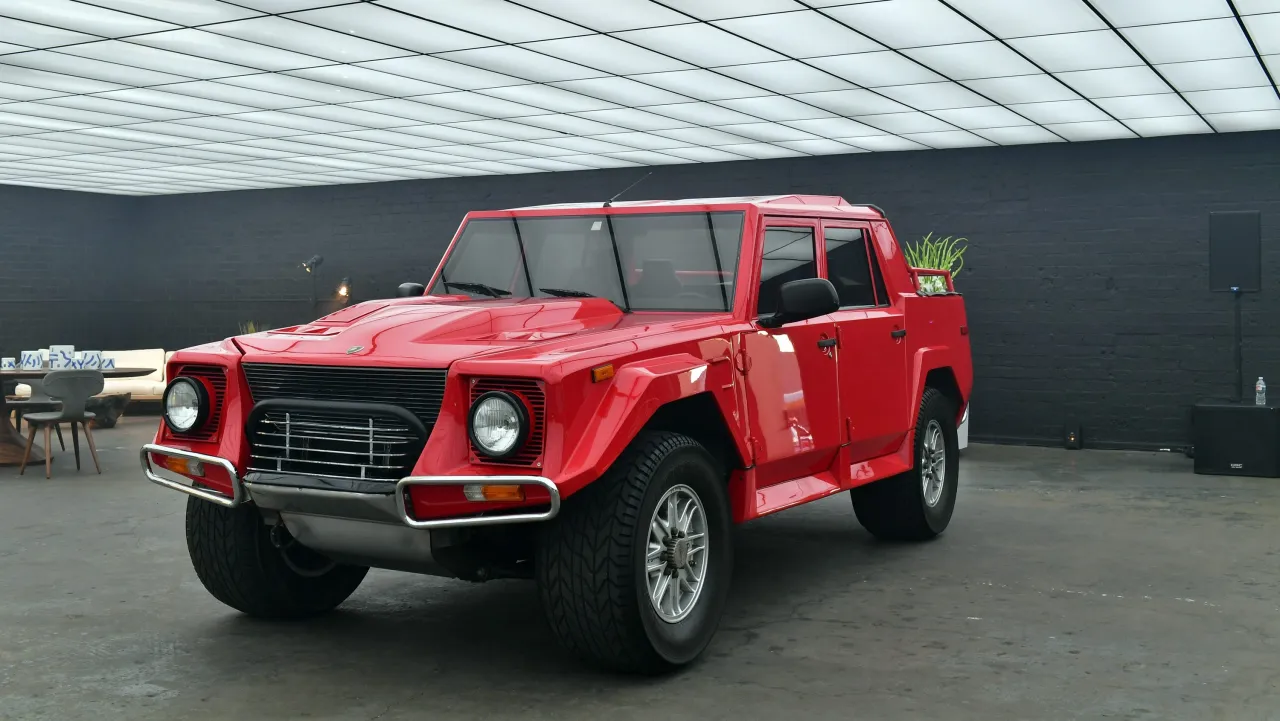
So, one year later, Lamborghini returned again to the Geneva Motor Show with an off-road concept car that fixed the glitch. Actually, it fixed both the power plant’s location and sourcing issues in one fell swoop. The SUV was redesigned as a front-engined machine, and instead of an outsourced V-8, Lamborghini plopped the Countach’s 4.8-liter V-12 into the prototype, dubbed LMA002. Weight was up, with the beefy sport-ute clocking in above 5,700 lbs, but the 12-cylinder engine’s 332 horsepower meant that was much less of a concern than it had been in previous Lambo off-road prototypes. And unlike the past versions, it now came with part-time four-wheel-drive.
The production version, its name stripped down a letter to just LM002, showed up four years later as a refined version of the ’82 concept. The design had been refined, but it still clearly bore a resemblance to its predecessors. A five-speed manual shoveled power through a part-time four-wheel-drive system. Weight was up again, to almost 6,800 lbs, but the engine was also bigger; the SUV now used the latest Countach’s 5.2-liter V-12, pounding out 444 hp and 368 lb-ft of torque. And if that weren’t enough, buyers could even spec a 7.2-liter version of the Lambo V-12 that was usually reserved for powerboats and made 730 hp.
Not surprisingly, it proved an instant celebrity in the extroverted 1980s. Human celebrities began snapping it up, including Tina Turner, Eddie van Halen and Sylvester Stallone, fresh off the swollen bicep showcase of Rambo: First Blood Part II. Whether due to Sly’s association with the vehicle or simply as a tribute to its power and military-derived design, the LM002 would quickly earn a nom du guerre: Rambo Lambo. No matter how many blockbusters you made, taking one home would cost around $120,000.
Despite its fame, the LM002 remained rare. Production stretched out all the way until 1993, but only 301 units were built; by comparison, Ferrari built more than 1,300 F40s in the same span. Still, its combination of absurd capability — it could climb a 54º slope and do 0-60 mph in 7.7 seconds, albeit not at the same time — and appropriately fancy interior replete with leather upholstery, power windows and other frippery rarely found in SUVs of the era — made it an instant classic, a true supercarSupercarA high-performance sports car with exceptional speed, advanced engineering, and striking design, produced in low volumes by marques such as Ferrari, Lamborghini, and McLaren. Supercars sit near the top ofGo to Supercar Glossary of sport-utility vehicles.
But while the LM002 was still impressive in the early ‘90s, Lamborghini’s corporate health wasn’t. Its successor would have to wait until a new owner came into control.
2017: The Urus Takes the Lamborghini SUV Concept (Relatively) Mainstream
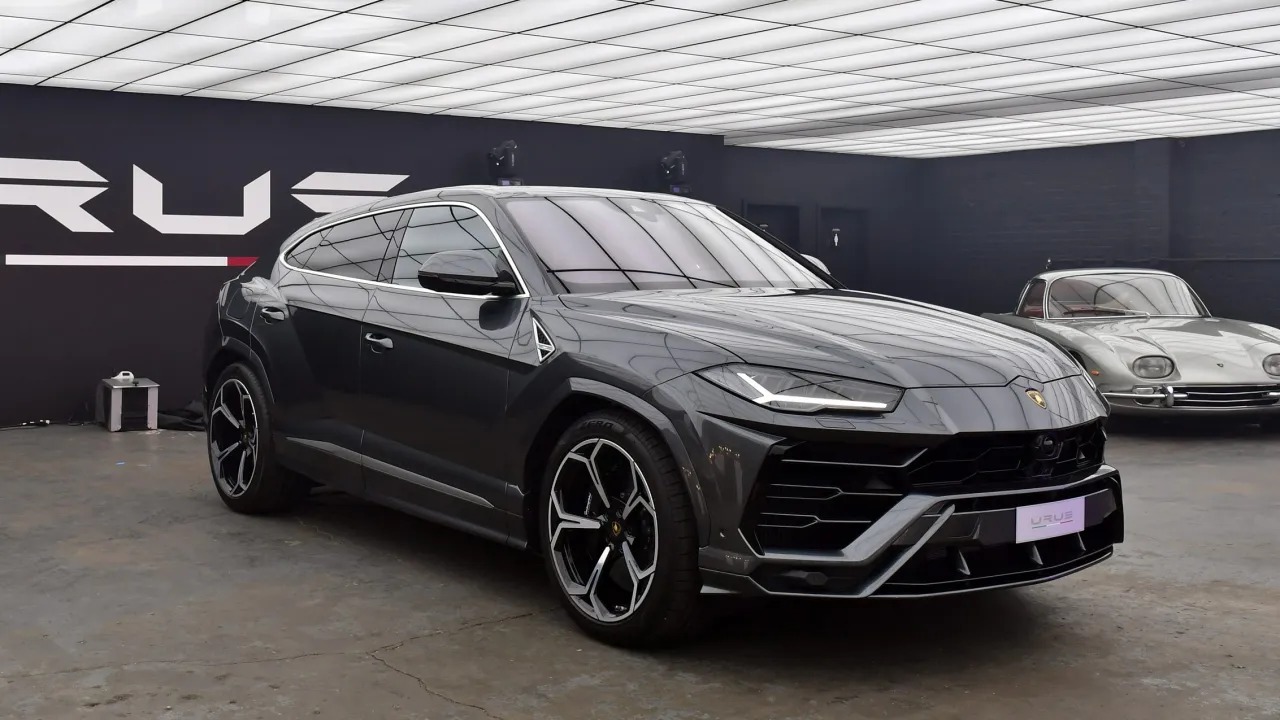
The Volkswagen Group scooped up Lamborghini for the now-incredibly-reasonable price of $110 million in 1998, placing it under the command of the Audi division in a move that the German company saw as a way to bolster both the four-ring brand’s sportiness and the Italian company’s quality and technology. The investment of capital and Teutonic industriousness quickly led to improved cars: the Murcielago, then the Gallardo, then the Aventador, then the Huracan, each moved the ball further down the field and re-established Lamborghini as a premier sports car company.
So it was a bit unexpected when, in late 2017, the carmaker revealed the production version of the Urus. Obviously, there was precedent for a Lambo SUV, and the company had even floated a V-10-powered Urus concept car in 2012. What made the Urus a bit of a curveball was that it was clearly built from the pieces in the VW Group’s corporate toolbox.
Even the Gallardo and Huracan had been made as Lamborghinis first before being adapted for Audi as the R8; the Urus, however, used the same platform as the Porsche Cayenne, Bentley Bentayga and Audi Q7 / Q8. The new Lambo SUV also used the same twin-turbo 4.0-liter V-8 as those models, and the same eight-speed automatic transmission. And while it offered off-road drive modes through a boat throttle-like selector, it only came with all-wheel-drive, and couldn’t deliver the same level of go-anywhere capability as the Rambo Lambo.
That said, it did certainly deliver Lamborghini-like performance. The compact boosted eight-cylinder spat out 641 hp and 627 lb-ft at launch, more than any Porsche, Audi or Bentley powered by the motor made at the time. And it very much looked the part, wearing bodywork replete with the sharp angles, crisp folds and trapezoids that defined the supercars it shared a showroom with. Hardcore enthusiasts might turn up their nose and call it a gussied-up RS Q8, but to the public, it was just another Lamborghini.
And it turned out to be a popular one, at that. Demand proved insatiable, at least by Lambo levels, with Urus number 10,000 rolling off the line in mid-2020 and the 20,000th one being built about two years later, in summer 2022.
Shortly after that milestone, Lamborghini rolled out the first major improvement to the Urus line, in the form of the more track-oriented Urus Performante model. Sliding in above the “base model” (which was rebranded as Urus S), the engine was pumped up to 657 hp, while weight was cut by a tad over 100 pounds and the ride and handling revamped with a sharper suspension and fixed springs in lieu of the adjustable pneumatic ones.
Then, in the spring of 2024, Sant’Agata announced a midlife refresh for the Urus that brought a big change to the powertrain: the SUV was going PHEV, as part of a corporate plan to give every Lambo both a plug and a gas cap. The new Urus SE boasted a system — similar to that found in Porsche’s Cayenne Turbo E-Hybrid – delivered a combined 789 hp and 700 lb-ft of torque, enough to offset the 600-plus-pound weight gain of adding an electric motor and a hefty lithium-ion battery.
Yet while the new system may seem an odd choice for an outgoing, high-performance SUV often heard popping off gunshot downshifts around town, it should future-proof Lambo’s crossover against rising emissions regulations and help it maintain its place as a profit driver that lets the company keep building supercars. Indeed, the Urus has proved popular enough, it’s even begun rubbing off on the sports cars in the company’s lineup. In 2023, Lamborghini released the Huracan Sterrato, a version of the AWD V-10 supercarSupercarA high-performance sports car with exceptional speed, advanced engineering, and striking design, produced in low volumes by marques such as Ferrari, Lamborghini, and McLaren. Supercars sit near the top ofGo to Supercar Glossary with a lift kit, off-road-ready tires, and SUV-style fender flares to catch flying gravel. How’s that for full circle?
This article originally appeared in Robb Report US.