Robb Report Philippines
    • Log In
    • About Us
    • The Team
    • Contact Us
    • FAQS
    • Privacy Policy
    • Terms and Conditions
    Follow Us On:
    facebook Twitter X Instagram Youtube Tiktok

    © 2026 Robb Report Philippines is published and presented by Modern Media Group, Inc., a subsidiary of AGC Power Holdings Corp. All rights reserved.

Be a member
Home › Watches

Piaget’s New High Jewelry Reinforces Its Watchmaking Mastery

The brand’s 150th-anniversary high jewelry pays homage to its groundbreaking 21st Century Collection from 1969—at just the right time.

By Shannon Adducci

January 24, 2025
FacebookXEmailCopy Link
piaget watches, piaget jewelry

It’s no secret that Piaget’s vintage watches are enjoying the spotlight. Stone dials, sleek dress silhouettes, funky gold shapes, and hand-etched details are again in demand, driving a niche but still a sizable portion of the secondhand market.    

The Swiss watchmaker has picked up on all of the vintage buzz. But to say that it’s taking its cues from the secondhand market belies the influence that the brand has long held in the realm of jewelry watches and design innovation. That Piaget chose to revisit its groundbreaking 21st Century Collection to commemorate its 150th anniversary in high jewelry and watches this year says a lot about the identity of the brand and its unique place in the watch market as it looks to a future where watches and jewelry—two adjacent but very different markets—become more intertwined with both each other and the larger fashion world.

Piaget did not invent jewelry watches: The hybrid of jewelry and timepieces dates back to the end of the 1500s after theologian and Protestant Reformation leader John Calvin banned the wearing of jewelry in Europe. As a result, Swiss watchmakers began to explore ways precious metals and materials could be disguised in “pocket clocks,” which, much later, morphed into wristwatches. Jewelry watches increasingly became more ornate; early versions for women were crafted as necklaces, with the watch face upside down so that the wearer could covertly view the time. More modern examples of classic jewelry watches came during the Art Deco period (think diamonds and platinum with clean white dials and black numerals). 

An archival image of a Piaget necklace watch worn on a model. The brand launched its 21st Century Collection in 1969 with an eye on the youth and culture movements happening in Paris and London.

Fast forward to 1969:  London’s Swinging Sixties movement was rapidly influencing fashion and youth culture, eventually coursing through the rest of Europe and the U.S. To capture the spirit, the Piaget family sent watch designers from its Swiss headquarters in La Côte-aux-Fées to Paris Fashion Week to figure out how to bring a fashion point of view to its timepieces. Their team took in runway shows, doing live sketches in the front row and later working from tear-outs of magazine fashion shoots to design timepieces onto models in ways that incorporated a full look. The brand’s 21st Century Collection was born—and with it, an entirely new way of looking at jewelry watches. 

vintage fashion
An archival image of a Piaget gold belt worn with a Pierre Cardin look. The brand sent its designers to Paris Fashion Week to observe runways and design pieces with a distinct fashion point of view, something unheard of for a watch or jewelry brand at the time.

“They didn’t want to be just another watch brand. They embraced this period of creativity in the ‘60s and ‘70s with their know-how,” said Piaget CEO Benjamin Comer of the Piaget family’s decision to explore new ways to design and execute jewelry watches 55 years ago.

While the watchmaker has revisited its mid-century heritage here and there over the past decade (the popular hard stone dial Black Tie collection was reintroduced in 2014), Piaget took an even deeper dive into the 21st Century Collection to commemorate its 150th anniversary in this year’s high jewelry line, which debuted in Abu Dhabi. The collection ups the ante on the brand’s signature hard stone dials, which are no easy feat on their own—Piaget sometimes goes a hundred cuts of malachite, lapis lazuli, tiger’s eye, opal, or coral before arriving at one slice that’s precise enough to set as a dial with a movement behind it. Piaget’s creative director, Stephanie Sivrière, took on watches in 2016, in addition to jewelry, which has been spearheading since 2011.

piaget high jewelry
This is an exclusive look at Piaget’s Essence of Extraleganza knitted gold cuff watch, part of the brand’s 150th anniversary high jewelry and watch collection. An interpretation of a popular archival piece, the Polish Mesh, it boasts articulated gold in a chevron mesh design with shades of applied blue lacquer (a first for the brand in high jewelry). The timepiece also includes a full integration of the design on both the dial and the bracelet and flexible, asymmetrical fringe.

While the brand knows its buzz in the secondhand market, Piaget says it focuses squarely on new collections. “If our collections are strong now, they will be strong in the secondhand market in the future. We are building that now,” says Comar. The Piaget CEO notes that while the brand currently has some 1,200 heritage pieces in its archives, they are not for sale at the moment. “We see the momentum and we are very happy with it and very proud. We want to show that we are still matching in value.”

Piaget Magazine
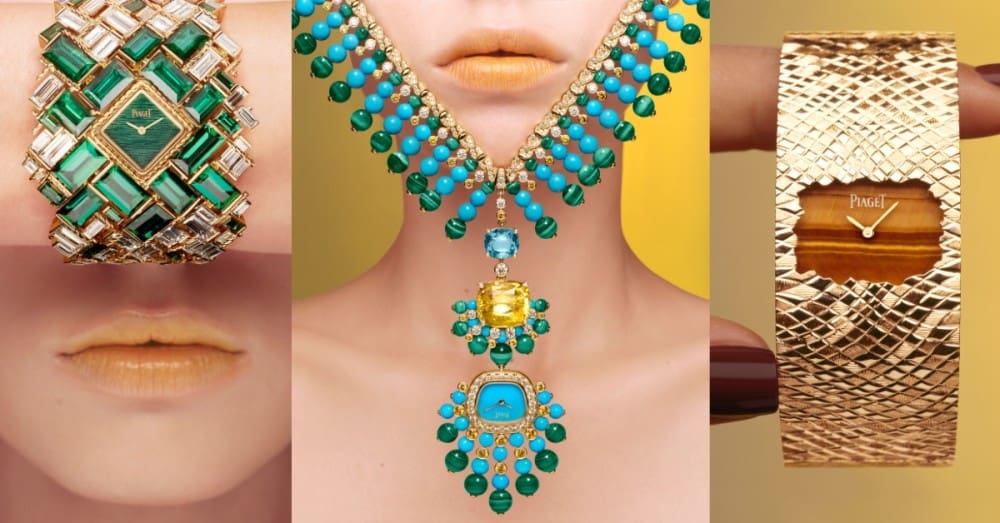
One of Piaget’s showpieces from the Essence of Extraleganza high jewelry and watch collection celebrating its 150th anniversary. The necklace watch has turquoise and malachite beads, a cushion cut yellow sapphire, and aquamarine in an upside-down dial reflecting archival pieces from its groundbreaking collection from 1969. 

Standout pieces in the anniversary collection include a gold-fringed cuff set with turquoise beads and a matching turquoise stone dial (partially hidden by the fringe like a curtain) and an etched enamel dial wristwatch accompanied by 40 Colombian-origin emeralds and emerald-cut diamonds. Another watch uses a woven chevron motif of gold and enamel in an asymmetrical winged shape, with a dial in the same gold chevron pattern. Yet another, a gigantic bib of turquoise and malachite beads, yellow and white diamonds, cushion-cut yellow sapphire, and a cushion aquamarine, pays homage to the covert watch necklace with an upside-down timepiece pendant dangling at the end of it.

Piaget Watch
Piaget’s gold-engraved watch has a tiger’s eye dial and a wood-inspired gold motif. For the first time, it is paired with a flexible gold bracelet, inspired by a vintage cuff.

The brand also used the 21st Century Collection as inspiration for its world tour of the collection, which debuted at Paris Couture Week in July before making its way to Shanghai for an exhibition at the city’s Fosun Foundation in September, then to Abu Dhabi’s Emirates Palace, and Seoul’s Korea Furniture Museum, both in November.

“Abu Dhabi is becoming known in the region for its focus on culture,” said Fatti Laleh, Piaget’s director of brand image and communication. “Our concept is that collision of past and present, and Abu Dhabi is a very new city, but also very much rooted in tradition and heritage.”

piaget jewelry
A fringed gold and turquoise watch from Piaget’s 150th anniversary collection.

This article originally appeared in Robb Report US.

Access to this content is reserved for members only. Please purchase a membership to unlock this content.

Be A Member Already a member? Sign IN. If you need assistance, please email [email protected]

Exclusive Events

Notice
There are no upcoming events.

E-Magazine

Read Now

LATEST IN Watches

Watches

Glashütte Original’s New Chronographs Take Cues From Horological History

By Nicole Hoey 13 hours ago
Watches

Chopard’s Alta Moda Collection: When Time Wears Couture

By Carl Cunanan August 25, 2026
Watches

A Century of the Oyster

By Carl Cunanan August 24, 2026
Watches

Making Time Sing: A Look at the Chiming Watches Competing at GPHG 2026

By Carl Cunanan August 20, 2026