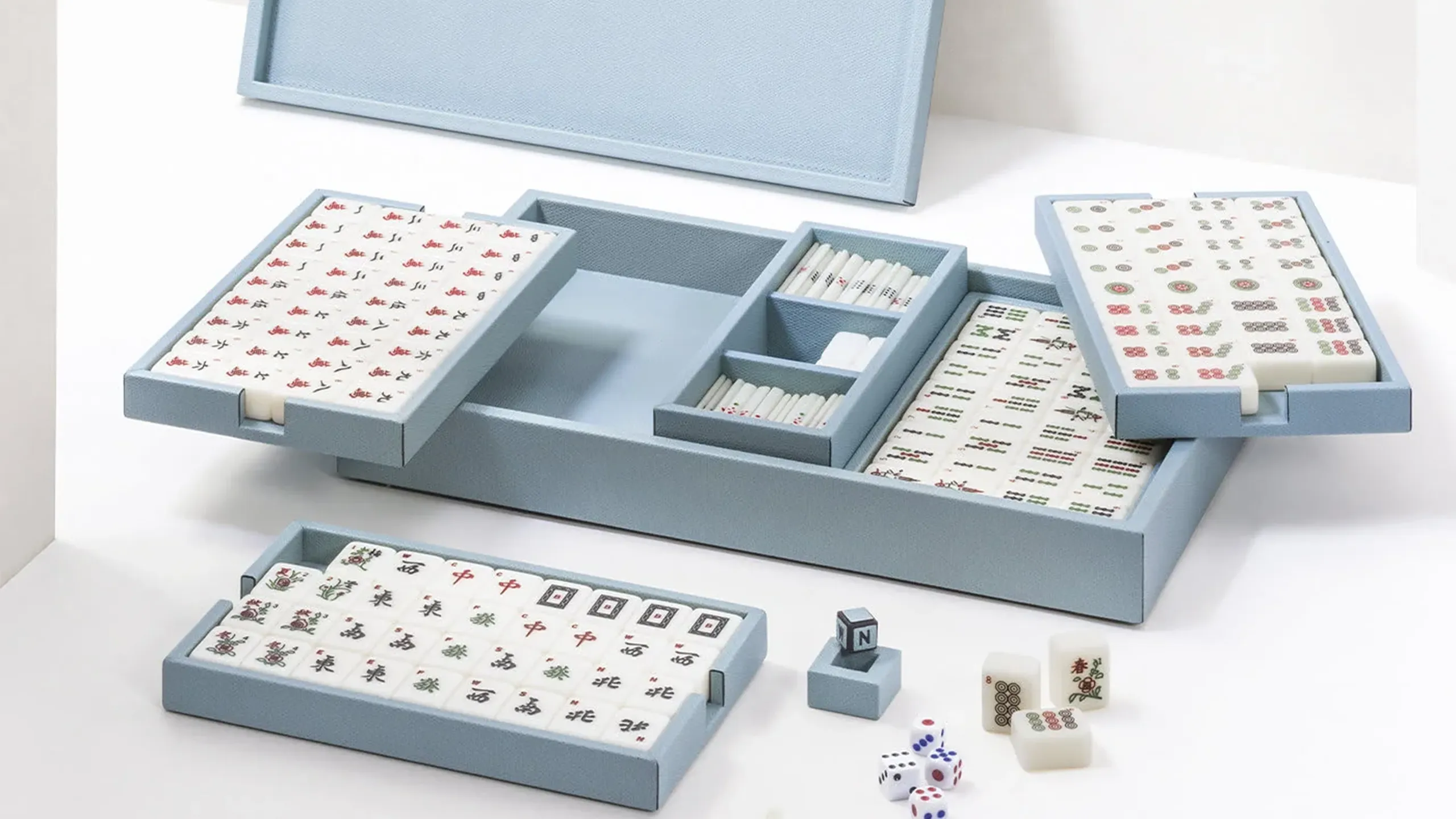
Mahjong’s Masterpieces: The World’s Most Luxurious Sets
For many Filipino families, the unmistakable sound of mahjong tiles is part of the soundtrack of every Chinese New Year, weekend reunion, and long afternoon at the club. Many learned the game on colorful acrylic sets passed around for decades.
Beyond those familiar acrylic tiles lies an entirely different world, one where mahjong sets command six- and seven-figure prices and are displayed alongside collectible watches and contemporary art, crafted with the same care as haute horlogerie or bespoke furniture.
Unlike many decorative objects, its beauty reveals itself through use. The satisfying weight of a perfectly balanced tile, the crisp sound of a well-made set being shuffled, and the subtle sheen acquired through age cannot be appreciated only through display.
Before Luxury Brands, There Were Master Craftsmen
Surprisingly, there are few Chinese luxuryLuxuryA lifestyle defined by exceptional quality, craftsmanship, exclusivity, and sophistication, encompassing the finest products, services, and experiences that represent the highest standards of refinement and excellence.Go to Luxury Glossary brands devoted to mahjong. Premium mahjong sets have historically been an artisan tradition rather than a branded luxury business. Since the late Qing dynasty, collectors have judged exceptional sets by the workshop that produced them, their age, materials, condition, and provenance. The prestige belonged to anonymous craftsmen passing their skills from one generation to the next. The finest examples emerged during the late Qing dynasty and the Republican era, when prosperous Chinese families commissioned handcrafted sets that reflected both wealth and gentility.
Each tile began as two separate pieces: a polished bone face attached to a carefully shaped bamboo backing. Every Chinese character, bamboo stalk, dragon, flower, and season was engraved by hand before colored pigments were painstakingly applied to the carved recesses. The tiles were then polished repeatedly until their surfaces felt perfectly smooth. A complete set contains 144 tiles, each of which had to match precisely in height, width, thickness, and weight. No two handcrafted sets were ever exactly alike. Ivory sets also existed, although CITES restrictions prohibit most international commercial trade in elephant ivory, making ownership, sale, and cross-border transport legally complex.
Even the slightest inconsistency could affect how the tiles handled during play. Experienced players could often identify superior craftsmanship by the sound the tiles produced when shuffled across the table. Collectors often judge tiles by weight, balance, feel, and sound.
The cabinets were equally impressive. Fashioned from rosewood, hongmu, camphor, or other prized hardwoods, they featured brass hardware, hidden compartments, intricate carvings, and beautifully fitted drawers. Many surviving examples today are regarded as museum-quality antiques, valued as much for their decorative artistry as for the game they contain.
Shanghai’s Golden Age of Mahjong
By the early twentieth century, Shanghai had become the center of luxury mahjong production. Dozens of specialist workshops supplied affluent Chinese households and exported finely crafted sets throughout Asia, Europe, and North America. Rather than competing through branding, these workshops earned their reputations through precision carving, elegant calligraphy, balanced proportions, and meticulous finishing.
Many disappeared during the war, revolution, and restructuring of Chinese industry during the mid-twentieth century, making surviving examples sought after by collectors. Sets retaining their original cases, accessories, and documentation can command significant prices at auction. Some workshops signed their cases with paper labels or carved seals, making complete surviving examples especially desirable today.
The Million-Dollar Mahjong Set
If one creation represents the absolute pinnacle of modern, luxury mahjong, it is the collaboration between S.T. Dupont and Parisian jewelry atelier L’AquART.
Valued at approximately US$1 million, the set transforms a traditional Chinese game into haute joaillerie. Each tile is carved from Tanzanian ruby and protected by engraved gold vermeil, while more than 1,000 rubies and 300 diamonds embellish the set, which takes months of work. The result is a collector’s masterpiece, an object whose rarity rivals that of exceptional high jewelry or a unique grand complication watch.
When the Maisons Took Notice
Only in recent years have Europe’s luxury houses embraced mahjong as part of their expanding lifestyle collections.
Louis Vuitton approaches the game through the lens of travel, housing its mahjong set inside one of the maison’s impeccably crafted miniature trunks. Wrapped in the signature Monogram canvas and fitted with polished brass hardware, it reflects the same savoir-faire that has defined Vuitton’s luggage for more than 170 years.
Hermès’ Macao mahjong set (Php 864,639.00) combines beautifully finished wood, supple leather, and understated proportions that embody the house’s philosophy. It is also designed to allow the materials to acquire character over time.
Italian craftsmanship has also found its place at the mahjong table. Brunello Cucinelli (Php635,321.70) interprets the game through warm walnut and minimalist elegance, Giobagnara (Php245,920.88) applies its celebrated leatherwork to handcrafted cases, while Giobagnara x Poltrona Frau (price depends on customization) creates a mahjong set that feels as much like a piece of furniture as a gaming accessory. These objects blur the distinction between leisure, interior design, and collectible art.
A Collectible Design Object Beyond Traditional Categories
Luxury gaming objects have distinguished themselves beyond trendy, collectible design objects, with covetable bespoke chess sets, handcrafted backgammon boards, artisan poker cases, and museum-quality billiard tables. Mahjong belongs naturally within that conversation and have become fixtures in the homes of collectors who value craftsmanship beyond traditional categories. Whether carved by anonymous Chinese craftsmen a century ago or sold today by Europe’s most celebrated maisons, they offer an enduring truth: true luxury is measured by the skill, heritage, and human hands that brought it to life.
FAQs
Traditional handcrafted mahjong tiles commonly combined an engraved bone face with a bamboo backing. Colored pigment was applied to the carved characters and symbols before the tiles were polished.
One of the most expensive known examples is the ruby-and-black-obsidian mahjong set created by S.T. Dupont and L’AquART. It has been valued at approximately US$1 million.
The set contains 144 tiles carved from Tanzanian ruby and protected by engraved gold vermeil. More than 1,000 rubies and 300 diamonds embellish the complete creation.
Louis Vuitton, Hermès, Brunello Cucinelli, Giobagnara, and Poltrona Frau are among the luxury houses and design companies that have produced contemporary mahjong sets.
Collectors assess antique sets according to their age, materials, condition, craftsmanship, provenance, and completeness. Original cabinets, accessories, labels, and documentation can strengthen their desirability.