Why Hypercar EVs With Staggering Specs Haven’t Generated Big Sales




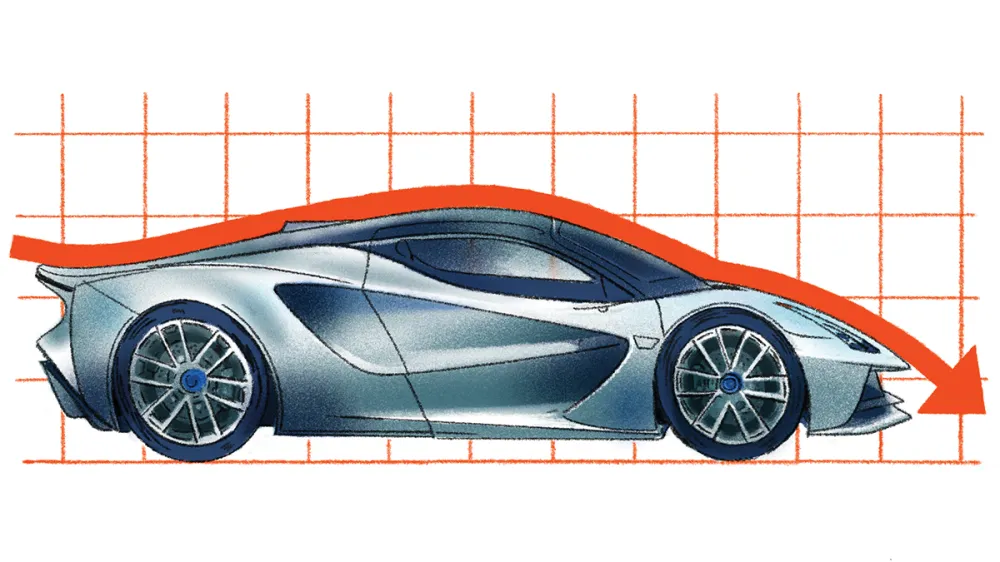
It felt like the dawn of a new era. Skeptical journalists, excitable influencers, and industry insiders alike all climbed aboard an open-top bus for a sightseeing tour of London that culminated at a cramped and stifling-hot theater. The unusual final stop was for the reveal of the nearly 2,000 hp Lotus Evija, touted to be the world’s most powerful production car. Six years later, it still is.
Back in that heady summer of 2019, electric hypercars appeared to be overtaking (both literally and figuratively) the gas-powered old guard. Lamborghini had shown its futuristic zero-emissions Terzo Millennio concept, the battery-powered Rimac Nevera and Pininfarina Battista were deep into development, and Elon Musk was promising a new Tesla Roadster for the following year. The Evija seemed to be riding the crest of a massive wave.
Today, the tsunami that threatened to obliterate internal-combustion-engine (ICE) performance cars has all but receded. Lotus hasn’t revealed how many of the Evija, which starts at about $2.7 million, have found buyers, but the planned production run of 130 examples looks to be a distant dream. Meanwhile, V-12-powered exotics such as the Ferrari Daytona SP3 and the GMA T.50 sell out almost instantly.
Porsche C.E.O. Oliver Blume recently announced an about-face in strategy, taken in “response to the significantly slower growth of the demand for exclusive battery-electric vehicles.” Any production version of the Porsche Mission X, debuted in 2023, will almost certainly be among the first casualties.
Elsewhere, the initial purely electric vehicles from Ferrari and Lamborghini—the 2026 Elettrica and 2029 Lanzador, respectively—promise to be more S.U.V. in character, with halo-hypercarHypercarAn extreme, limited-production performance car that sits above supercars in power, technology, price, and exclusivity, often featuring hybrid powertrains and advanced aerodynamics. Hypercars act as rolling engineering showcases, and modelsGo to Hypercar Glossary status reserved instead for the Prancing Horse’s F80 and the Raging Bull’s Fenomeno, both of which are hybrids. “Lamborghini will also keep combustion engines as part of our current hybrid strategy for as long as possible,” says Stephan Winkelmann, the marque’s chairman and C.E.O., in response to our query. “We see the V-12 continuing after 2030.”
So why haven’t buyers in this price segment been more accepting? Mark Tapscott, C.O.O. of E.V. sports-car start-up Longbow, believes they want an emotional connection. “For too long, electric cars have been engineered around abundance, with vast batteries, huge motors, and staggering power outputs, all of which create speed but not necessarily feeling,” he says. “The world doesn’t need faster numbers; it needs better experiences.”
The category’s unofficial godfather Mate Rimac also thinks the market has shifted. Addressing the 2024 Financial Times Future of the Car conference in London, he said, “We started to develop Nevera in 2016-2017, when electric was cool… the narrative has changed.” He likened the difference between ICE and electric hypercars to mechanical watches and smartwatches: “An Apple Watch can do everything better. It can do a thousand more things, it’s a lot more precise, it can measure your heart rate. But nobody would pay $200,000 for an Apple Watch.” Fittingly, in his latest role as C.E.O. of Bugatti, Rimac has unveiled the 1,800 hp Tourbillon, which is powered by a naturally aspirated V-16 engine and draws its name from Swiss timepieces.
Down the road, legislation may force a reckoning in the 2030s, and a new generation of enthusiasts raised on E.V.s will perhaps think differently. For now, though, the all-electric hypercarHypercarAn extreme, limited-production performance car that sits above supercars in power, technology, price, and exclusivity, often featuring hybrid powertrains and advanced aerodynamics. Hypercars act as rolling engineering showcases, and modelsGo to Hypercar Glossary seems to have come and gone as rapidly as, well, an Evija in Track mode.
This article originally appeared in Robb Report US.