A Place in the Picture: Imelda Cajipe Endaya


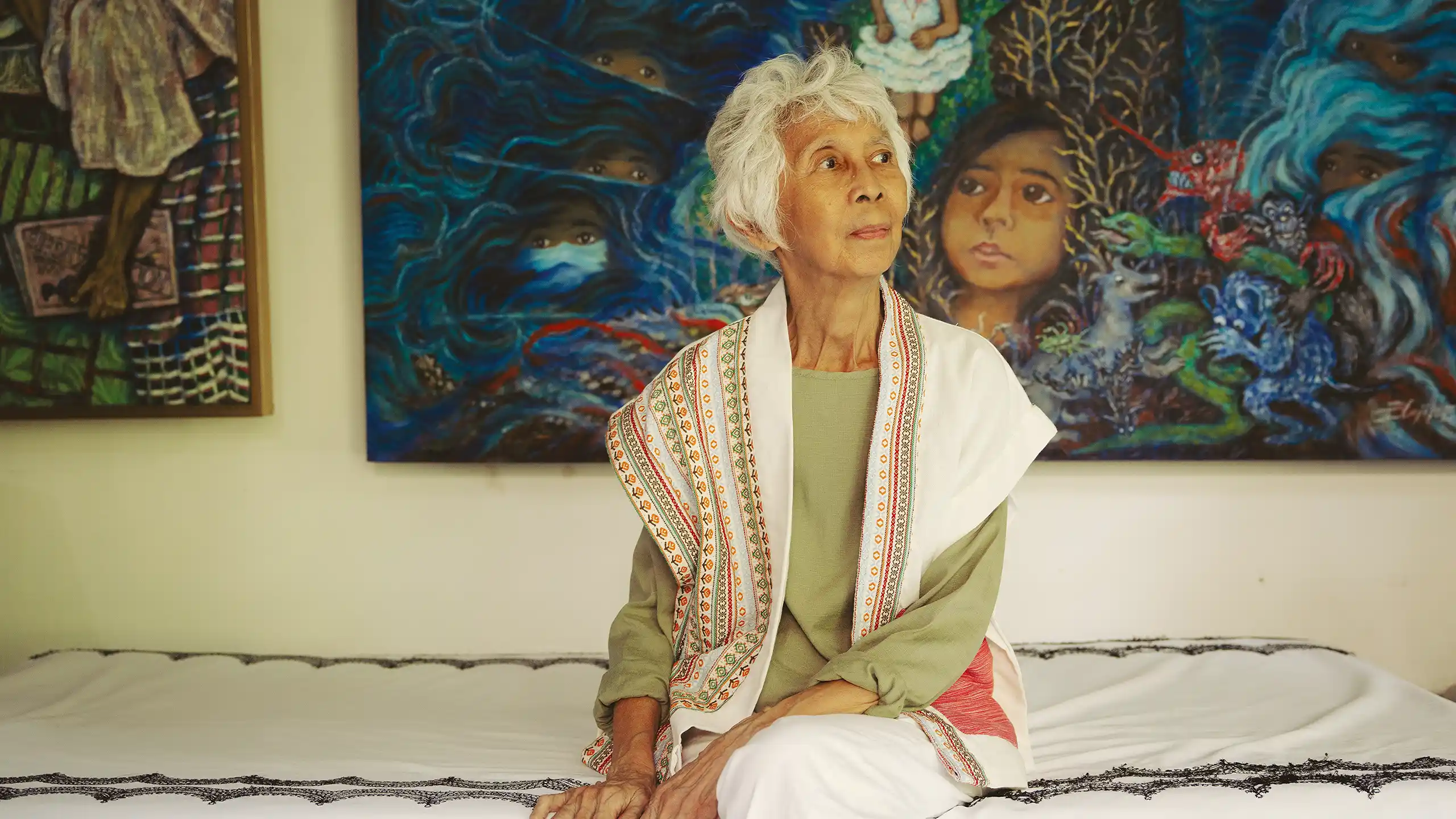
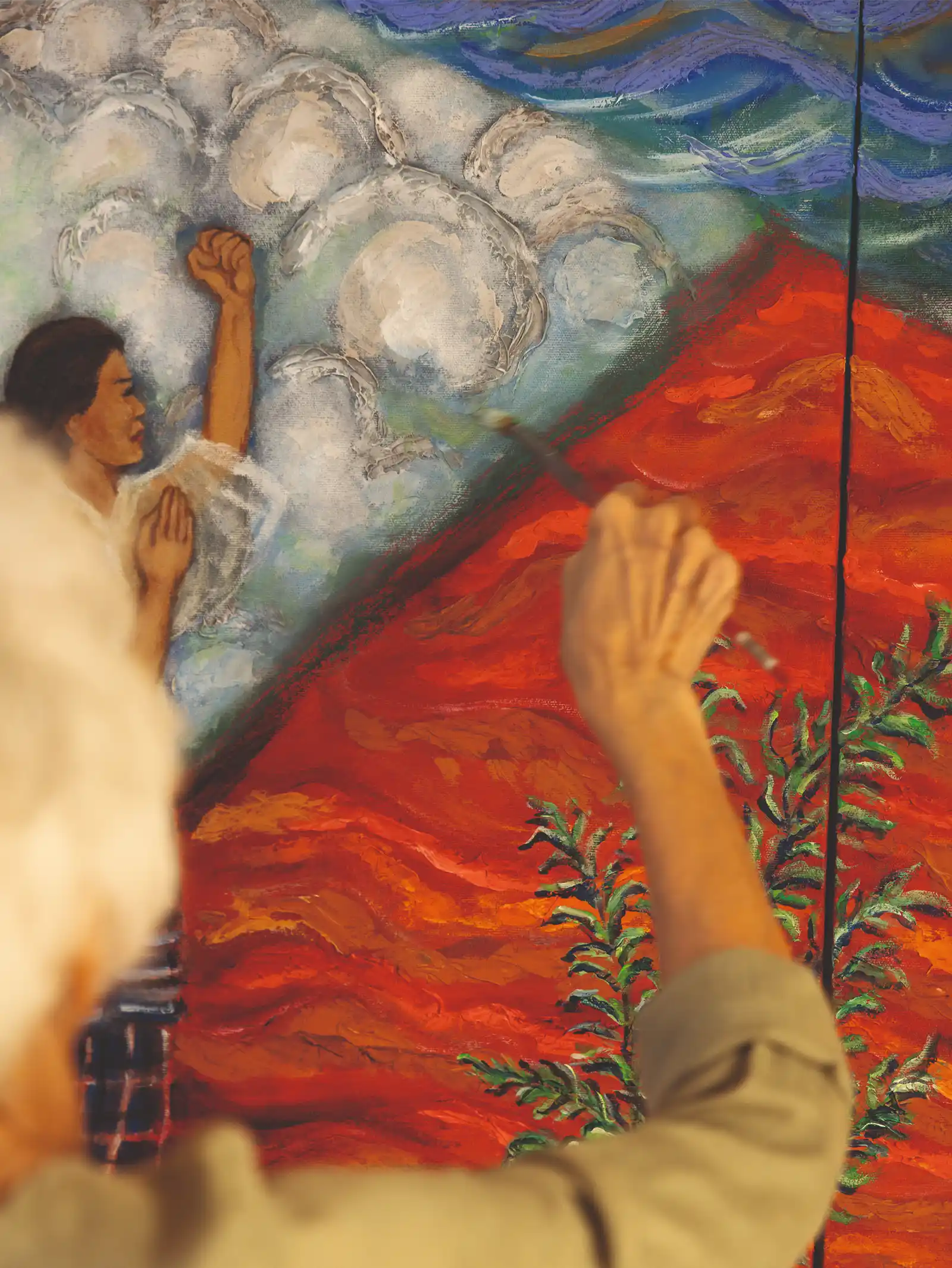
Not melancholy blue, necessarily, nor scared blue. A face emerges from one half of Imelda Cajipe Endaya’s 2013 diptych, “Portrait of the Artist as Babaylan.” Monumental and watchful, layered against voluminous folds and textile-like patterning, she appears as artist and ancestor, maker and medium, the living woman alongside an older form of authority she has summoned. Elsewhere, a younger version of the artist stands palette in hand. Healer, shaman, and creator converge in a ritualized self-portrait.
It is tempting, particularly now, to view the painting as somewhat prophetic. On September 1, 2026, Cajipe Endaya was proclaimed National Artist for Visual Arts, becoming the first woman to receive the country’s highest artistic distinction in the field. At 77, she finds herself occupying a place in Philippine art history that women of her generation once had to organize simply to enter.
History in the Image
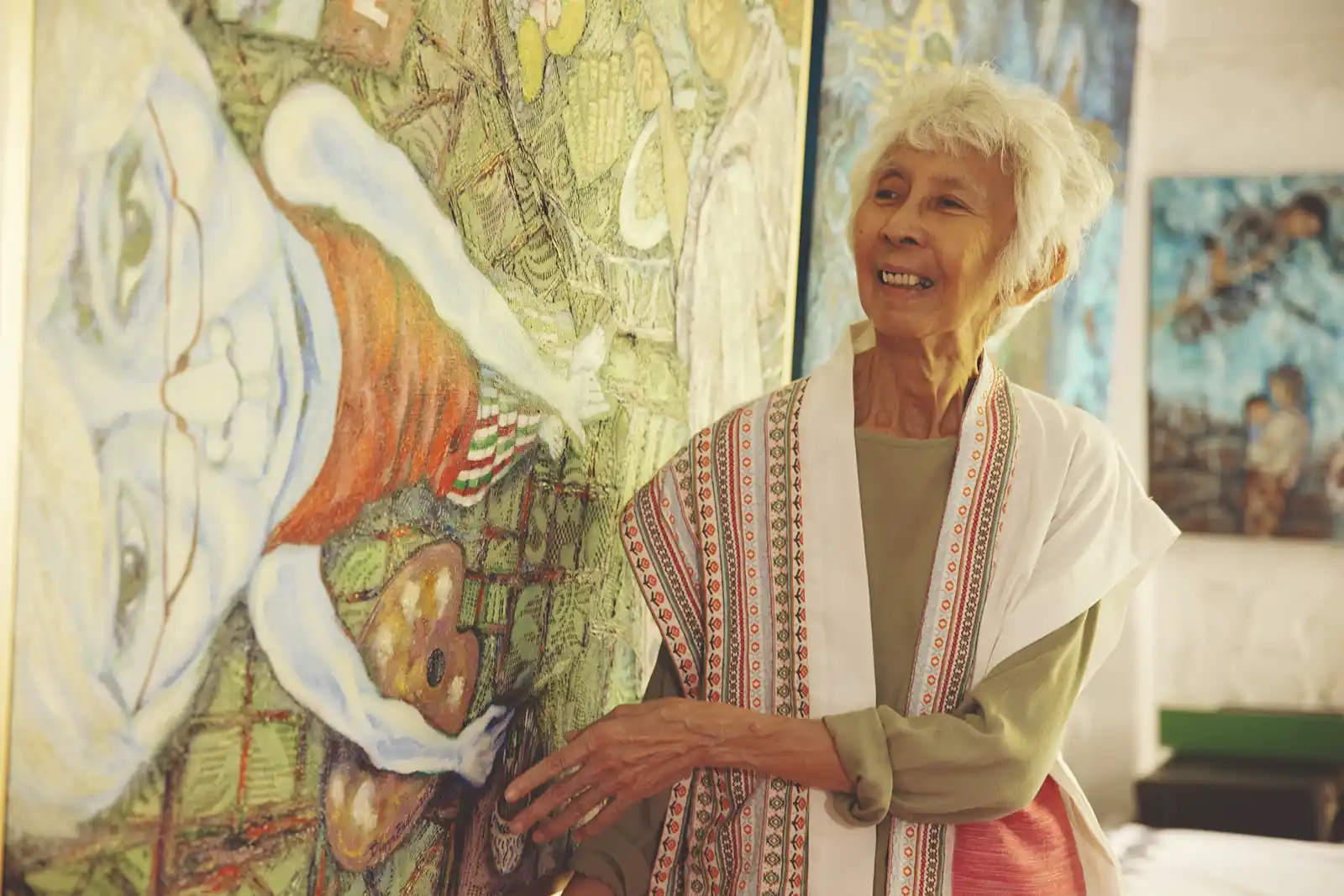
Cajipe Endaya was already a young mother when President Ferdinand Marcos declared Martial Law in September 1972. Her first daughter was due in November. “I was watching TV,” she says. “When Proclamation No. 1081 flashed on the television, I remember the face of Marcos declaring Martial Law.”
What stays with her around that particular image is another set of images being manufactured. “Fences were being built to cover the informal settlers,” she says. “They were painted white, and then murals were commissioned—beautiful things to paint over them.” Manila, too, was being prepared for foreign dignitaries and international meetings, including the International Monetary Fund (IMF)-World Bank conference. Cajipe Endaya adds the country was being presented as a showcase of what she calls a “perfumed Martial Law.” Behind that presentation were arrests, torture, and the closure of Congress and the Senate. “Those things were all happening all at once.”
For an artist coming of age in those years, representation could hardly remain an innocent problem. The dictatorship understood how easily an image could organize perception. A painted wall could make poverty disappear from view while leaving its causes untouched. Cajipe Endaya’s politics would arise, in part, from that tension between what is shown and what is kept outside the frame.
She turned instead toward what such public images rarely admitted: the private life behind them.
“At first it was intuitive,” she recalls, tracing the feminist impulse in her early work. “I was just painting my own situation, being an isolated mother at home, [who was] taking care of children.”
Domesticity supplied both the setting and the structure of those early works. Her paintings at the time often placed women near windows, perhaps watching others depart from spaces they themselves seemed unable to leave.
“I didn’t even know what feminism was [back then]. I said I was just painting my own situation.”
Although these were never conceived as illustrations of feminist theory, Cajipe Endaya encountered the concept afterward. At a talk for the Commission on Filipino Women, where she showed slides of her work, women writers in the audience recognized something she had yet to name. “They said, ‘Oh, you’re feminist.’ I didn’t even know what feminism was [back then]. I said I was just painting my own situation.”
When Cajipe Endaya began reading feminism, much of what she found was distinctly American or very “Western,” so to speak. The ideas were useful, but the conditions she knew were more specific to Filipino life, which were shaped by motherhood, faith, class, and the expectations placed on women at home.
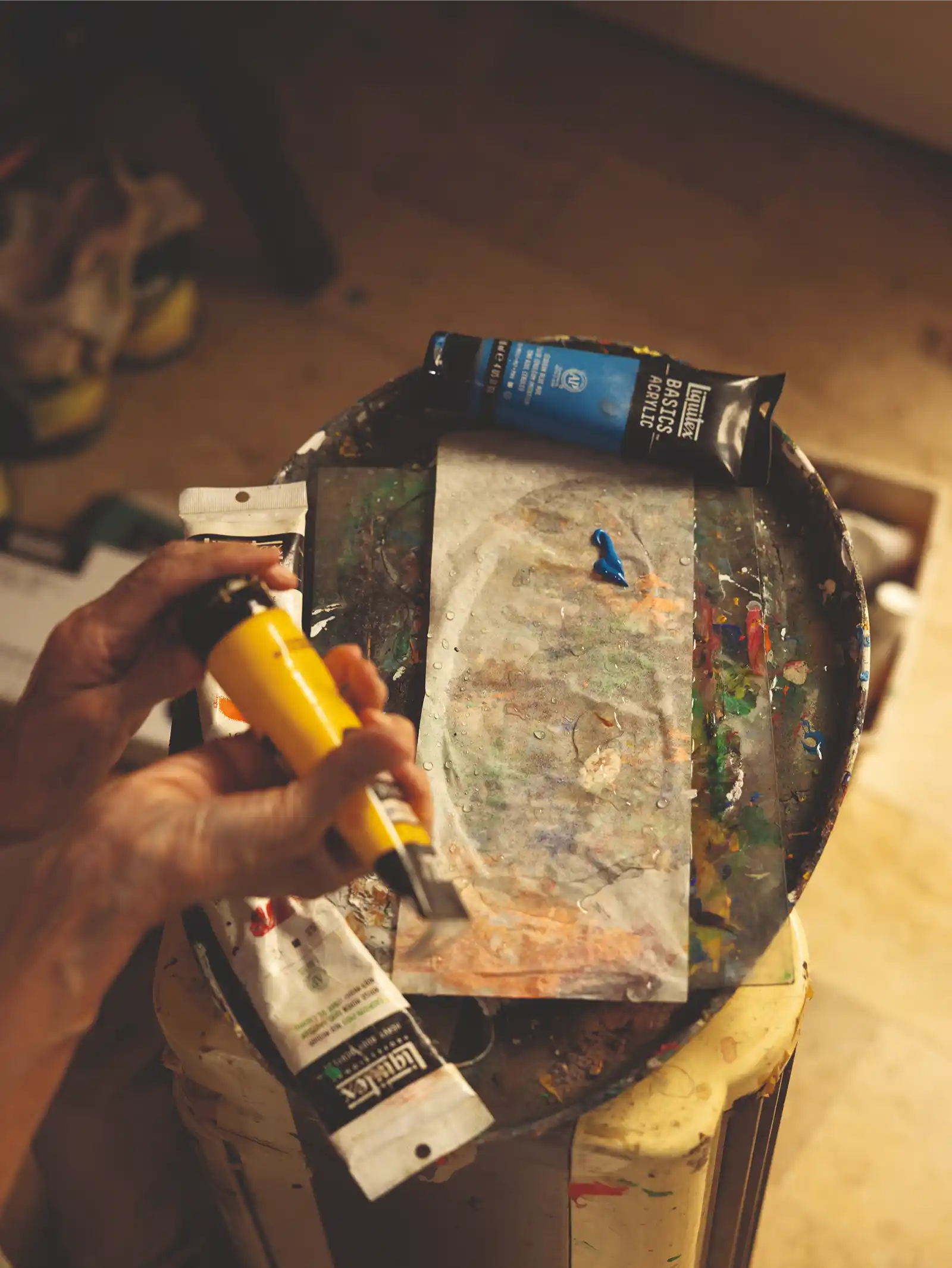
Her choice of materials reflected the same specificity. Crochet, lace, sawali, clothing, papier-mâché, and found objects entered the work because they were familiar and available.
“I have to be sincere in my choice of materials,” Cajipe Endaya says, valuing their familiarity and proximity to everyday life.
Her interest in history further developed alongside this attention to material. The Mga Ninuno prints, for example, drew from colonial images of Filipinos, including material associated with the Boxer Codex and early engravings she encountered in reproductions and collections.
“I felt I needed to ground myself in history,” she says, “so that I can anchor my identity and understand better the issues that I will talk about in the present.”
Printmaking gave her a way to engage those images directly. She came to the medium partly through leading Filipina printmaker Ofelia Gelvezon-Tequi, then a young teacher at the University of the Philippines in Diliman, who encouraged her to move beyond the silkscreen she knew from advertising and into the print workshop. Cajipe Endaya is careful about calling the relationship mentorship.
“She didn’t think she was mentoring me,” she stresses. “We were working together. She’s a friend.”
Against Solitude
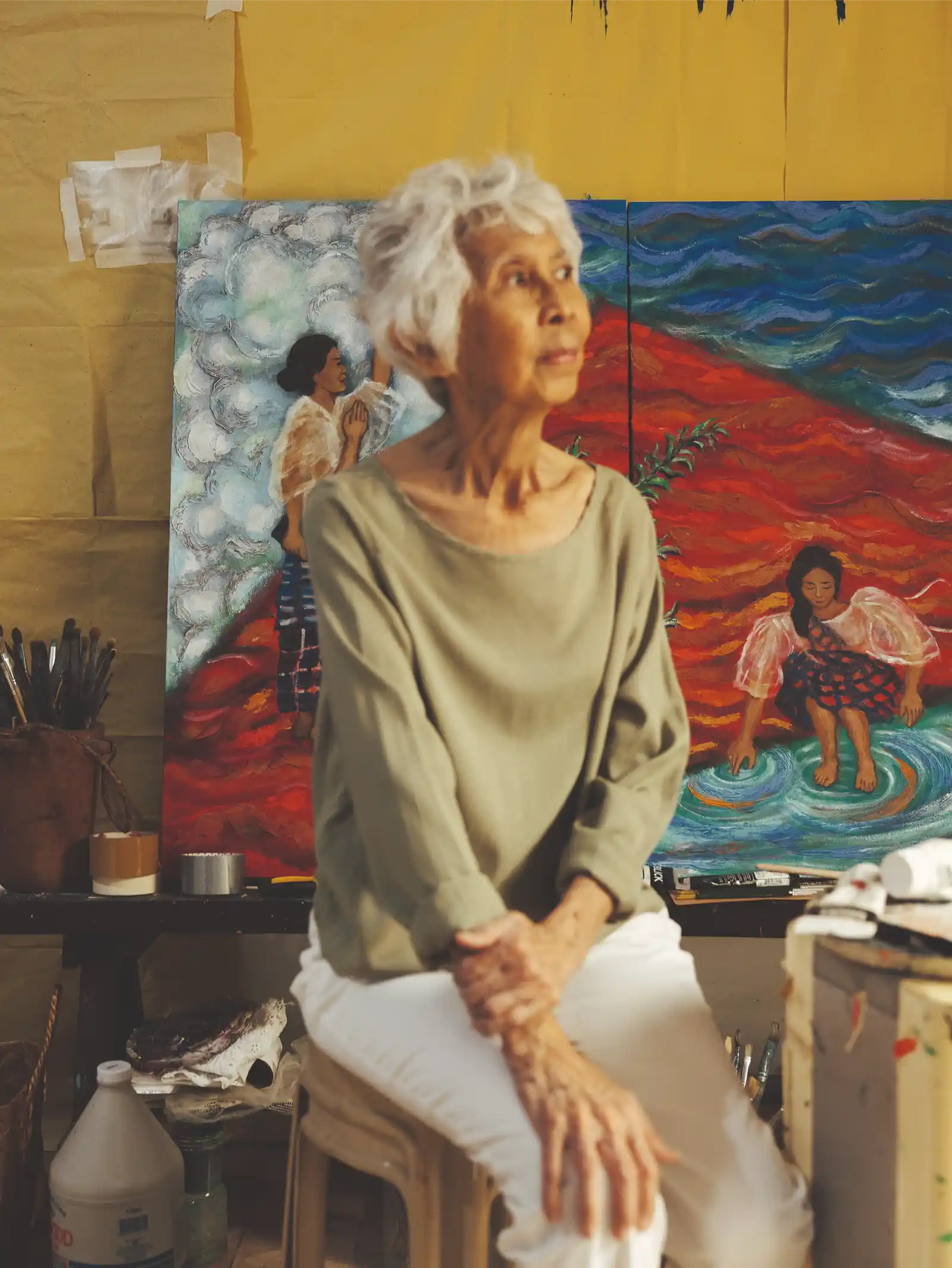
Cajipe Endaya remembers women doing much of the work that kept the Philippine Association of Printmakers running, from maintaining catalogs to helping install exhibitions. Yet the attention still went mostly to men.
“We were hanging the men’s works on the walls… Why is it like this? We’re the secretaries,” she recalls. “We keep the catalogs, we keep things in order, but it’s the men who were ‘large.’”
Kasibulan created space for women artists to exhibit and organize together. In 1987, Cajipe Endaya founded the collective with artists and cultural organizers Brenda Fajardo, Ana Fer, Julie Lluch, and Ida Bugayong. Women had long been making art, she says, but many remained outside the exhibition circuit. The group created opportunities to show work and, just as importantly, to develop it in conversation with other women artists.
“All of them are very much part of what I am now,” the artist says of the people and organizations that defined her career. “I wouldn’t have done work alone.”
“I felt I needed to ground myself in history,” she says, “so that I can anchor my identity and understand better the issues that I will talk about in the present.”
Her interest in the collective practice later extended to the visual arts journal Pananaw. While volunteering with the National Commission for Culture and the Arts (NCCA), Cajipe Endaya felt artists needed to be more articulate about their own work.
“One has to be self-critical,” she says, “and to have dialogue with other artists so that you can grow together.”
The publication, along with its conferences and regional exchanges, gave artists a greater role in documenting and debating developments in Philippine art.
By the 1990s, another question of women’s work had become central to Cajipe Endaya’s practice. Her landmark mixed-media installation “Filipina DH” addressed the growing number of Filipino women leaving the country for domestic work as overseas labor assumed an increasingly important place in the Philippine economy. First shown in Manila in 1995 and presented later that year at the NCCA Gallery, the work was most recently exhibited at Silverlens Manila for Cajipe Endaya’s 2026 solo exhibition Kahapon Muli Bukas. She recognized that migration could offer income and independence, but she was equally interested in what remained unchanged.
“In a sense, it was a way for some women to gain mobility, to earn for themselves,” she explains. “At home you’re isolated, but when you go there, you exit, and you work for yourself, but actually, you’re again isolated in domestic work. The burden of keeping a house for another family, which is not even yours.”
Suitcases and household objects became recurring elements in the installation, linking migration to the domestic labor that followed women across borders. Three decades after its first exhibition, the work’s continued resonance struck Cajipe Endaya as bittersweet.
“It could be fulfilling to know that one’s painting is relevant,” she notes, “but it’s also sad that the issues are still there.”
Faith, too, has proven just as persistent a presence in her work. Catholic figures appear alongside older images of a precolonial feminine spiritual power, including the babaylan. Cajipe Endaya sees little reason to force a clean separation between the two.
“You can’t remove that faith,” she emphasizes. Catholicism, for her, belongs to the lived history of Filipino women, however complicated its colonial inheritance may be.
Her 2022 retrospective, Pagtutol at Pag-asa, paired resistance with hope in its title. The relationship remains central to how she talks about political art: Resistance without the possibility of another world can consume itself, while hope without resistance becomes a form of anesthesia.
“Hope should always be there,” Cajipe Endaya says. “Otherwise there’s no reason to work or to move forward.”
After more than five decades, some of that work has survived long enough to enter the institutions it once challenged.
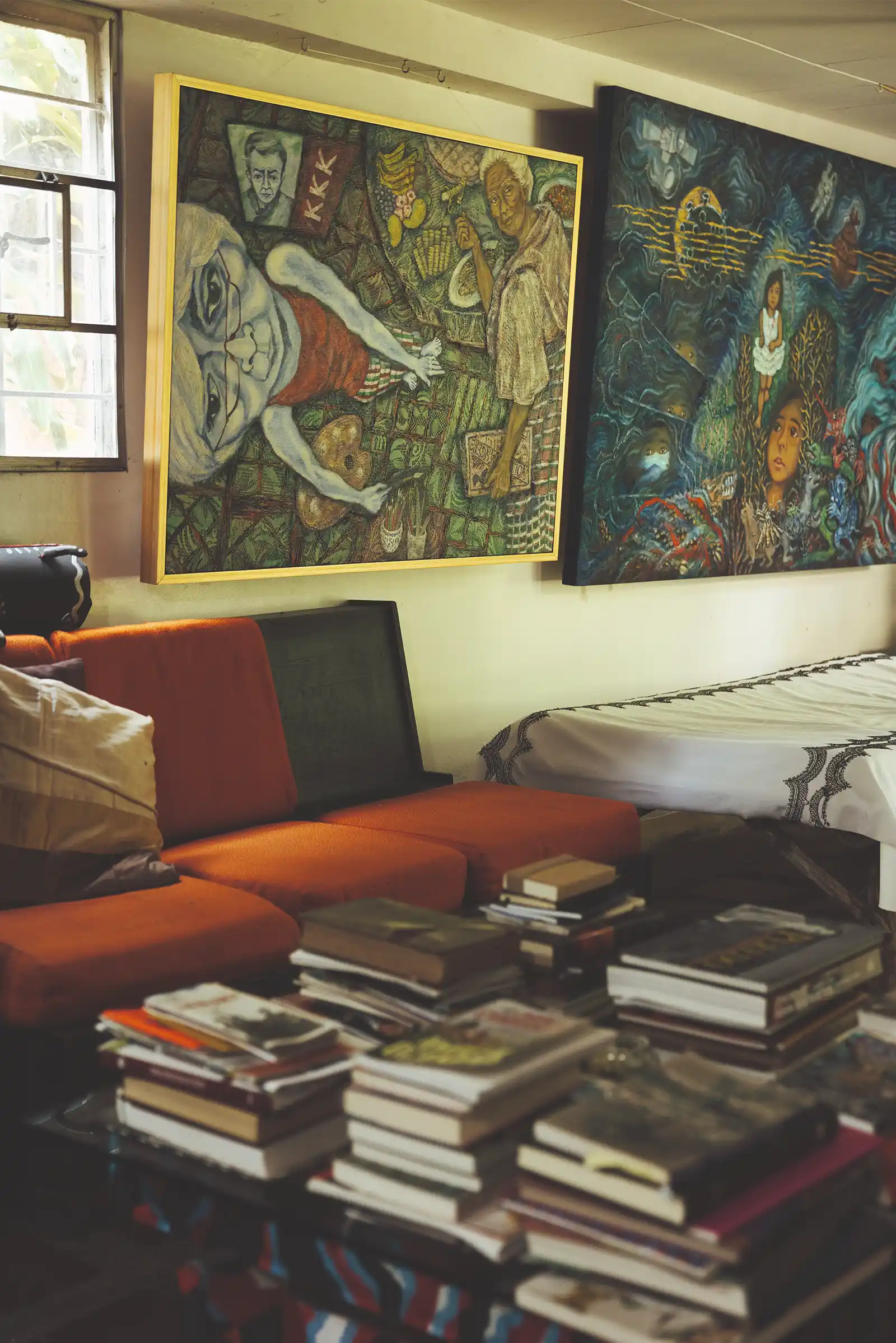
Cajipe Endaya herself recognizes the irony. “There’s some kind of guilt feeling there,” she says of anti-Marcos and anti-imperialist works that later entered, for instance, the Metropolitan Museum. “But then, well, they preserve it.” Once political art enters a museum, its context changes. What remains, however, is its availability to generations who did not live through the history it addresses.
An artist who spent decades questioning who gets exhibited, remembered, and written into national canon now occupies its most official category. Asked what the National Artist distinction has changed in her, she laughs. “Oh, same, same. I just have to keep on painting.” Then she adds, “It’s good to have some pension, which I appreciate.”
Posterity interests her even less.
“I don’t really think much of legacy,” Cajipe Endaya says. “I just have to do my work well each time.” Her children and grandchildren will eventually inherit the work. What place it ultimately occupies in art history is beyond her concern. “That’s not for me to decide,” she concludes. “That’s for others to criticize, or to do whatever else they want with.”
This article originally appeared in Robb Report Philippines’ Best of the Best issue, October 2026.
FAQs
Imelda Cajipe Endaya is a Filipino visual artist whose five-decade practice spans painting, printmaking, installation, mixed media, and collective cultural work. In September 2026, she became the first woman named National Artist for Visual Arts.
Cajipe Endaya recalls seeing Ferdinand Marcos declare Martial Law in 1972 while Manila was simultaneously being cosmetically prepared for international visitors. The contrast between polished public imagery and the violence occurring behind it helped shape her interest in representation, politics, and what images leave outside the frame.
Her feminist concerns began with her own experience as a mother working in domestic isolation. She later encountered feminist theory and developed an approach grounded more specifically in Filipino realities shaped by motherhood, faith, class, and expectations around women’s labor.
Kasibulan is a collective founded in 1987 by Cajipe Endaya with Brenda Fajardo, Ana Fer, Julie Lluch, and Ida Bugayong. It created more opportunities for women artists to exhibit, organize, and develop their work together at a time when men still dominated much of the Philippine art establishment.
First shown in 1995, Filipina DH examines Filipino women leaving the country for domestic work overseas. Using suitcases and household objects, the installation considers how migration can bring income and mobility while reproducing forms of domestic isolation and labor abroad.