Olafur Eliasson: Rainbows, Retinas, and the Moral Failure of Distance




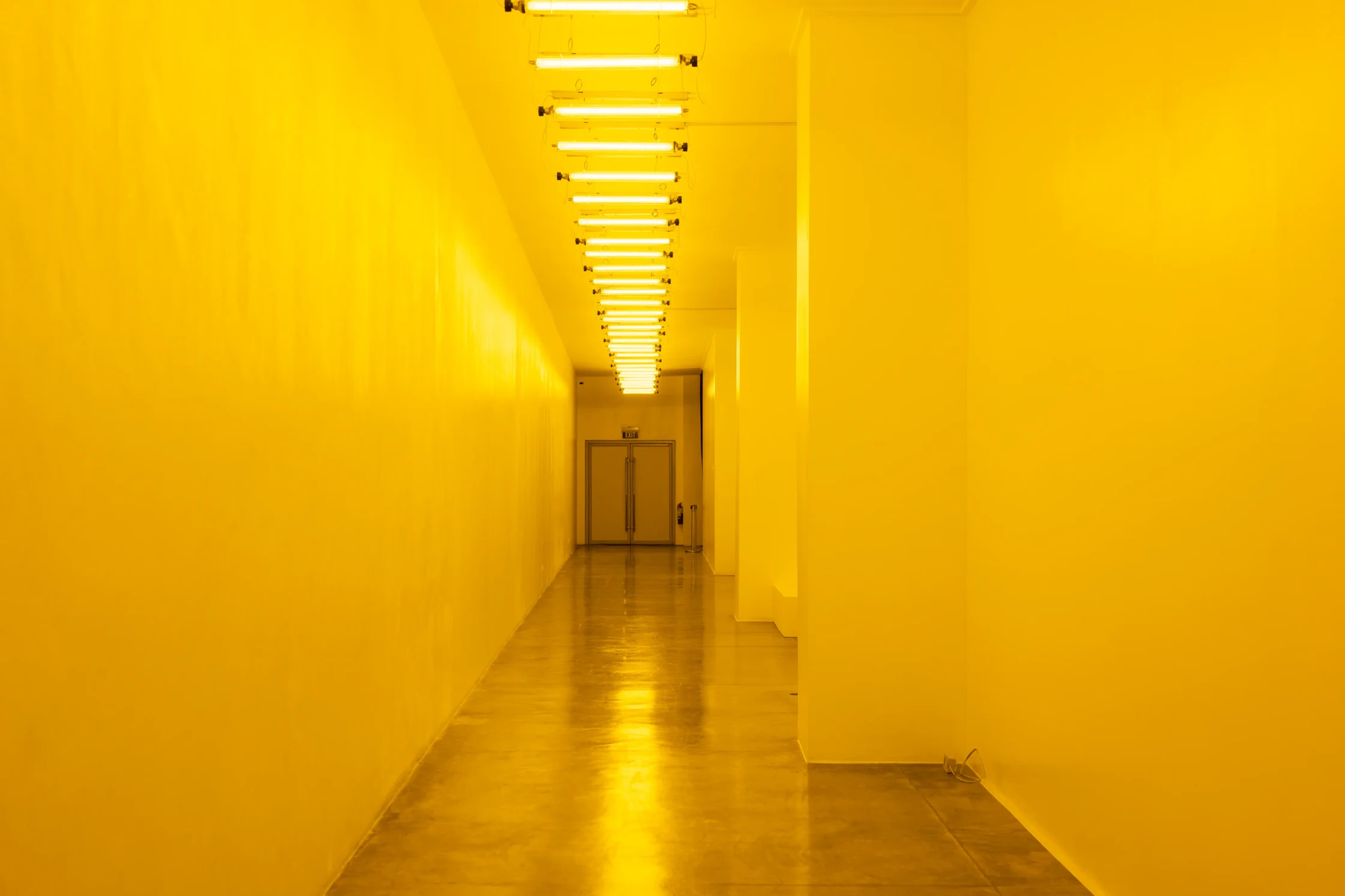
Monofrequency lamps narrow the visible spectrum inside the entrance corridor of the Museum of Contemporary Art and Design in Manila. Bodies, clothing, and architecture turn yellow or black, their familiar colors removed as the threshold assumes the queasy intensity of an overexposed photograph. Depth begins to waver even as edges and contrasts sharpen. Upon leaving, the eye produces a bluish afterimage, a kind of retinal rebellion against deprivation. The corridor demonstrates that perception has an edit function. (Article continues after the video.)
Video:
The Manila leg of Icelandic-Danish artist Olafur Eliasson’s Your curious journey opens with “Yellow corridor” (1997), turning the museum’s entrance passage into its first perceptual experiment. By temporarily disrupting ordinary color vision, Eliasson reveals perception as an event assembled by light, nervous system, and context rather than a neutral way of seeing. Eliasson decidedly makes the spectator responsible for coproducing the exhibition.
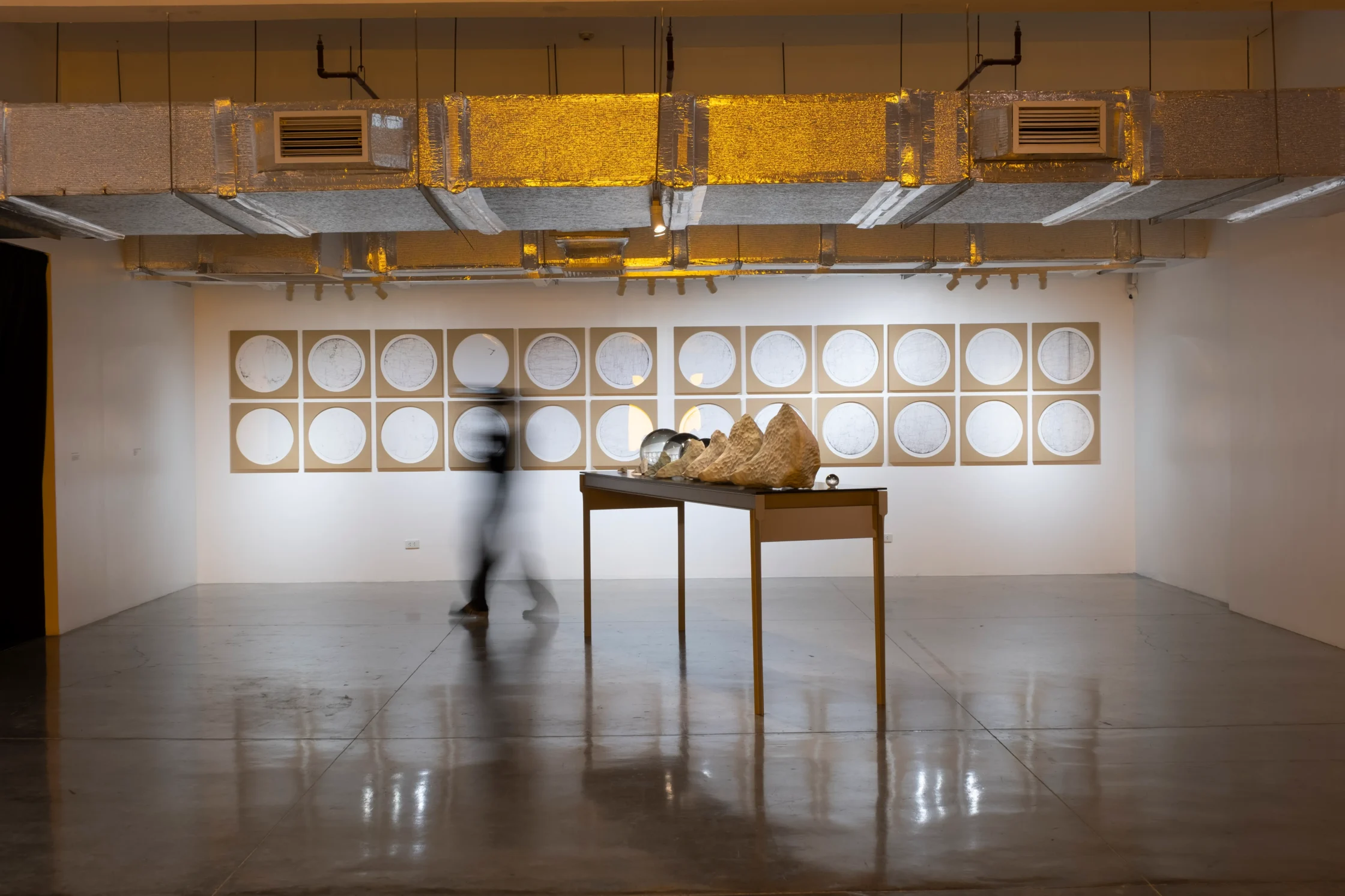
Your curious journey began at the Singapore Art Museum in 2024 with Eliasson’s first major solo exhibition in Southeast Asia, then traveled to Auckland, Taipei, and Jakarta. Manila is the final stop before the works return to his Berlin studio. The tour pursued lower-carbon logistics by selecting lighter works, using objects already within the region, sourcing certain materials locally, and reducing transport distances. Drawing devices placed inside shipping crates recorded the bumps and turns of the journey, thereby transforming logistical movement into another form of mark-making.
No official symbolic rationale has been given for concluding the tour in Manila. Geography supplies its own meaning. Ending a survey about unstable perception and environmental flux in a nation profoundly exposed to climate risk sharpens every work. The setting also clarifies why Eliasson travels so well. His materials are elemental, but the meanings they gather inevitably become local.
The American critic Peter Schjeldahl once praised Eliasson for possessing “the mental discipline of a scientist and the emotional responsibility of a poet.” For three decades, the artist has built environments from water, fog, mirrors, wind, ice, lichen, and restricted wavelengths of light. Their effects can feel immediate enough for a child and open enough for a seminar. His best works allow wonder to happen, then reveal the rig that produced it.
That movement from wonder to mechanism places Eliasson within a longer argument about how vision works. John Berger began Ways of Seeing with the declaration that “seeing comes before words.” Maurice Merleau-Ponty, in Eye and Mind, bound vision to the moving body rather than an eye detached from the world. Ernst Gombrich, conversely, described representation through a process of schema and correction. Rudolf Arnheim treated visual perception as a mode of thinking, whereas Alva Noë, in Strange Tools, argued that art reorganizes the habits through which experience ordinarily makes sense. Each work begins with something apparently recognizable—sometimes a corridor, a rainbow, a field of moss, a glacier—then unsettles the conditions through which it becomes visible.
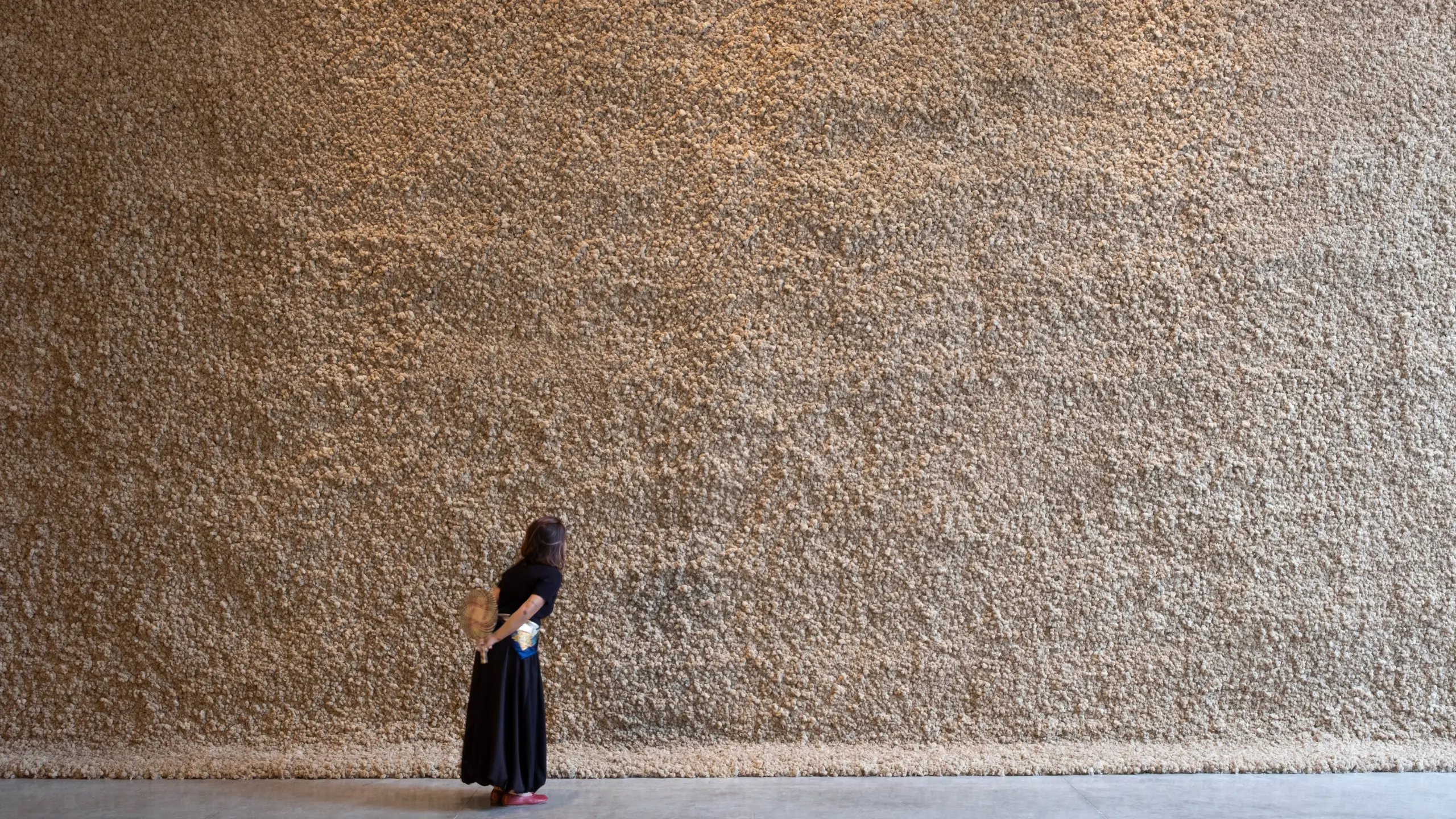
“Moss wall” (1994) carries a different kind of seduction. The surface engages the senses before the mind can quite settle what it sees. Reindeer moss (technically a lichen called “Cladonia rangiferina”) spreads across the vertical plane like a bleached forest seen from the air, interrupting the gallery’s white-cube severity with an evocation of Arctic tundra and boreal forest. Woven into wire mesh, it contracts and fades as it dries, then expands, changes color, and releases its fragrance when watered.
In Manila, this ecology from the northern latitudes becomes stranger. Nature arrives indoors as material, specimen, memory, and décor. The work is lush, though its lushness seems to be whipped into a rectangle, irrigated and maintained within an institutional system. Tension, of course, keeps “Moss wall” from collapsing into biophilic wallpaper. The installation shows how quickly “nature” becomes an image prepared for human consumption (Berger might ask who frames the view; Gombrich, how expectation guides recognition). We see tundra partly because the label teaches us to. We see abundance because the wall is full. Some may also see extraction, a living-looking surface detached from habitat and made portable through the museum circuit. Eliasson leaves the contradiction fragrantly unresolved.
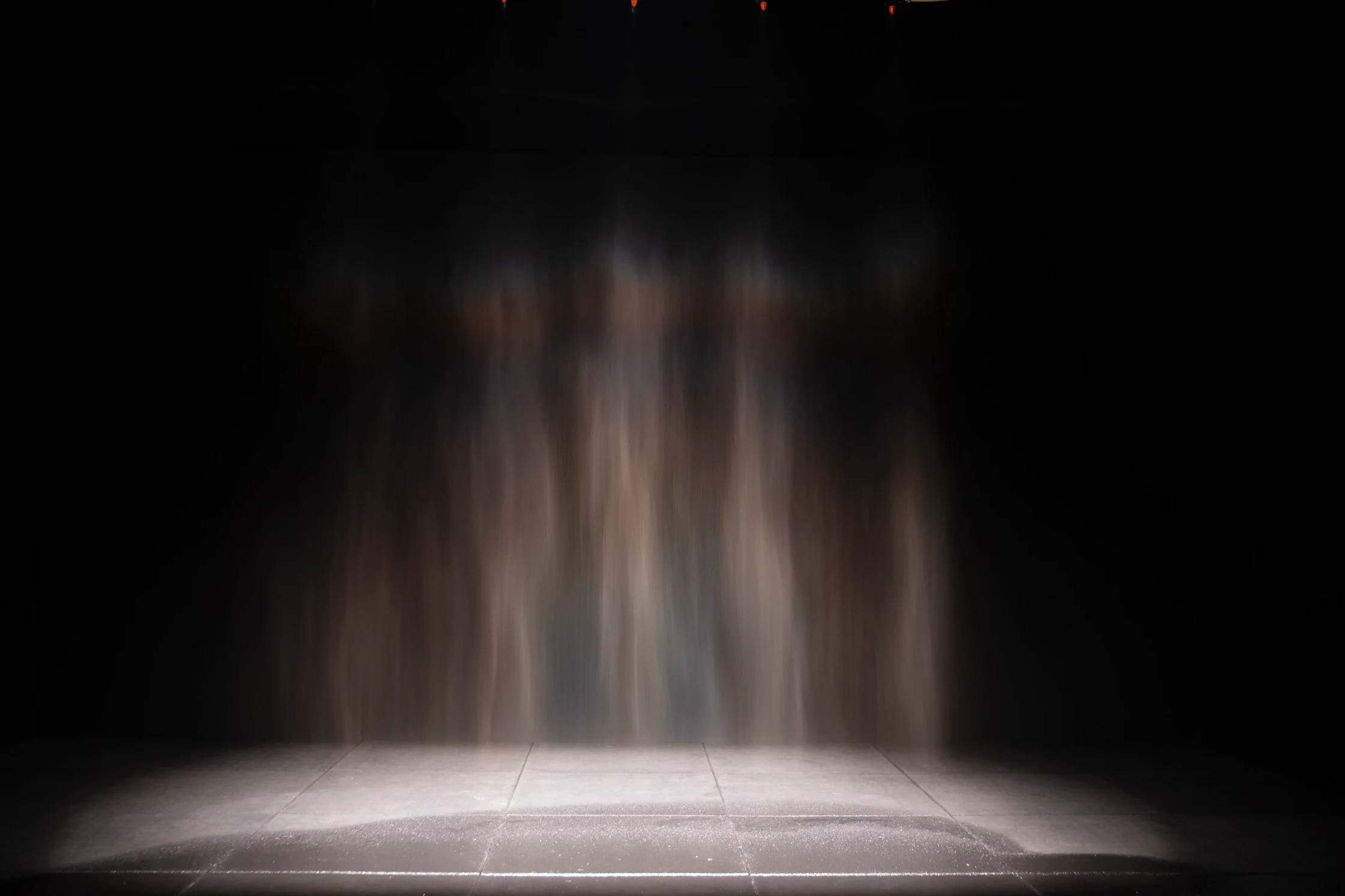
Elsewhere, a rainbow appears in the dark, although “appears” makes the whole thing sound more autonomous—and frankly more mystical—than it is. “Beauty” (1993) consists, in practical terms, of a spotlight aimed through a thin curtain of water released from visible nozzles: museum plumbing enlisted in the production of transcendence. Stand in the right place, and the spectrum coheres. Shift half a step, and it frays. Move again, and it disappears, which is when you realize that the rainbow was never exactly in the room, or not in the way the spotlight and water were in the room. It existed in an unstable agreement among droplets, light, distance, angle, and the particular pair of eyes doing the looking.
The result is almost embarrassingly beautiful, especially to the kind of viewer trained to distrust anything that delivers pleasure before interpretation. Eliasson anticipates this suspicion and leaves the mechanism exposed, as though disclosure might neutralize enchantment. It doesn’t. The trick remains a trick, and the miracle remains, somehow, miraculous. “Beauty” offers no fixed image to contemplate, acquire, or remember correctly, really. Every viewer receives a slightly different rainbow, and only for as long as the body maintains the necessary position. The work’s real material is therefore not water or light alone, but contingency, this unnerving fact that what we see depends upon where we happen to be standing.
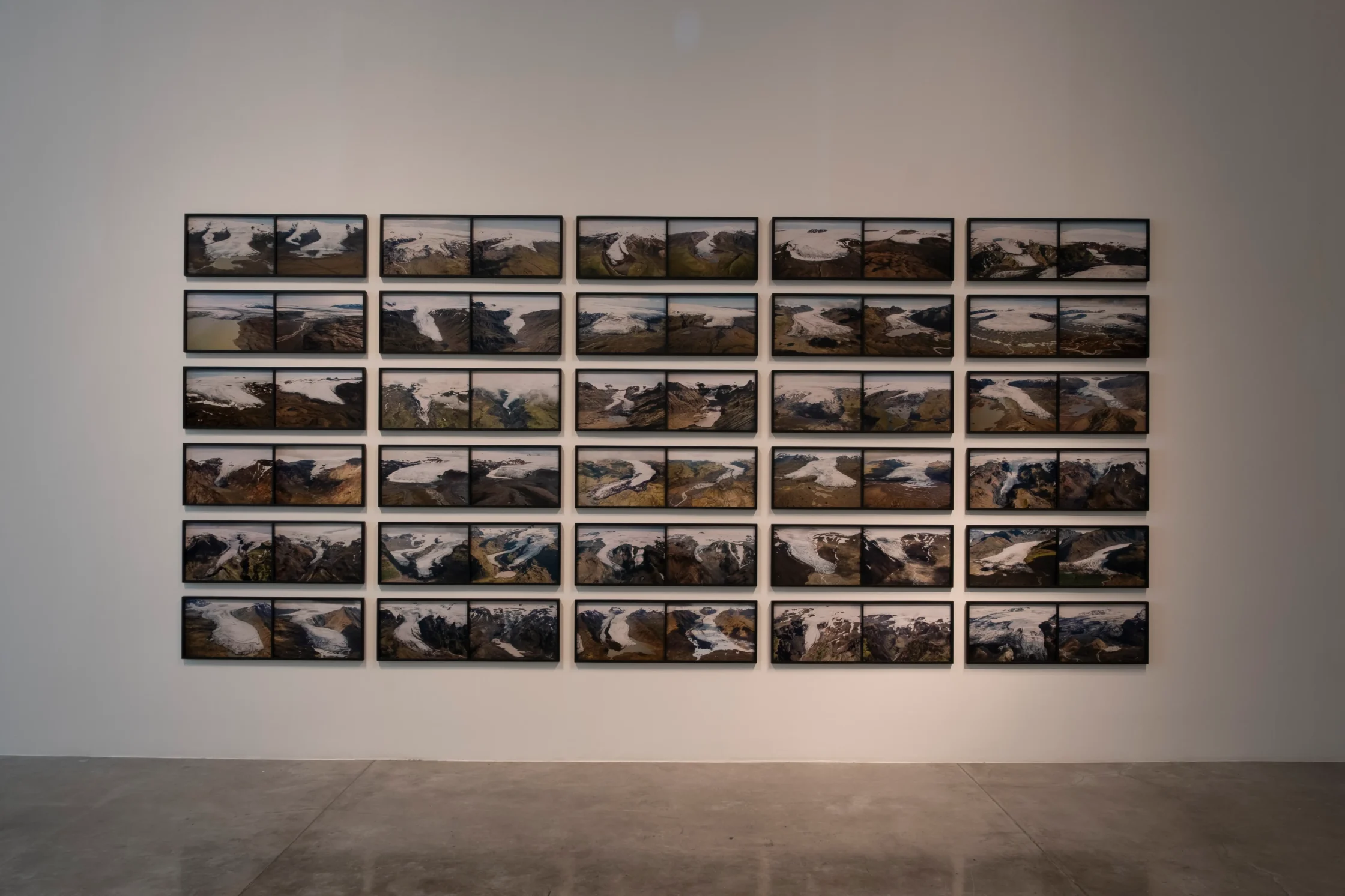
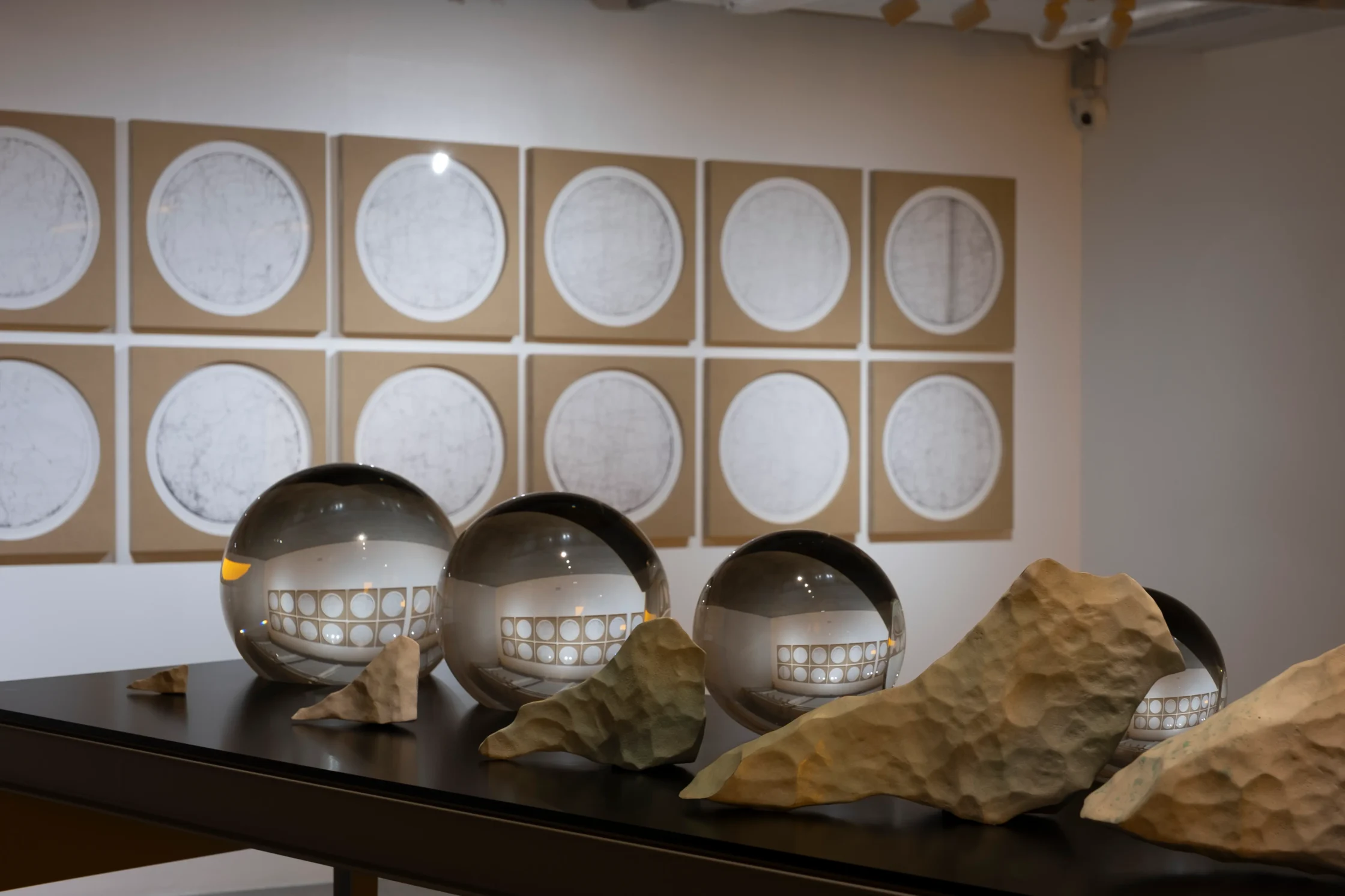
Contingency darkens when the thing that vanishes is no longer a rainbow. In “The glacier melt series 1999/2019” (2019), Eliasson trades optical instability for historical evidence. He photographed several dozen Icelandic glaciers in 1999, then returned twenty years later to photograph them from the same perspectives, as though asking the landscape to sit for a second portrait. Thirty C-prints bring the earlier and later images into relation. Ice gives way to rock, volume to absence. Nothing shimmers or performs. The photographs simply insist that the before and after occupy the same world, and that the distance separating them is only two decades. Time, ordinarily too diffuse to see, acquires an edge.
The series is quieter than “Beauty” or “Yellow corridor”, but its silence feels a bit more accusatory. Its mechanism is history itself, advancing through what the environmental writer Rob Nixon calls “slow violence”: damage dispersed across time, easily ignored until the conditions sustaining a landscape, or a life, have already begun to disappear.
In Manila, Iceland’s retreating glaciers feel anything but remote. The Philippines stands at another exposed edge of the same climate system, where rising seas, punishing heat, violent rainfall, and destructive tropical cyclones are less distant forecasts than recurring facts of life. A PAGASA assessment based on satellite data from 1993 to 2015 estimated sea-level rise at five to seven millimeters annually over the Philippine Sea and 4.5 to five millimeters in some parts of the country (and mind you, it’s 2026!). The World Bank estimates that typhoons currently cost the national economy around 1.2 percent of gross domestic product each year, rising to 4.6 percent in extreme cases such as Super Typhoon Yolanda.
“Global South” is often used so broadly that it risks compressing radically different histories into one administrative category. Here, however, it describes an ugly distribution of consequence. The Intergovernmental Panel on Climate Change has stated with high confidence that communities that have historically contributed least to climate change are disproportionately affected by it. In the Philippines, those consequences are absorbed through flooded homes, lost livelihoods, damaged infrastructure, displacement, and misappropriated
public budgets locked into permanent recovery. Should we then think of Eliasson’s glaciers as a northern elegy or an advanced notice? The ice disappears there. The water arrives here.
Perception is never innocent, and seldom complete, which is another way of saying that nobody enters a gallery as a disembodied eye. We look from somewhere: through bodies conditioned by weather, class, institutions, memory, and all the quiet arrangements of power that determine what can be seen and who is permitted to remain merely a spectator. “There is no outside and inside,” Eliasson has said. “There is only the world.” It’s a nice line, maybe too nice, because it asks the museum to surrender the fantasy that its walls can keep consequence out. Art, after all, cannot cool the atmosphere, rebuild a coastline, or reroute climate finance toward the people already paying for the crisis. You know, Adrian Searle once faulted Eliasson for “too much operatic artifice,” and the criticism still lingers. Do these spectacles carry us beyond sensation, or merely leave us stunned inside the glow? Awe isn’t action, and beauty, when it asks nothing after the initial astonishment, can begin to feel like anesthesia.
Yet Eliasson’s art works earlier in the chain, at the moment when sensation becomes recognition and recognition might become relation. In “Beauty”, the rainbow disappears the moment the viewer moves away. Its fragility is also its truth: a world can exist and still go unseen, or vanish in plain sight. Eliasson asks us to shift position, look again, and admit our place within what we see. In Manila, where climate change arrives as heat, flood, displacement, and eroding coastlines, curiosity becomes the difficult practice of recognizing oneself inside the picture.
Olafur Eliasson’s Your curious journey runs until November 15, 2026 at the Museum of Contemporary Art and Design, De La Salle-College of Saint Benilde, Design and Arts Campus (D+A Campus) in Malate, Manila.
FAQs
Your curious journey is a major survey of Icelandic-Danish artist Olafur Eliasson’s work exploring perception, embodiment, natural phenomena, and climate change. The exhibition uses light, water, moss, and documentary photography to show how viewers actively participate in constructing what they see.
The exhibition includes major works such as “Yellow corridor” (1997), “Moss wall” (1994), “Beauty” (1993), and “The glacier melt series 1999/2019” (2019). Together, they examine altered color perception, the transformation of nature inside the museum, the physical conditions required to see a rainbow, and the visible effects of climate change.
“Yellow corridor” uses monofrequency lamps to remove most colors from the visible spectrum. Bodies, clothing, and architecture appear primarily yellow or black, while depth and contrast seem altered. After leaving, some viewers may experience a bluish afterimage, revealing how color is produced through the interaction of light, the nervous system, and the surrounding environment.
Manila is the final stop of the exhibition’s regional tour after Singapore, Auckland, Taipei, and Jakarta. Although no official symbolic reason has been given for ending the tour in the Philippines, the location adds urgency to works about environmental change because the country faces rising seas, extreme heat, destructive rainfall, and tropical cyclones.
Olafur Eliasson’s Your curious journey runs until November 15, 2026, at the Museum of Contemporary Art and Design, located at the De La Salle–College of Saint Benilde Design and Arts Campus in Malate, Manila.