Robb Report Philippines
    • Log In
    • About Us
    • The Team
    • Contact Us
    • FAQS
    • Privacy Policy
    • Terms and Conditions
    Follow Us On:
    facebook Twitter X Instagram Youtube Tiktok

    © 2026 Robb Report Philippines is published and presented by Modern Media Group, Inc., a subsidiary of AGC Power Holdings Corp. All rights reserved.

Be a member
Home › Profiles

Driving Change: Why Charlie Rufino is Fueled with Purpose

To Charlie Rufino, personal success doesn’t mean only his own–he puts the pedal to the metal towards opportunities for future generations, with no signs of slowing down.

By Kimberly Delgado

February 05, 2025
FacebookXEmailCopy Link
Charlie Rufino

Once a year in February, on the Sunday before Valentine’s Day, Bonifacio Global City vibrates with the deep, rumbling growl of sleek Ferraris, Lamborghinis, Porsches, and glossy classic cars driving towards 4th Avenue, the locus of Sports Cars for a Cause. At the heart of the traffic of people and supercars is the president of NEO, Carlos “Charlie” Rufino, widely known for prioritizing and pioneering sustainability in real estate in the large scale, showcasing its proof of concept from One/NEO through to Seven/NEO–with the entire portfolio reaching net zero status in 2021, four years ahead of its target. 

His properties have transformed the former military base Fort Bonifacio into the energetic, world-class development it is today and, consequently, the landscape of urban development in the country.

For this car show, Rufino is just another car enthusiast; this car exhibition, his brainchild. But Sports Cars for a Cause isn’t just any car show. Neither is it about its major sponsor, NEO, or the car clubs involved, or even the cars themselves: it’s about the Sisters of Mary Schools, and its students like Almer Postor, the son of a fisherman in a remote, small fishing town on an island off of Quezon.

Courtesy of Sports Cars for a Cause/NEO

“Now, let me tell you a success story,” Rufino says. “Almer was just a kid walking along the beach in the fishing town where he lived, holding his sandals in his arms. His sandals didn’t even match, but these were the only pair he had, and kept them close to protect them from the water,” Rufino continues. “Someone had told him that there was a nun visiting their town to invite parents to send their children to study for free in their school. He applied and was accepted.

“He graduated valedictorian from Sisters of Mary in 2007, then was sent to NTMA [NYK TDG Maritime Academy] for free by a friend of mine, Robbie [Delgado], and graduated magna cum laude. He eventually became a ship’s mate, earning eight thousand dollars a month,” he says. “To celebrate that milestone, Robbie flew him to Balesin. On the way there, Almer asked, ‘Do you think we could fly over my town?’ They did, and my friend saw buildings and fishing boats that turned out to be Almer’s ongoing contribution to the town, a co-op for the fishermen…” Rufino’s voice cracks, his eyes welling with tears.

Cars at Bonifacio Global City
Courtesy of Sports Cars for a Cause/NEO
 

The Sisters of Mary Schools have been Rufino’s personal advocacy since 1985—even before his hallmark development of Bonifacio Global City and the involvement of NEO—and are the primary beneficiary of Sports Cars for a Cause. The car clubs, the supercars, the enthusiasts, and the entertainers who sing and play for free all gather on a sunny morning to raise funds for scholarships for the students of The Sisters of Mary Schools. The students are enrolled in well-equipped, sprawling campuses in Cavite and Cebu that offer high-quality secondary education with a focus on a vocational and technical education. Food, board, and medical and dental care are fully covered by the school, which is completely funded by donors like Rufino.

 “Cardinal Sin invited me to meet Fr. Aloysius Schwartz, a Ramon Magsaysay Awardee who had founded The Sisters of Mary Boystowns and Girlstowns,” recounts Rufino. Sent by his order to Busan right after the Korean War, Fr. Aloysius successfully raised funds for the project by beaming First Lady Nancy Reagan’s visit to the campus, “using a newfangled satellite TV, which meant, at that time, the equivalent of going viral,” says Rufino. 

Charlie Rufino with students of the Sisters of Mary Schools
Charlie Rufino with students of the Sisters of Mary Schools.
Willy Saw

“Duplicating its success in the Philippines in 1985, when businesses were closing and there was a wave of capital flight, was nothing short of a miracle.” The schools now support 9,300 students yearly, boasting success stories like Almer’s, with alumni securing positions at multinational companies and government agencies.

Rufino is not just compassionate toward the children; he expresses pride at the tenacity and achievements of their graduates. “It’s like a revolution,” he says. “Giving opportunities to the poorest of the poor and offering them hope when otherwise they have none. Like Almer—before the school, he didn’t even have shoes, or any hope—but having been given the opportunity, made such an impact on the town, transforming it completely. The power of that! Can you imagine?”

In the auditorium of the Cavite Girlstown campus, with 3,000 students in neat rows singing a Christmas-themed song written by Apl.de.Ap, yes, we can imagine. The students are bustling with excitement, but nobody is more delighted than Rufino, wearing a baseball cap, jeans, and a big smile. 

Apl.de.Ap’s team, including Grammy award-winning Keith Harris (music producer for artists like Michael Jackson, the Black Eyed Peas, and Madonna, to name a few), is filming a music video featuring the school’s choir, with 100% of its streaming proceeds benefiting the school. 

The kids know Mr. Rufino well, as do the sisters, who update him on recent developments and ask for advice. He proudly shows us how the students, still in high school, learn AutoCAD, electronics, computer programming, and other technical and vocation skills that are assessed and certified by TESDA, equipping them for immediate employment while also giving them an advantage towards a university degree.

While Rufino’s involvement reflects a deep engagement with the school’s operations, it is his astute ability to identify synergies between the school and his network that serve as an extraordinary asset. “I brought the German ambassador here one time,” he says. “She was clearly impressed, and promised to see what she could do. A few months later, she called me. ‘Do you know the Porsche people?’”

That connection proved fortuitous. Rufino was introduced to Porsche Training and Recruitment Center Asia (PTRCA), the first established outside of Germany, located in Don Bosco, Makati, which trains qualified technicians in various classes of Porsche vehicles. Only about 20 students graduate, securing jobs within Porsche or recommendations for prestigious positions abroad. “I took the opportunity to recommend six graduates from our school, and they were willing to take them on. Four passed the entrance test, but there was another hurdle–they needed to be housed.

Willy Saw

“I called my friends who love Porsches as much as I do, and together we put up a fund for their housing, anything they needed,” continues Rufino. “One of our graduates turned out to be the topnotcher, and is being sent to Germany. The other three are in Dubai–they send me pictures, showing me their new life there,” he says, again visibly moved.

“We must acknowledge that we live in difficult times. Those of us who can provide should give back more. Life is about stewardship; we need to leave the world better than we found it,” he asserts. “Personal success grants you a network, and I can say that whenever I ask my associates to help, it’s always a resounding yes,” he says, dabbing his eyes again. 

He admits it can be different in a business setting, where parties might come with one-sided agendas. “With the school, everyone aligns quickly. ‘We need this—Yes! We need that—Yes!’ There’s no negotiation; decisions are made promptly. They want to give.”

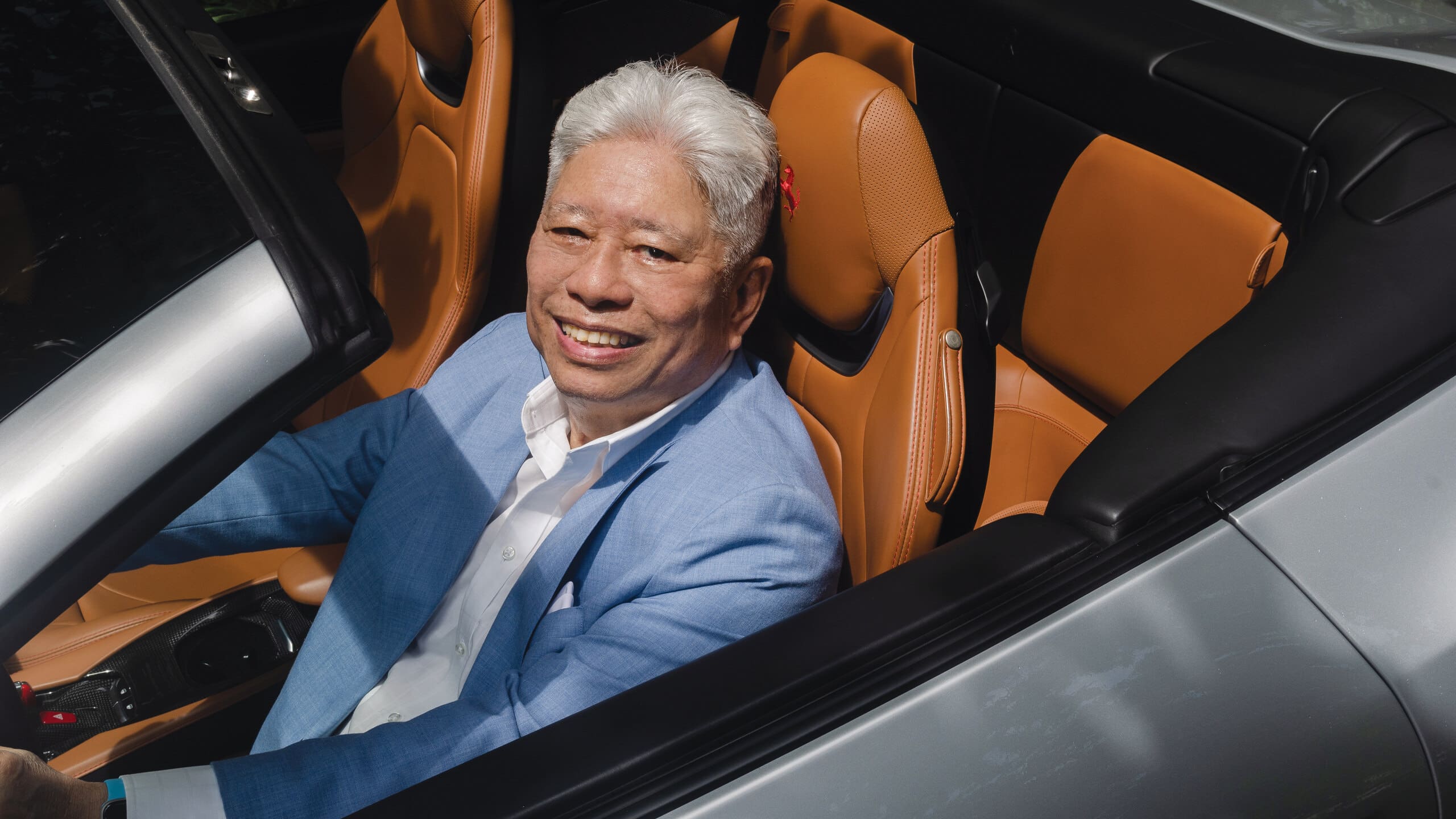
It’s likely also due to his genuineness, affability, and earnestness that nobody can say no to Rufino. One can easily sense his warmth: when his sons drop by the photo shoot in NEO Park, there is easy, affectionate banter, and his sons give him a little ribbing, teasing him as he poses next to his Ferrari Portofino and his Tesla Y Performance. Much has been said about the successful, seamless succession of his sons, under whom the family business continues to thrive.

He attributes that accomplishment to the way he himself was raised. “I was very lucky I was born into a family that was very nurturing,” he says. “And my mother, before she passed, before [it became popular in succession planning], we had somewhat of a family mission statement. 

She said, ‘We are a family of harmony, and we will strive to help everybody achieve their full potential.’ That, regardless of whether we wanted to be in the family business or not.” It was by his parents’ example that informed the way he raised his own family. “I can’t tell them, do this, and do that. It’s not what you teach, it’s what you observe.”

His sons joined him in meetings and at construction sites years before he planned the passing of the baton, something he deemed essential. “I tell them, it’s what you inspect, not expect, that happens,” he says. “People will always tell you the story they think you want to know; then you find out it’s too late to change anything because very often, bad news doesn’t get said.

“I’m very open, transparent. And they know every supplier now, every contractor, their reputations, good or bad. Now, they can cut through the fat.” By the time he handed over duties to his sons, they could base their decisions not only through their hands-on experience, but also by being familiar with their father’s decision-making style–which, interestingly, is not always by the book. Some of the most compelling success stories are marked by intuitive, risky decisions, and Rufino’s is no exception.

“I took a risk and took on speculative building,” he says. On the eve of the proliferation of BPO businesses in the Philippines–which highlights Rufino’s facility to recognize economic phenomena ahead of the curve– Rufino decided that he would build One/NEO without existing contracts. “Building to suit means that [the companies involved contractually] will work at each other’s pace, irrespective of what the realities require. 

But I knew at least 80% of what these companies needed; so we said, ‘The train has left the station, we’re building this building, it’s ESG compliant, among other things, and it will be turned over on this date,’” Rufino explains. Their success stemmed from the company’s capability to execute plans efficiently and deliver on time, allowing them to onboard these large, multinational accounts while their competitors remained stuck in pre-development. The rest is history.

Charlie Rufino poses next to his Ferrari Portofino.
Rufino poses next to his Ferrari Portofino.
Kai Huang

Of course, Rufino’s own cars figure in Sports Cars for a Cause. When asked about which of the cars he’s ever owned is his favorite, he is hesitant to answer. “It’s like asking who my favorite is among my children,” he laughs. “But I suppose it would have to be the 1971 Porsche 911E Targa,” a car he himself went to Germany to pick up, “because that’s the car I had when I courted my wife.”

It’s now owned by a friend. A number in his wide collection of cars are, of course, electric. “The Tesla is a completely different car from what you’re used to. It’s like you’re on a magic carpet: you sit down, you move, and there’s nothing that you hear, no sound, and it’s magical. EVs give a very different experience because there’s no going through the gears, no exhaust note, nothing to make your blood pump. But it’s lovely, too, not to hear anything; it feels like you’re a part of nature.”

From 30 cars in its inaugural year to 200 in the 2024 iteration, Sports Cars for a Cause exemplifies Rufino’s skill in bringing individuals together for a shared mission. “We were just a group of Porsche enthusiasts, gathering on Sunday mornings. I asked them, ‘Wouldn’t it be great if we could do something meaningful?’” he says. “And it was the president of the Porsche Club that said, ‘What if we did something like Sports Cars for a Cause?’ He coined that. And from that initial group of thirty, this year we were able to raise enough money to support 150 scholars.”

He may have passed the baton to his sons, but he is still very involved in the business. He’s constantly distilling ideas (he wakes up at four in the morning, where in the quiet these ideas and synergistic partnerships jell) and, as expected, is thinking big. He has begun investment in data centers, an industry he feels is crucial in keeping the Philippines competitive globally. He’s thinking of linking the organizations he’s part of, think tanks like the Urban Land Institute, with the Young Presidents’ Organization. 

He’s working on initiating projects around massive national infrastructure projects currently in development. Of course, he’s passionate about education, and one of his projects is aiming to raise the country’s PISA score by offering access to Khan Academy, an online educational platform developed in Silicon Valley being brought into the Philippines by social impact investor and lawyer Geraldine Acuña-Sunshine. 

He is working on implementing digital sciences in the Sisters of Mary school curriculum to ensure they remain ahead of the curve. “Moving the needle” frequently surfaces in his conversations, and given his track record, it’s evident he intends to continue making a significant impact, bullish about what the Philippines can achieve in furthering economic progress.

A Porche 911 parked in front of Seven/NEO.
Kai Huang

In a world where success is often quantified by financial metrics or impressive resumés, it seems that Charlie Rufino, even if he can easily tick those boxes, redefines it: success is not a finish line, but a way of living in sync with one’s values. For Rufino, it is being a steward of the Earth, a devoted family man, a contributor to the country’s progress, and a person who actively pursues opportunities to change the lives of those who can’t hope for a better one—those whose own successes remain his goal.

Even with his busy schedule, there is always time for the Sisters of Mary. It’s late in the afternoon, the music video team has packed up, and the rest of us are ready to go on our way. We say goodbye to the sisters, to the children, and to Mr. Rufino, who is still as energetic as he was when he arrived at seven in the morning. He is staying behind, discussing matters with the sisters as they proceed with inspections.

To him, there is still much to do. He rises from his seat and off he goes, zero to 60 in one second.

This article originally appeared in the Premiere Issue of Robb Report Philippines.

Access to this content is reserved for members only. Please purchase a membership to unlock this content.

Be A Member Already a member? Sign IN. If you need assistance, please email [email protected]

Exclusive Events

Notice
There are no upcoming events.

E-Magazine

Read Now

LATEST IN Profiles

Chef in a dim kitchen pours sauce from a ladle into a pan, with ingredients and equipment visible; bold headline reads 'Robb Report Philippines: Profiles: Luminaries' over the scene.
Profiles

Jorge Mendez: The Measure of a Chef

By Alicia Colby-Sy May 13, 2026
Profiles

The Answers With Eric Dee

By Alicia Colby-Sy May 05, 2026
Lessons and Legacies Jorge Araneta Robb Report
Profiles

Lessons and Legacies: Jorge Araneta, A Lifetime at the Table

By Yvette Fernandez April 27, 2026
Profiles

Cecile Licad: Beyond the Standing Ovation

By Yvette Fernandez March 25, 2026