Vacheron Constantin’s Wild Automaton Clock Tracks Earth & Stars




Sometimes, the best birthday gifts are the ones you make yourself.
At least that seems to be the logic behind the two newest debuts from Vacheron Constantin, the Swiss watchmaker that celebrates its 270th anniversary this week. The milestone makes it the world’s oldest continuously operating timepiece manufacturer.
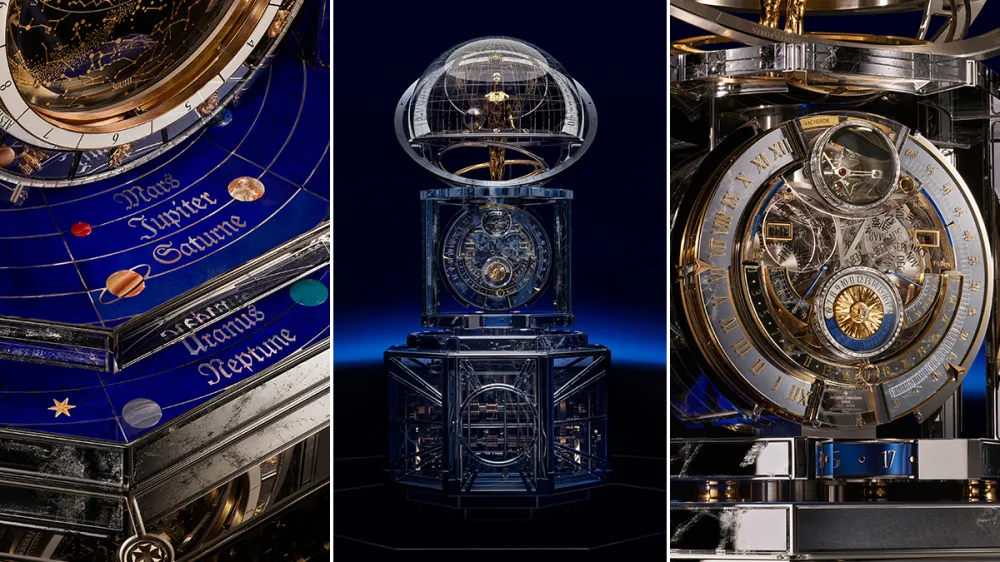
To commemorate the achievement, the lauded maker has devised an impressive and unique automaton clock—taller than most toddlers—that tells the time not only here on earth, but also across the solar system. In addition, it created a limited editionLimited EditionA product produced in deliberately restricted numbers, often numbered, signed, and distinguished by special materials or design. Limited editions create scarcity, urgency, and desirability, and they are common across watches,Go to Limited Edition Glossary of 20 watches that distill the clock’s grand gestures into a wearable format. Both pieces are chock-full of references to nearly three centuries of history.
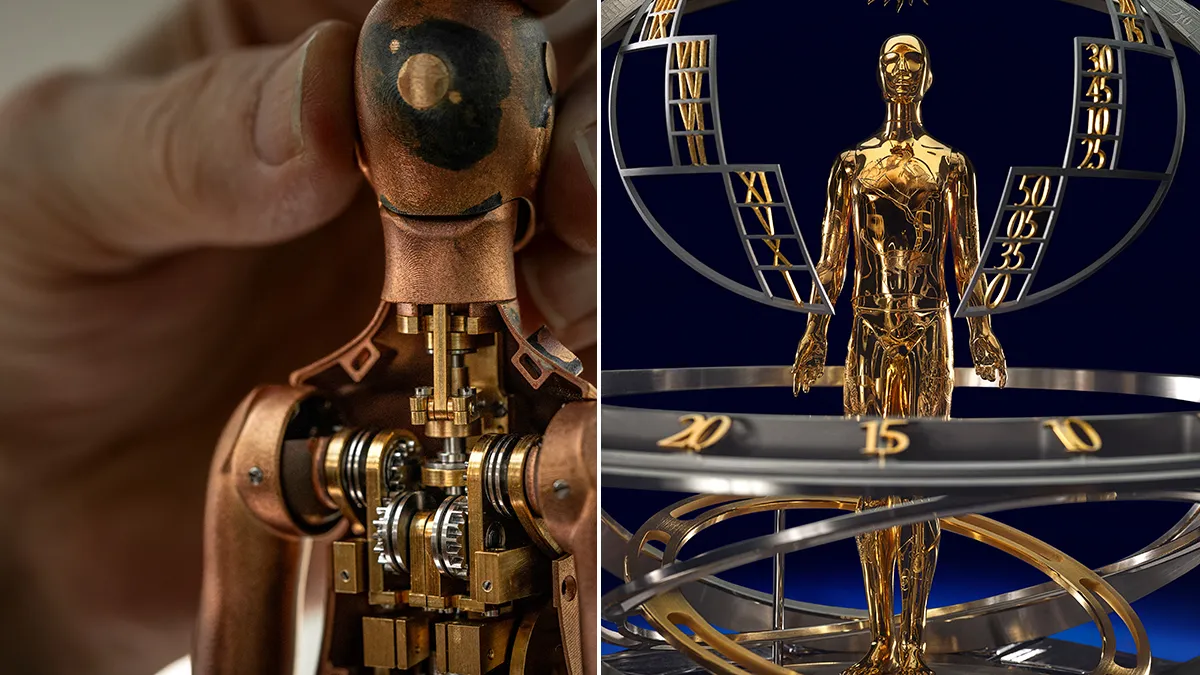
At the center of the clock, which took seven years to bring to life and is called La Quête du Temps or The Quest for Time, there’s an automaton nicknamed “the Astronomer,” which was conceived as a standing complicationComplicationAny function on a mechanical watch beyond telling the hours, minutes, and seconds, such as a calendar, chronograph, moon phase, or tourbillon. Complications demonstrate a watchmaker's technical skill, and moreGo to Complication Glossary and designed by François Junod, a leading maker of automatons. The figure actually tells time with its arms, pointing to retrograde scales suspended inside its glass dome, which is also decorated with constellations. On command—or on a schedule programmed 24 hours in advance—it will look to the stars, trace the path of the moon, and indicate the passing hours, all while a mechanical music box plays melodies composed by Woodkid—a musician who has collaborated with the house for several years.
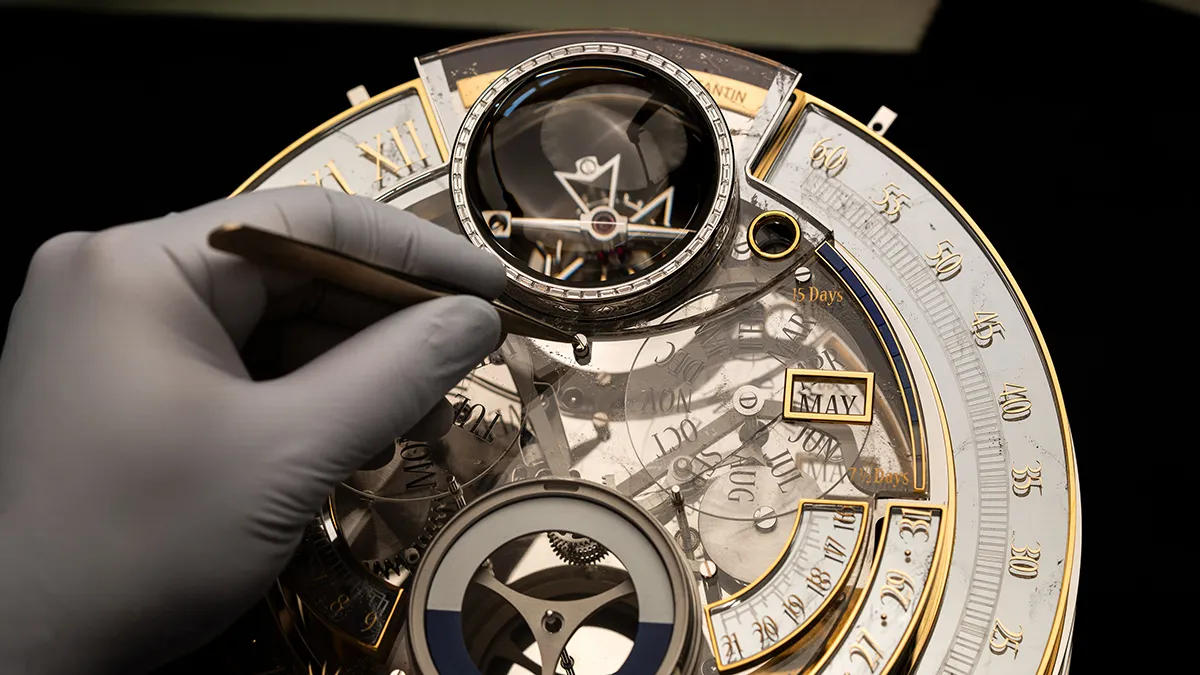
To power the clock, several of the maison’s teams worked together to create a new movement, Calibre 9270, which contains 2,370 components and 23 complications, from sunrise and sunset times to a 3-D moon phaseMoon PhaseA watch complication that displays the current phase of the moon through a small aperture on the dial, usually accurate to within a day for years. Romantic, the moon phaseGo to Moon Phase Glossary indicator so accurate that it won’t require a reset for another 110 years. All of this merited applications for 15 patents.

And then there’s the look of the thing. To represent all 12 zodiac signs, the stars in the night sky, and the movement of the heavens, Vacheron Constantin’s artisans deployed an impressive array of skills, including bronze casting, grand feu enameling, gem setting (the tourbillonTourbillonA watch complication invented around 1801 by Abraham-Louis Breguet that rotates the escapement in a cage to counter the effects of gravity on accuracy. Tourbillons are mesmerizing and very difficultGo to Tourbillon Glossary bezel is set with baguette diamonds, for instance), and marquetry achieved not with wood, but with mother-of-pearl.
The clock is unquestionably a museum piece, and, fittingly, it’s heading straight for one of the world’s finest such institutions. La Quête du Temps will take center stage at the Louvre’s “Mécaniques d’Art” exhibition, which will be on display from September 17 to November 12, 2025.
Vacheron Constantin hasn’t said whether it will offer this piece for sale, but it is offering something a little more practical for its most dedicated collectors: The Métiers d’Art Tribute to the Quest of Time watch. Limited to 20 pieces, it runs on a brand-new, manually wound movement—Calibre 3670—that took three years to develop.
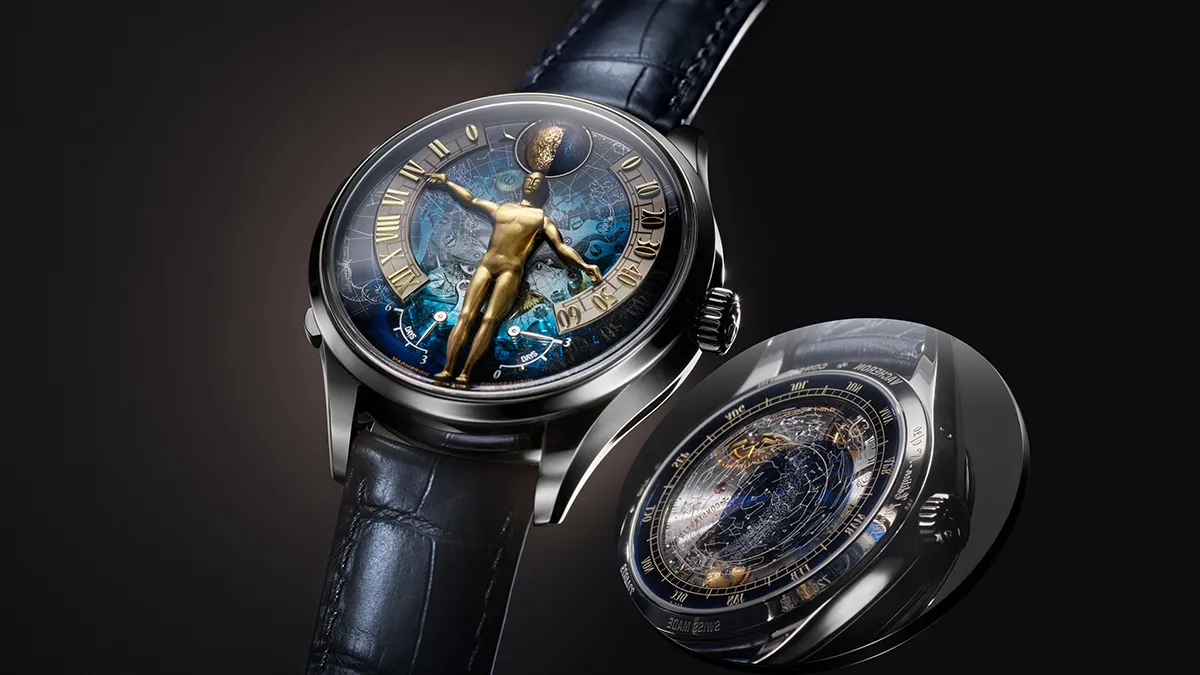
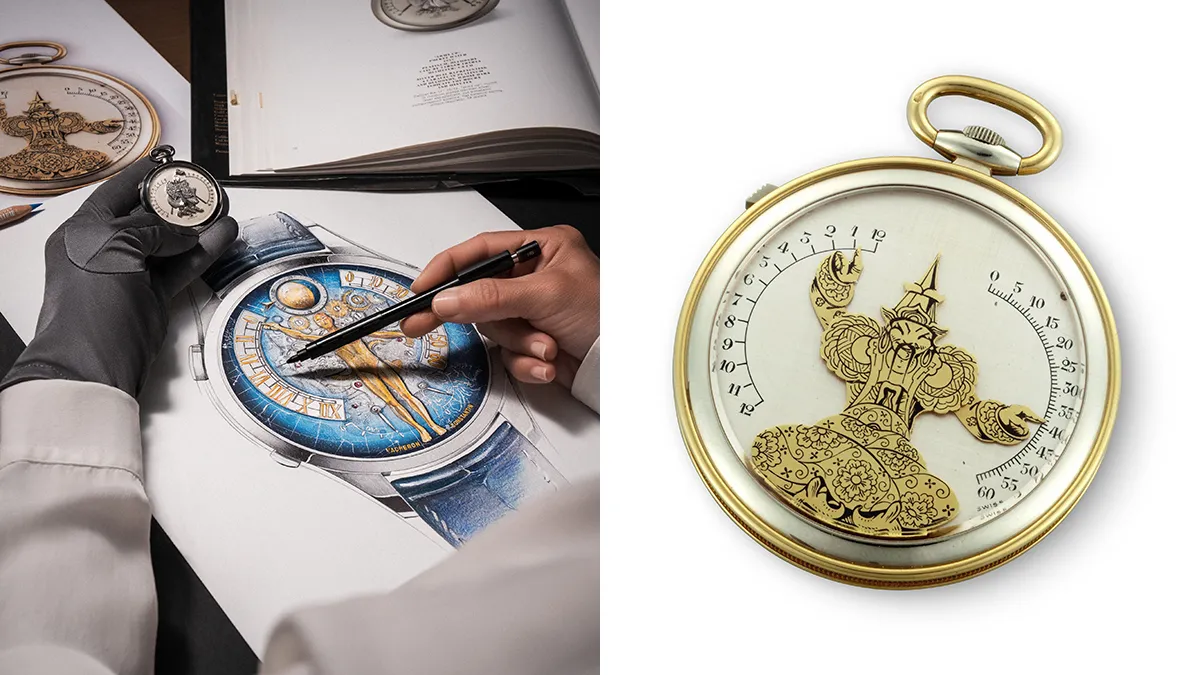
Here, too, a human figure tells the time. Borrowing from a 1930s “Bras en l’Air” pocket watch from the brand’s archives, the golden figure on the dial raises its arms to indicate hours and minutes on twin retrograde arcs. But while the clock will keep running, the watch offers wearers a choice: keep the display going continuously, or let it rest in a neutral pose until you activate a pusher that summons the time on demand.
Behind the figure stretches another sky chart, which recreates the night above Geneva on September 17, 1755—the date Vacheron Constantin was founded. A precision three-dimensional moon phase indicator and twin retrograde power reserve displays round out the dial side, while the reverse reveals a sidereal time display that charts the stars in real time. All of it is packed into a 43 mm white gold case.
The movement itself is a feat of miniaturization: 512 parts humming along at a high frequency of 5 Hz, which achieves a six-day power reserve. It’s an echo of the maison’s 2019 Twin Beat Perpetual CalendarPerpetual CalendarA watch complication that automatically tracks the date, day, month, and leap years, requiring no manual adjustment until the year 2100 in most cases. The perpetual calendar demonstrates remarkable mechanicalGo to Perpetual Calendar Glossary, another watch that offered dual modes of operation.
But in both the case of the watch and the clock that inspired it, the designs aren’t simply about keeping time, but about representing it with real daring and artistry.
“Is it always possible to do better? Is it always possible to be amazed? Undeniably,” says Laurent Perves, CEO of Vacheron Constantin, in a statement shared with Robb Report. “At Vacheron Constantin, the pride and emotion we feel with each new project comes from the freedom and passion to create, which is fuelled by the quest for excellence and innovation.”
It all makes you wonder where this company might be in another 270 years.
This article originally appeared in Robb Report US.