Rolex’s New Perpetual Padellone Revives a Cult-Favorite Vintage Watch


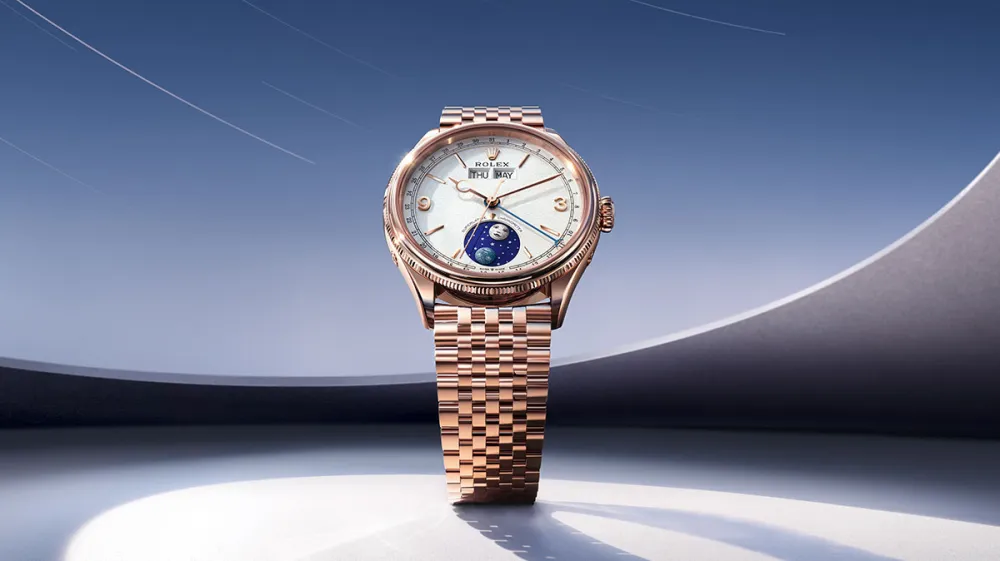
Unlike the rest of the watch industry over the past decade, Rolex has released very few, if any, vintage-inspired watches. In fact it releases very few new collections or models at all. But when it does, it’s a blockbuster. The name of the new Perpetual Padellone, launched today, is taken from the nickname of the watch that inspired it, the reference 8171, a triple calendar (day, date, month) with a moon phaseMoon PhaseA watch complication that displays the current phase of the moon through a small aperture on the dial, usually accurate to within a day for years. Romantic, the moon phaseGo to Moon Phase Glossary display. The 8171 was a rare complication made by Rolex only for a few years in the late 1940s and early 1950s in very small numbers. Recently, it has become an auction darling, selling in the mid-six figures to upwards of $1-million, depending on case material and condition. The name “Padellone” was not the official name of the watch, but a nickname bestowed by collectors. Padellone means “large frying pan,” in Italian, cited because of the 8171’s wide (for the time) 38 mm case and flat proportions, with a slightly domed dial. It’s no mistake that the new watch was launched in Milan, where the original was nicknamed by astute collectors.
The new release comes three years after the launch of the Perpetual 1908 collection in 2023, which replaced the discontinued Cellini collection and introduced the Perpetual line. It’s called a Perpetual, because it’s part of the Perpetual collection, but it is not a perpetual calendarPerpetual CalendarA watch complication that automatically tracks the date, day, month, and leap years, requiring no manual adjustment until the year 2100 in most cases. The perpetual calendar demonstrates remarkable mechanicalGo to Perpetual Calendar Glossary; it’s an annual calendar. The movement, the new annual calendar caliber 7190, is an evolution of the caliber 7135 introduced in 2025 in the Land-Dweller, and is covered by 30 patent applications, two of them exclusive to this caliber. While the watch of the 1950s was a complete calendar that required manual correction at the end of shorter months, the new one is an annual calendar, automatically accounting for 30- and 31-day months and requiring adjustment just once a year, at the end of February.
This is thanks to Rolex’s new Haplos system, for which a patent application has been filed, and which uses just two additional components to distinguish between 30- and 31-day months. It’s a high frequency movement, oscillating at 5Hz (36,000 vph), which improves chronometry and carries Rolex’s Superlative Chronometer certification. The power reserve is approximately 66 hours.

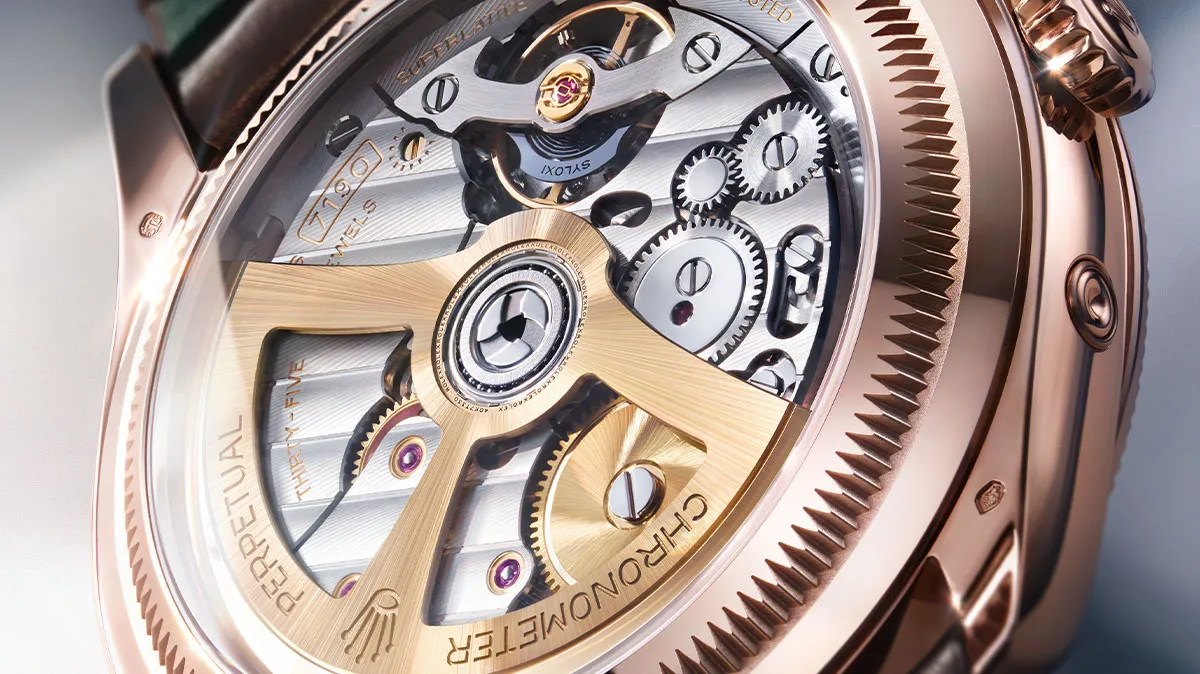
The case is 39 mm (and 12.2 mm thick), only slightly larger than the original 8171, with a fluted bezel instead of a polished one, but with the same number of correctors on the case band: four, to set the day, date, month, and moon phaseMoon PhaseA watch complication that displays the current phase of the moon through a small aperture on the dial, usually accurate to within a day for years. Romantic, the moon phaseGo to Moon Phase Glossary. A transparent caseback offers a view of caliber 7190, including its Côtes de Genève-finished bridges and cut-out yellow-gold oscillating weight. The case is water resistant to 50 meters (165 feet).
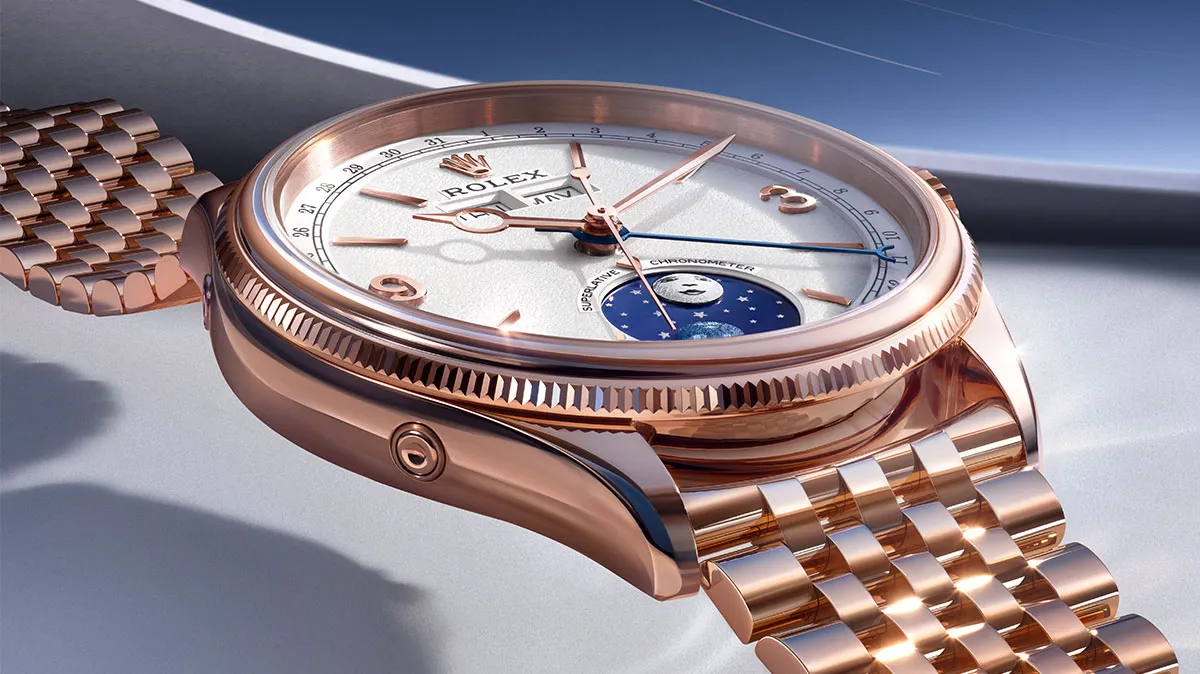
The hands are a departure from the original Dauphine hands, with an hour hand rendered in the Breguet style—a slim, elegant stem and hollow circular ring near the tip—just like that on the 1908. The numerals also conform to the 1908 style, with 3 and 9 o’clock Arabic numerals instead of stick indexes like those on the 8171.
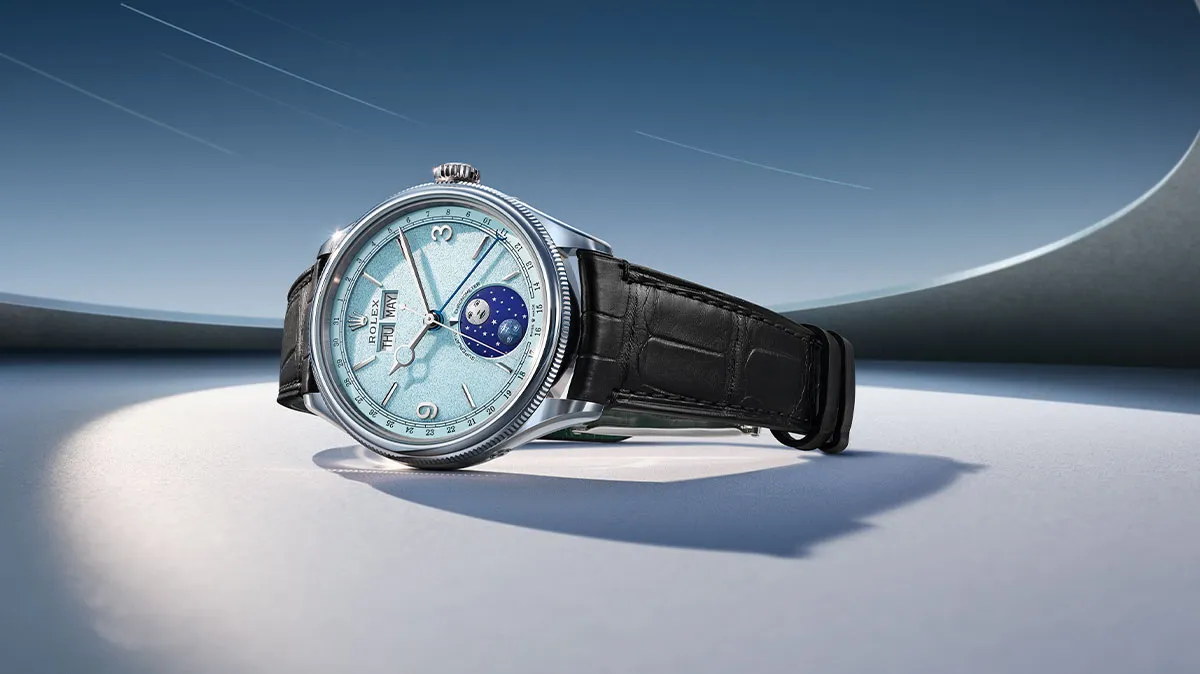
Day of the week and month are displayed in two apertures below 12 o’clock, while the date is indicated with a crescent-tipped blue hand that frames the number on an outer index. The moon phase, at 6 o’clock, appears in a fully visible enamel disk rather than the half-aperture of the 8171, with both the full and new moons rendered in meteorite—the latter with a dark PVD coating. Over the course of a lunar cycle, each representation aligns in turn with a triangular indicator above the disk. The moon phase displayed is not created by partially obscuring an image of the Moon, but by the continuous movement of the two, illustrating the time elapsed between one new moon and the next full moon. There are three references: two Everose models with grain-finished white dials, one with strap and the other with the brand’s seven-link Settimo bracelet, unveiled on the 1908; and a platinum model with the ice blue dial Rolex reserves for watches made with that metal, on an alligator strap.
The watch is not a limited editionLimited EditionA product produced in deliberately restricted numbers, often numbered, signed, and distinguished by special materials or design. Limited editions create scarcity, urgency, and desirability, and they are common across watches,Go to Limited Edition Glossary, but like the 1908 collection in general, it will be rolled out slowly, in limited quantities. Now is the time for collectors to lean in to their relationship with authorized dealers. Prices are $59,000 for the Everose version with leather strap; $72,000 with Settimo bracelet; and $66,200 for the platinum version with leather strap.
This article originally appeared in Robb Report US.
FAQs
The Rolex Perpetual Padellone is a 39 mm annual-calendar watch inspired by the rare ref. 8171 triple-calendar moon-phase model produced in the late 1940s and early 1950s.
“Padellone” means “large frying pan” in Italian. Collectors gave the original ref. 8171 the nickname because its 38 mm case was unusually wide and flat for its era.
No. Despite its name, the Perpetual Padellone uses an annual calendar that automatically distinguishes between 30- and 31-day months and requires correction once a year at the end of February.
The watch uses Rolex’s new caliber 7190, a 5 Hz automatic annual-calendar movement with approximately 66 hours of power reserve and Superlative Chronometer certification.
Prices start at $59,000 for the Everose gold model on leather, rise to $72,000 for Everose gold on the Settimo bracelet, and reach $66,200 for the platinum version on an alligator strap.