Louis Vuitton’s Escale au Mont Fuji Turns a Pocket Watch Into a Moving Landscape




For most of modern history, the pocket watch was the original personal timekeeper. Gentlemen carried them in waistcoats, retrieving them with a practiced gesture, but soon enough, the wristwatch eventually displaced it—first through convenience, later through habit.
Watch the video:
In haute horlogerieHaute HorlogerieA French term meaning high watchmaking, referring to the finest mechanical timepieces, characterized by complex movements, painstaking hand finishing, and limited production. Haute horlogerie represents the highest level of theGo to Haute Horlogerie Glossary, however, the pocket watch survives, though more as an heirloom or antique curiosity. A small circle of watchmakers has continued to explore the format, maybe due to a little bit of nostalgia, but also because it offers something modern wristwatches rarely can: space. With a larger case diameter and fewer ergonomic constraints, it allows the integration of complications and artistic flourishes that would be impractical—or simply invisible—on the wrist. (Historically, this is why many of the most complicated watches ever made were pocket watches.)

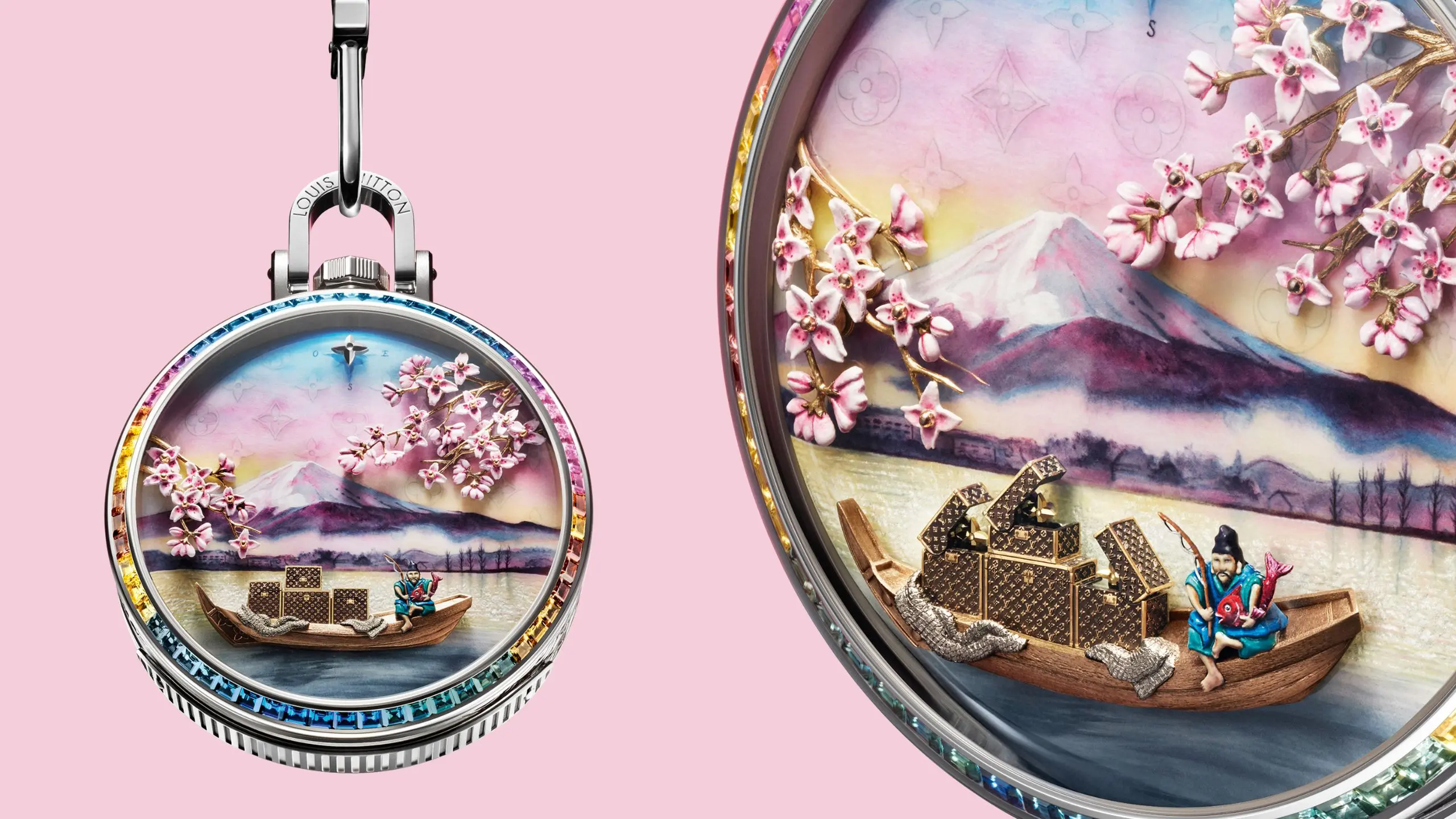
Louis Vuitton’s Escale au Mont Fuji belongs squarely in that tradition. The piece transforms the format into something closer to a moving tableau: its dial is almost entirely a miniature landscape rendered through engraving, enamel, and automaton mechanics, continuing a series (previous editions featured Paris and the Amazon) that treats destinations as narrative settings. And then, housed in a white-gold case with a bezel set with 60 baguette-cut sapphires, is a movement that combines a minute repeater with a tourbillonTourbillonA watch complication invented around 1801 by Abraham-Louis Breguet that rotates the escapement in a cage to counter the effects of gravity on accuracy. Tourbillons are mesmerizing and very difficultGo to Tourbillon Glossary. All in all, it required more than 1,000 hours of work across watchmaking, engraving, and enamel.
On a spring dawn depicted in Escale au Mont Fuji, a river runs through a landscape of pink and blue enamel skies. A wooden fishing boat travels slowly from right to left, carrying several Louis Vuitton trunks, and advances in small increments; the trunks aboard it open and close to reveal tiny Louis Vuitton Monogram flowers, while a gold compass rose turns above it the whole scene.
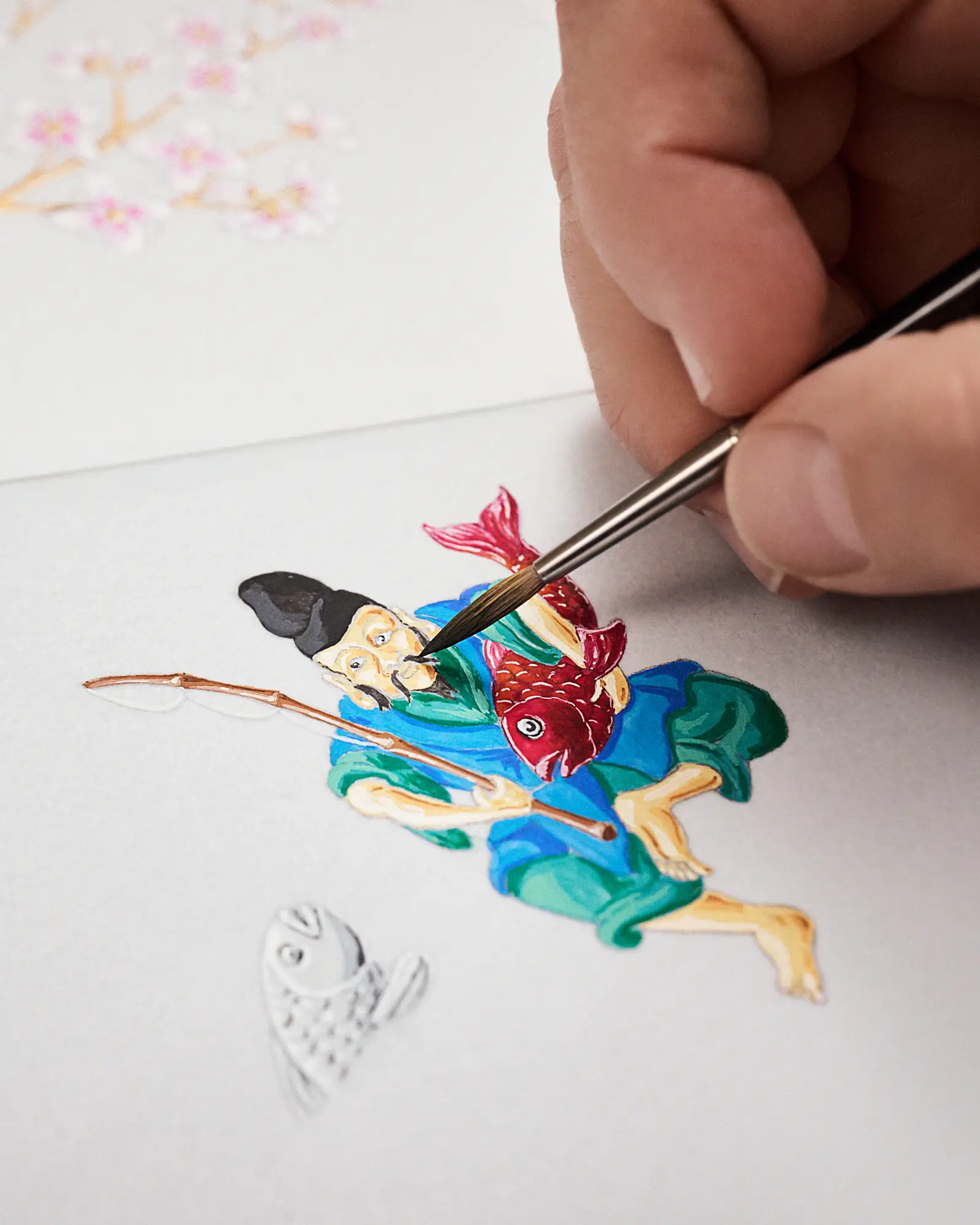
At the stern stands Ebisu, the fisherman deity from Japanese folklore associated with prosperity. The engraver responsible for the figure worked at a scale measured in millimetres, and under magnification, the details become visible: the folds of his robe, the curve of his moustache, the quiet expression across his face. Beneath his arm rests a tai sea bream, its eyes and scales cut into the metal with a fine burin. A fishing rod extends forward from his hand, and a net drapes over the edge of the boat.
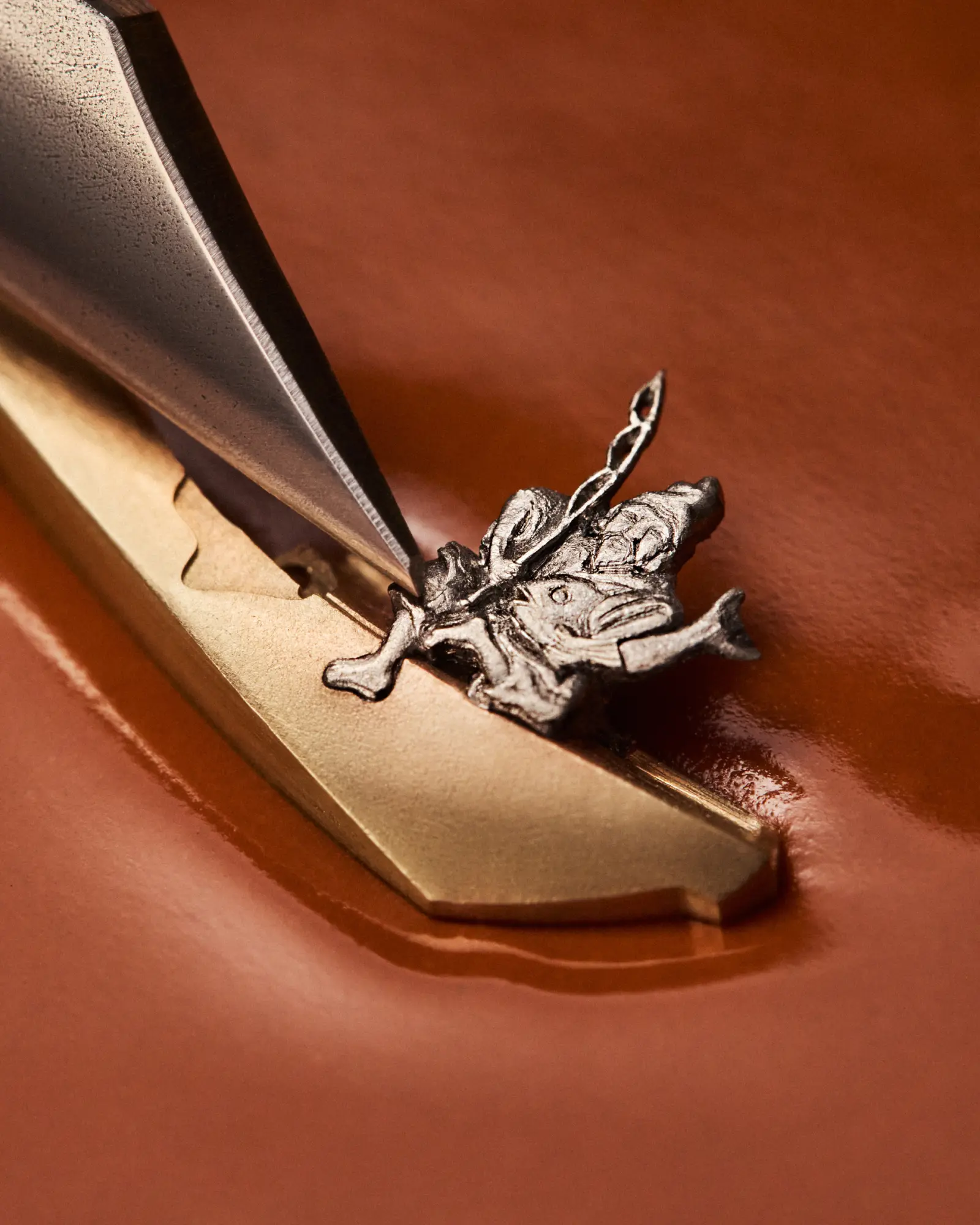
It’s no surprise that the watch required extensive work from the artisans responsible for engraving and enamel. The master engraver created several of his own tools from pieces of metal shaped by hand, adapting them to the unusually small scale of the components. The figure of Ebisu alone required numerous passes to define the contours of his clothing and the features of his face.
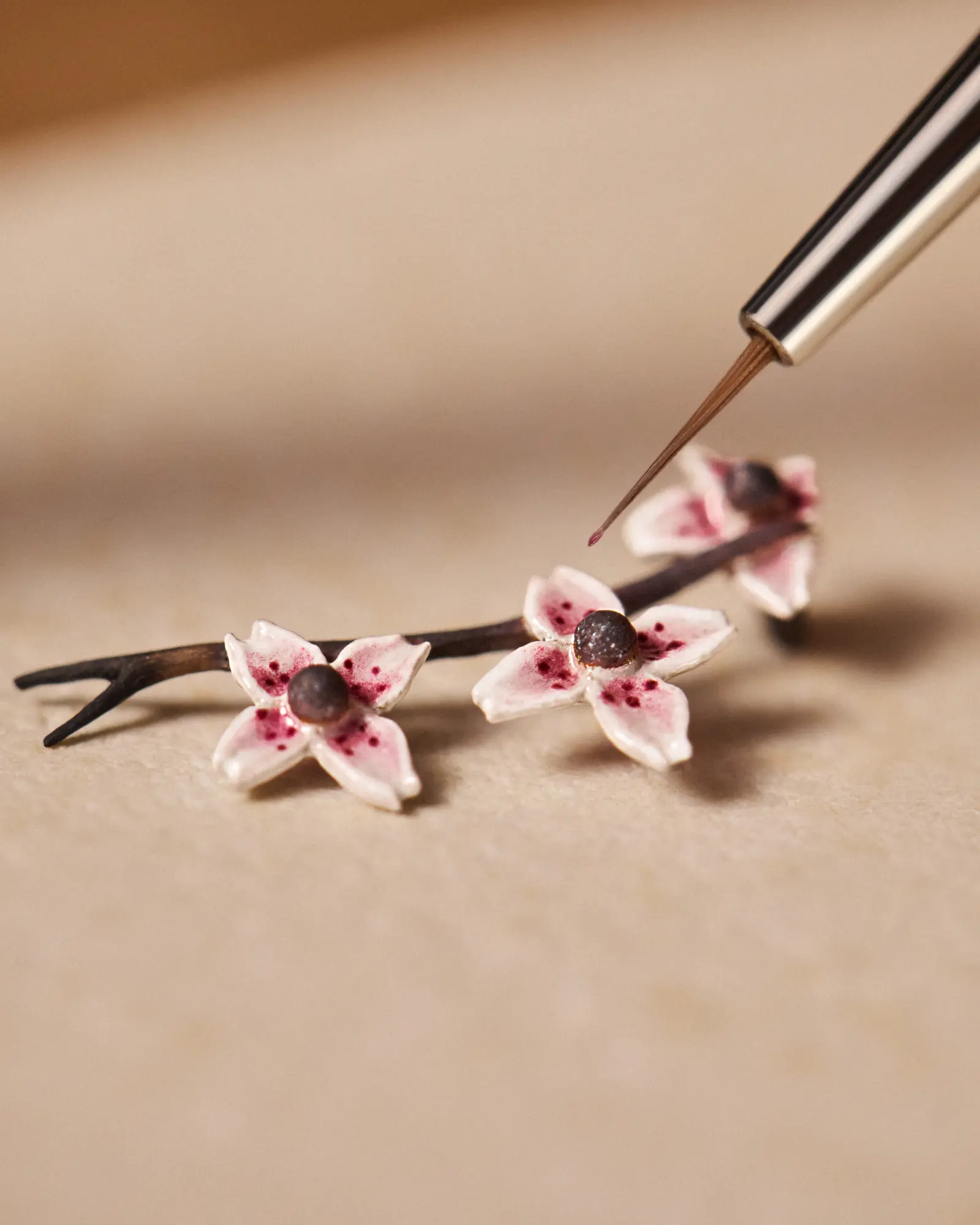
Nine cherry blossom appliqués were sculpted in yellow gold and finished with layers of pink enamel, with branches swaying through the automaton mechanism and their weight strictly within limits—they move as part of the automaton, so even a slight imbalance could affect the mechanism beneath them.
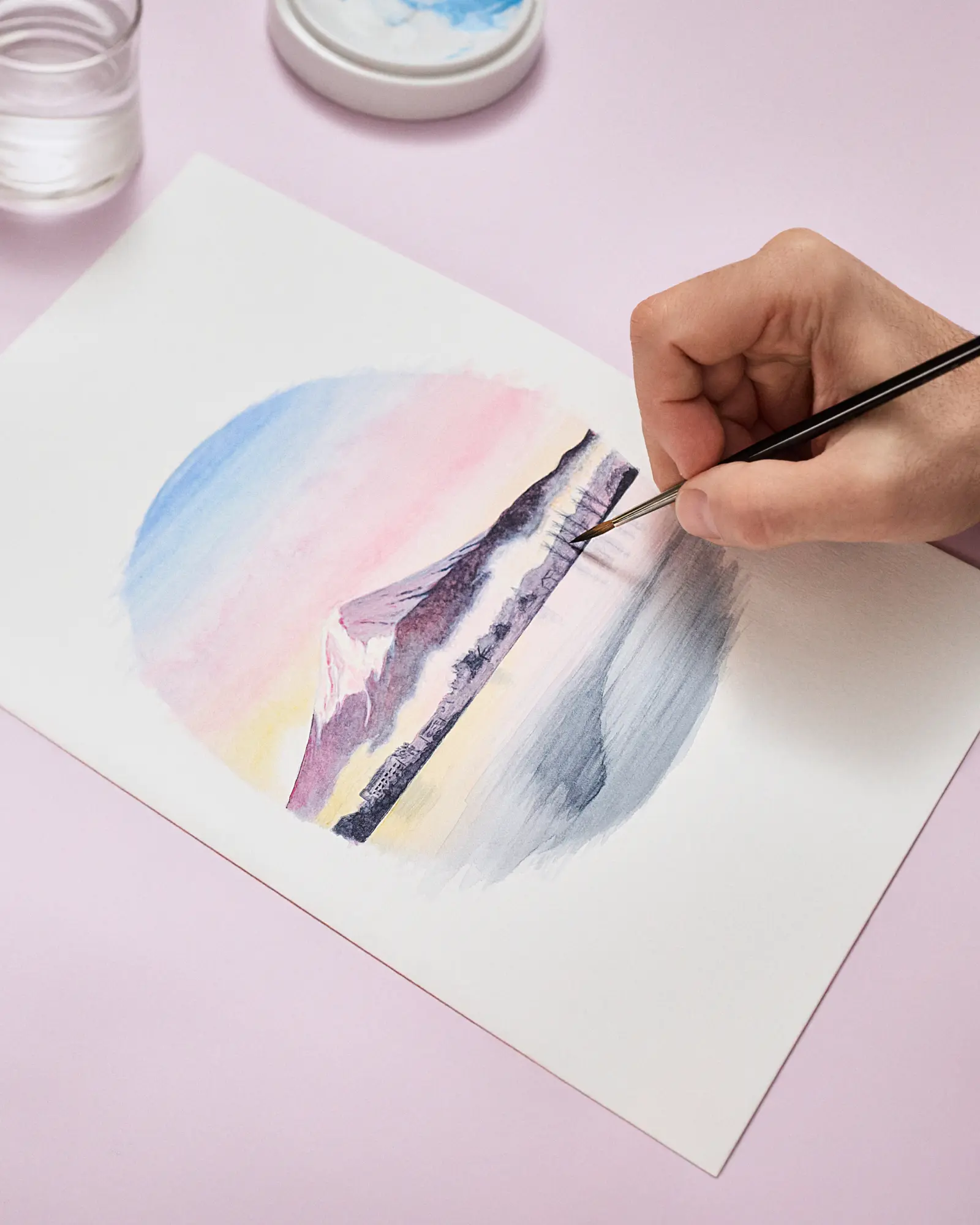
Enamel provides the colour and atmosphere of the dial. Artisans used several techniques, including grand feu, champlevé, paillonné, and miniature painting. The sky required thirty-three enamel colours layered across the surface in successive firings. Each layer passed through a kiln before the next could be applied, a process repeated around forty times.
Notably, the river uses paillonné enamel to create its reflective surface. Instead of placing strips of gold leaf beneath the enamel, the enameller used a single sheet of silver leaf, producing a continuous shimmer that suggests moving water. Mount Fuji rises above it in delicate gradients, its slopes fading into mist where the sky meets the mountain.
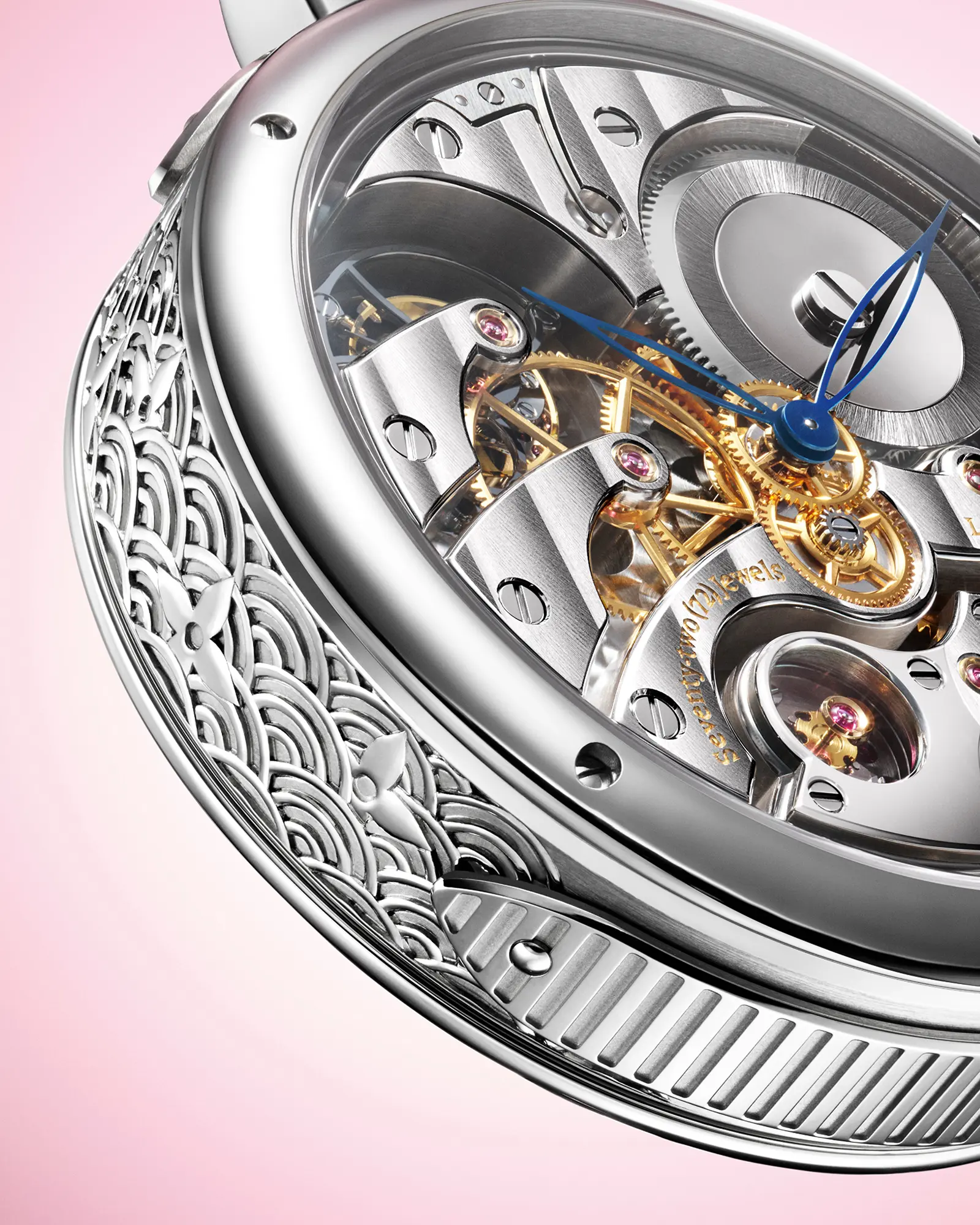
The Escale au Mont Fuji’s artistic aspects is complemented by an equally fastidious manual-winding LFT AU14.03 calibre, developed at La Fabrique du Temps Louis Vuitton in Geneva, and consists of 561 components which required about 500 hours to assemble and finish. Watchmakers beveled approximately 700 internal angles by hand, producing sharp edges capable of catching light across the bridges. Some of the work occurs in places most owners will never see: screws receive mirror polishing, and the ratchet wheel, carved into a concave shape, required weeks of shaping and finishing. Gold appears in unexpected places, including the prongs that hold the jewels and elements of the tourbillonTourbillonA watch complication invented around 1801 by Abraham-Louis Breguet that rotates the escapement in a cage to counter the effects of gravity on accuracy. Tourbillons are mesmerizing and very difficultGo to Tourbillon Glossary structure itself.
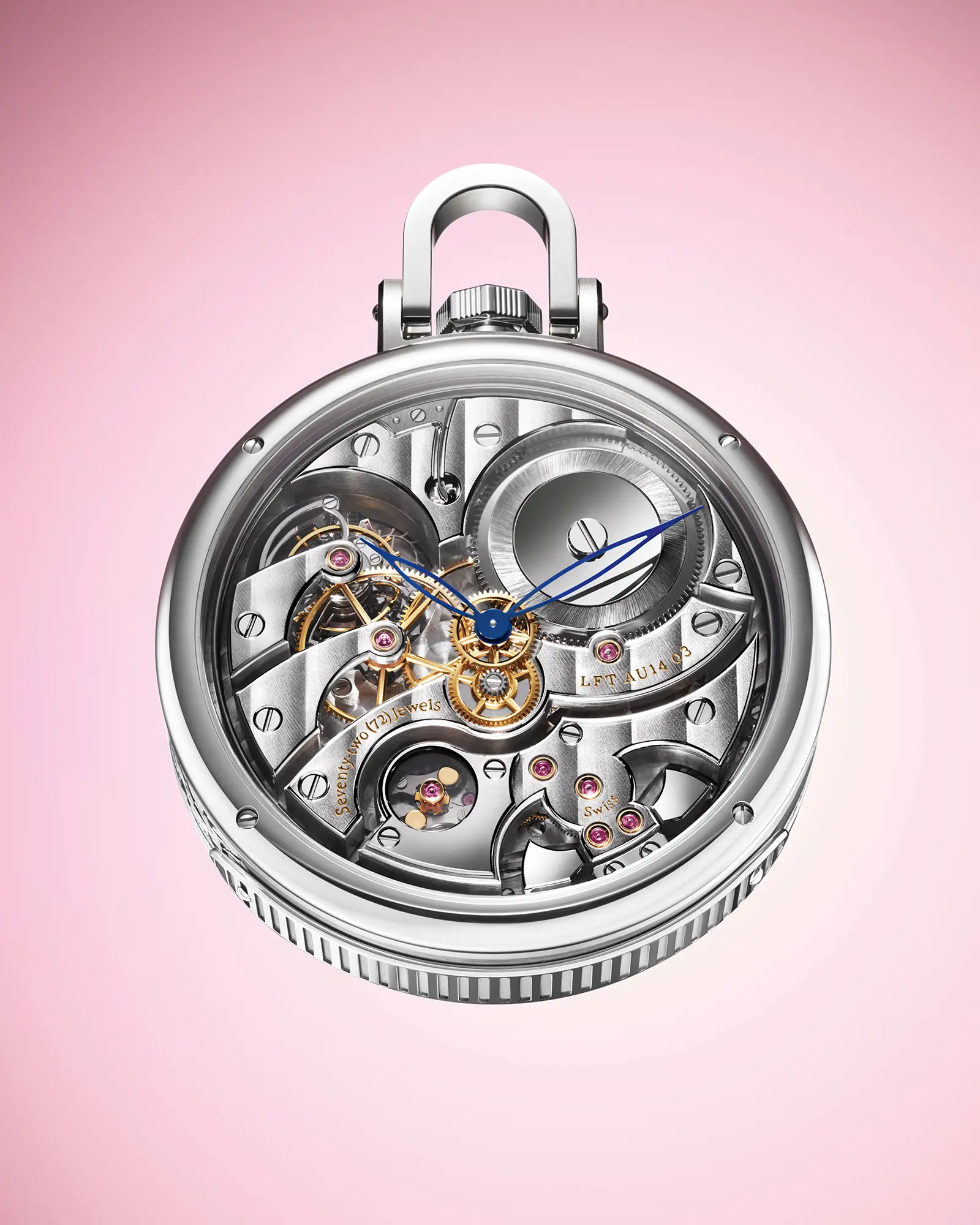
Where does one tell time, though? It’s on the reverse side of the watch rather than the dial, where a mechanical structure is displayed. The movement combines a minute repeater with the automaton module that animates the dial, while a tourbillonTourbillonA watch complication invented around 1801 by Abraham-Louis Breguet that rotates the escapement in a cage to counter the effects of gravity on accuracy. Tourbillons are mesmerizing and very difficultGo to Tourbillon Glossary rotates within the mechanism, a complication historically associated with pocket watches and once intended to counter the effects of gravity on a movement’s accuracy.
In high style, the watch arrives with leather pieces that reference Louis Vuitton’s origins in travel goods. One is a bespoke trunk built at the house’s historic workshop in Asnières, while the other is a doctor-style bag derived from a design first introduced in 1906 for early automobile travel. Both appear in pale blue leather that echoes the colours of the dial.
Few collectors will ever carry a pocket watch as their daily timekeeper, and fewer still need one capable of chiming the hours while animating a miniature landscape. Yet the appeal lies precisely there: freed from the constraints of practicality, the pocket watch becomes a format where watchmaking can stretch toward detail, imagination—and yes, a delicious excess—in ways the wrist rarely permits.