Audemars Piguet’s Game-Changing New Perpetual Calendar Can Be Set with a Single Crown





The perpetual calendar—or quantième perpétuel (“QP”) for the Francophones among us—has been kicking around the horological world for nearly three centuries. Thomas Mudge, an English watchmaker, was the first to build a pocket watch that displayed the day, date, month, phase of the moon, and accounted for Februaries of different lengths by tracking leap years. This sophisticated pocket watch, No. 525, was completed in 1762, over a decade before the American Revolutionary War.
Today, QPs are more common amongst high-end watchmakers, but still stunning in their mechanical complexity. Models from the so-called “Holy Trinity” of brands—Patek Philippe, Audemars Piguet, and Vacheron Constantin—are particularly sought after. A.P.’s history of QP manufacturing actually dates to the company’s founding, when Jules Louis Audemars completed a school pocket watch that combined a perpetual calendar with a quarter repeater as well as a deadbeat seconds mechanism. In 1955, the maison released the world’s first perpetual calendarPerpetual CalendarA watch complication that automatically tracks the date, day, month, and leap years, requiring no manual adjustment until the year 2100 in most cases. The perpetual calendar demonstrates remarkable mechanicalGo to Perpetual Calendar Glossary wristwatch with a leap year indicator; in 1978, it debuted the Calibre 2120/2800, the world’s thinnest automatic perpetual calendar wristwatch movement. More recently, the brand has released limited-edition Royal Oak Perpetual Calendar models in collaboration with musicians such as Travis Scott and John Mayer. Compelling for their incredible micro-engineering and aesthetics, QPs draw attention to the brand’s savoir faire and act as a calling card for its capabilities as a watchmaker.
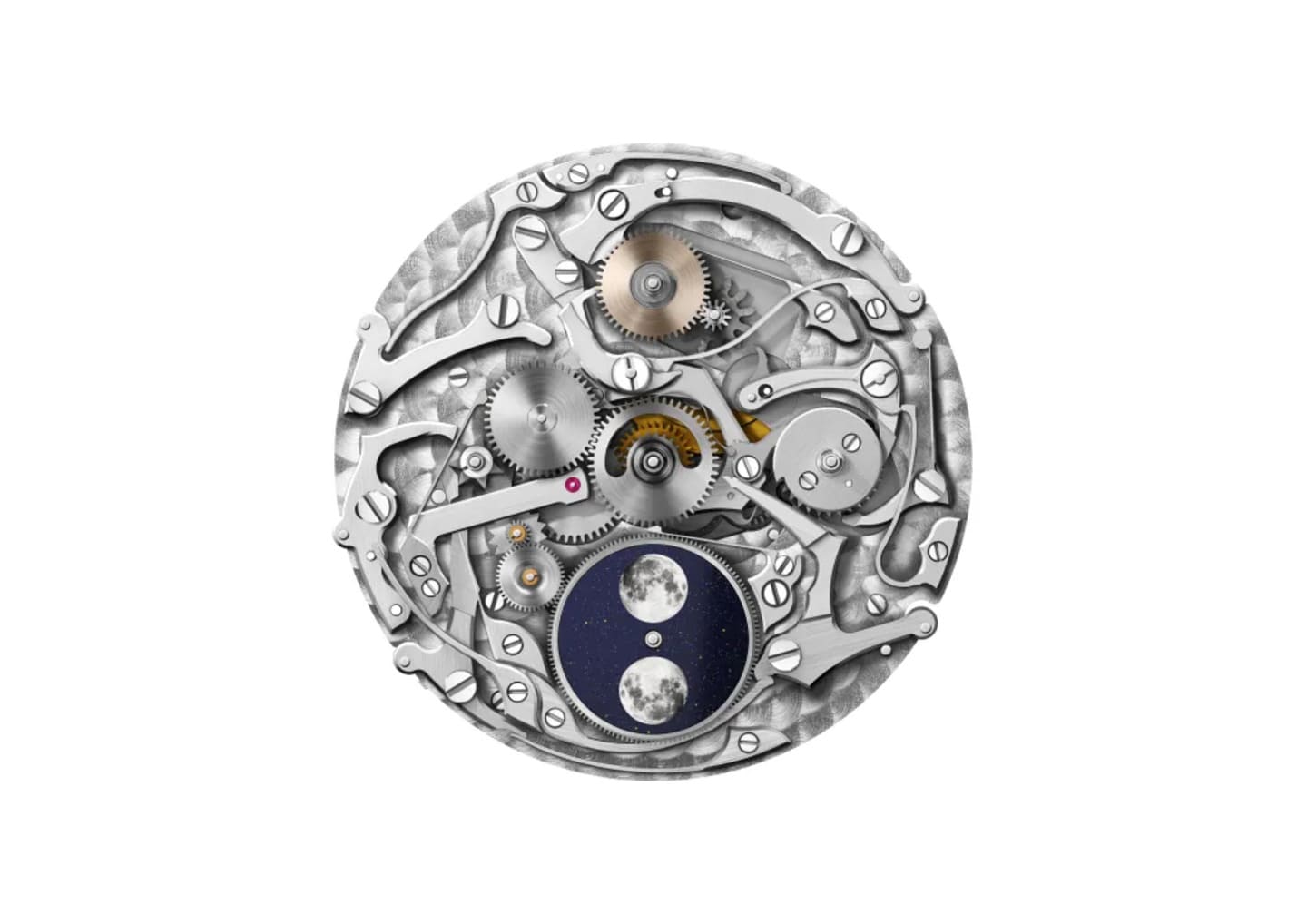
In celebration of Audemars Piguet’s 150th anniversary, the maison has released a fresh new QP movement that’s set to be a game-changer within the rarefied air of high-end complications: The automatic Calibre 7138 is the brand’s first such movement in which all functionality is controlled via the crown. Gone are the small case correctors used in conjunction with a small, easily-losable tool; gone is the compromised water resistance; gone is the painstakingly slow adjustment necessary after allowing the watch to sit for too long. Using the Calibre 7138’s intuitive system, it’s easy to set each function quickly and accurately. “The magic lies in the watch’s seamless blend of technical complexity and simplicity of use,” says Ilaria Resta, CEO at Audemars Piguet.
The system works like this: In the first position, the crown winds the watch manually. Pulling it out one stop further to the second position allows one to adjust the date clockwise and the month and leap year counterclockwise. In position three, the time can be set bidirectionally. But here’s the wild part: Pushing the crown back in one stop activates a set of wandering wheels that puts it into “position two prime,” a separate setting from position two. Here, the wearer can adjust the day and week number clockwise and the moon phases in the counterclockwise direction. Furthermore, setting the date between 9 p.m. and 3 a.m. cannot damage the movement as on other such calendar watches. It still has a red zone on the 9 o’clock day/24-hour indicator, which warns when the date may not engage properly if the user attempts to update it.

“No more setting tools, no more brain gymnastics—too complicated! Everybody can set it, and everybody can wear it and enjoy one of the most romantic and exciting complications ever,” says Resta. Indeed, this patented system is simple to use and smooth in its operation. Furthermore, it’s matched to a reworked dial layout that complements the useful movement technology with equally streamlined aesthetics: The updated European date display features the aforementioned day/24-hour indicator display at 9 o’clock; the date indicator at 12 o’clock; a month/leap year indicator at 3 o’clock; and the week numbers printed on the rehaut (as indicated by a central pointer hand).
“Monday,” “1,” and the first week of the year have all been aligned to the 12 o’clock index, making for a clean look, while the date indicator uses a set of customized gear teeth to ensure a display in which each number appears equally spaced. At 6 o’clock, a highly realistic moon phase based upon a NASA photograph has been reworked such that the moon is centered along the 12 o’clock axis. The net result of these subtle updates is a perpetual calendar display more intuitive, legible, and easy to use than ever before.

Of course, like most perpetual calendars, the Calibre 7138 computes for the differing lengths of February depending upon whether or not a leap year is in place—if kept fully wound, it won’t require manual adjustment from the wearer until the year 2100. Beating at 4 Hz, it features a power reserve of 55 hours, a 22-karat pink gold oscillating weight, and a thin profile of just 4.1 mm. High-end decorative techniques such as Côtes de Genève, satin-brushing, circular graining, satin, snailing, and chamfering are visible from the sapphire caseback of the three new references that incorporate it: The first is a fresh Code 11.59 in a 41 mm 18-karat white gold case (109,300 CHF) whose water resistance has been increased to 30m due to the absence of case correctors. Featuring a smoked blue PVD dial in a special guilloché pattern designed by Swiss artisan Yann von Kaenel, it’s paired to a blue rubber-coated strap with a calfskin lining.

Two Royal Oak references also use the new movement: The first, measuring 41 mm in stainless steel (109,300 CHF), features a matching integrated bracelet, a blue PVD Grande Tapisserie dial with color-matched subdials and rehaut, and white printing. The second reference is rendered in 18-karat sand gold, the maison’s unique alloy consisting of gold, palladium, and copper (130,000 CHF). Featuring a sand gold-tone Grand Tapisserie dial with matching subdials and black printing, it appears more white or pink depending on the light—a unique feature of the sand gold composition. Additionally, each of the three watches will be available in a special 150-piece limited edition in which the “Audemars Piguet” signature is executed in a vintage-inspired cursive script on the moon phase indicator, with an additional “150” logo and “1 of 150 pieces” engraving on the sapphire caseback frames.
A Special 150th Anniversary Openworked Perpetual CalendarPerpetual CalendarA watch complication that automatically tracks the date, day, month, and leap years, requiring no manual adjustment until the year 2100 in most cases. The perpetual calendar demonstrates remarkable mechanicalGo to Perpetual Calendar Glossary

Rounding out the QP offerings for early 2025 is the Royal Oak Perpetual CalendarPerpetual CalendarA watch complication that automatically tracks the date, day, month, and leap years, requiring no manual adjustment until the year 2100 in most cases. The perpetual calendar demonstrates remarkable mechanicalGo to Perpetual Calendar Glossary Openworked 150th Anniversary Edition (175,000 CHF), the last reference to use the brand’s Calibre 5135 that has featured in the catalog for almost a decade. A limited edition of just 150 pieces, its lightweight 41 mm case and matching bracelet are constructed from a mix of titanium and Bulk Metallic Glass (BMG), a high-tech, non-crystalline solid used in diverse applications including microelectronics and golf equipment. The dial, meanwhile, is inspired by a platinum pocket watch (ref. 25729) produced by the maison in the 1990s in honor of the Royal Oak’s 20th anniversary.
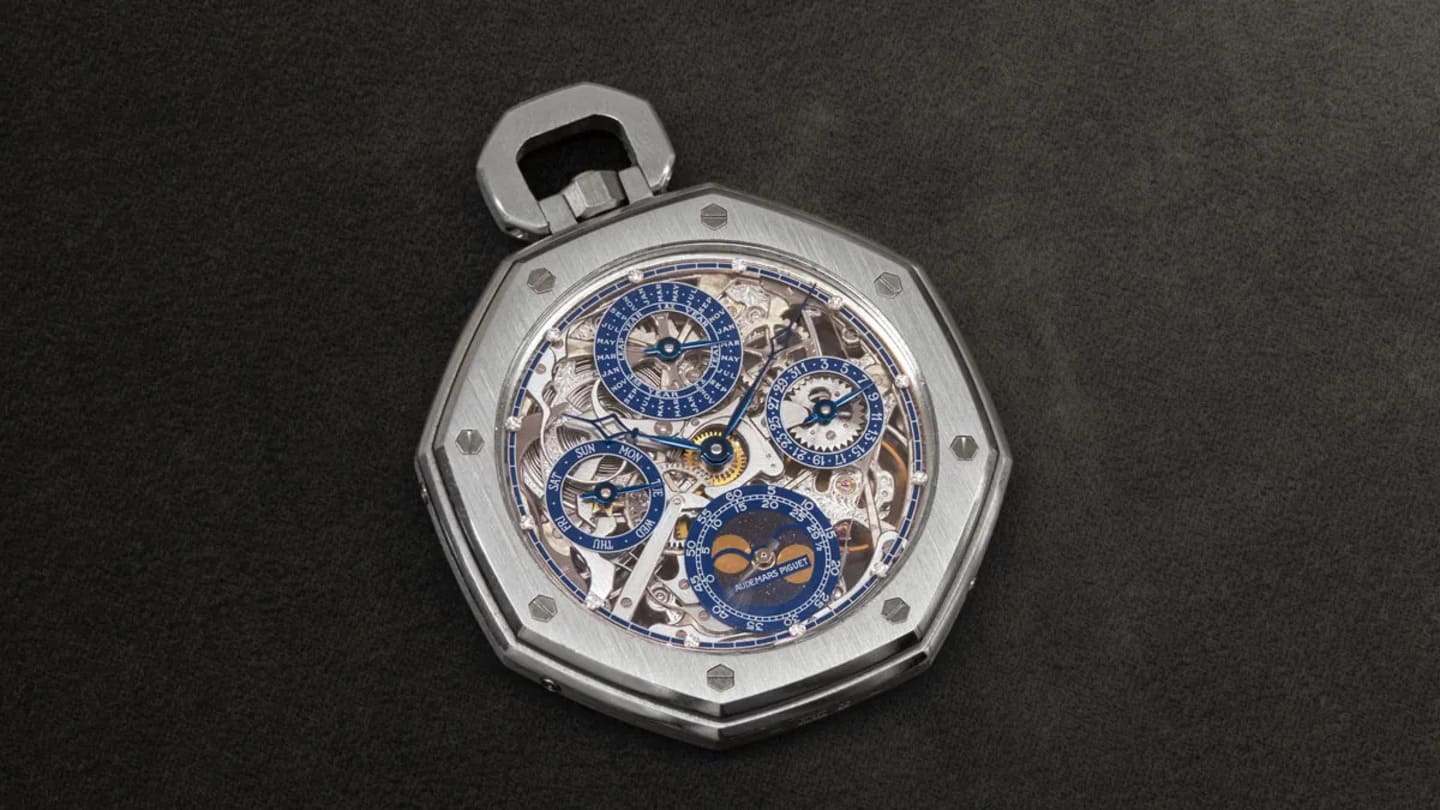
Measuring just 4.5 mm tall, the openworked perpetual calendarPerpetual CalendarA watch complication that automatically tracks the date, day, month, and leap years, requiring no manual adjustment until the year 2100 in most cases. The perpetual calendar demonstrates remarkable mechanicalGo to Perpetual Calendar Glossary Calibre 5135 features 374 components to power day, date, month, leap year, week number, and time-telling indications. Now retired by A.P, this movement builds on a longstanding legacy of both QP and openworked caliber development: In the 1970s, the brand released the Calibre 2120/2800, then the world’s thinnest automatic perpetual calendar wristwatch movement. The Calibre 5134, launched in 2015, updated this movement architecture and paired it with 41 mm Royal Oak cases. In 2019, the Calibre 5135—and openworked version of the 5134—hit the scene and went on to power several notable R.O. references, including the Cactus Jack collaboration.
The dial of the new Openworked, as mentioned above, is inspired by the neo-vintage pocket watch ref. 25729: Beneath a sapphire crystalSapphire CrystalAn extremely scratch-resistant, clear, transparent material used to cover luxury watch dials, produced synthetically from aluminum oxide. Sapphire crystal ranks near diamond in hardness, and it keeps a watch faceGo to Sapphire Crystal Glossary, the Calibre 5135’s componentry is surmounted by a rehaut and subdial surrounds in a deep blue color overprinted with white indices in a vintage-inspired typeface. Eighteen-karat white gold “bathtub” hands filled with SuperLumiNova and round silver-grey hour indices ensure excellent visibility, while the signature double-moonphase display executed via metallization on a sapphire disc is based upon a NASA photograph. Like the special editions of the three Calibre 7138-based QPs, the new Openworked features an “Audemars Piguet” signature executed in a vintage-inspired cursive script on the moon phase indicator, with an additional “150” logo and “1 of 150 pieces” engraving on the sapphire caseback frames.
When AP announced that the Royal Oak Perpetual CalendarPerpetual CalendarA watch complication that automatically tracks the date, day, month, and leap years, requiring no manual adjustment until the year 2100 in most cases. The perpetual calendar demonstrates remarkable mechanicalGo to Perpetual Calendar Glossary “John Mayer” would be the last to use the Calibre 5134 in 2024, the watch world held its breath for whatever was coming next. Now that the brand has delivered in the form of the Calibre 7138, we can only imagine a skeletonized version of this fresh movement will be coming down the pike within the next 12 months. In the meantime, the 150th Anniversary Openworked Perpetual Calendar is here to tide over 150 lucky buyers.
This article originally appeared in Robb Report US.