Audemars Piguet’s Most Complicated Pocket Watch Yet




While it’s hard to imagine the return of the top hat or the monocle, the pocket watch never quite went the way of the horological dodo—at least not completely.
“As collectible curios, displays of technical prowess, historical or personal mementos—or simply as art objects—quality pocket watches are once again gaining traction with younger generations of watch enthusiasts,” says James Lamdin, founder of Analog:Shift and vice president of pre-owned and vintage timepieces for the Watches of Switzerland Group USA.
Though these timekeepers ceded the spotlight to wristwatches during World War I, their larger cases and capacity to house multiple complications continue to make them an ideal canvas for maisons eager to demonstrate the full breadth of their watchmaking expertise.
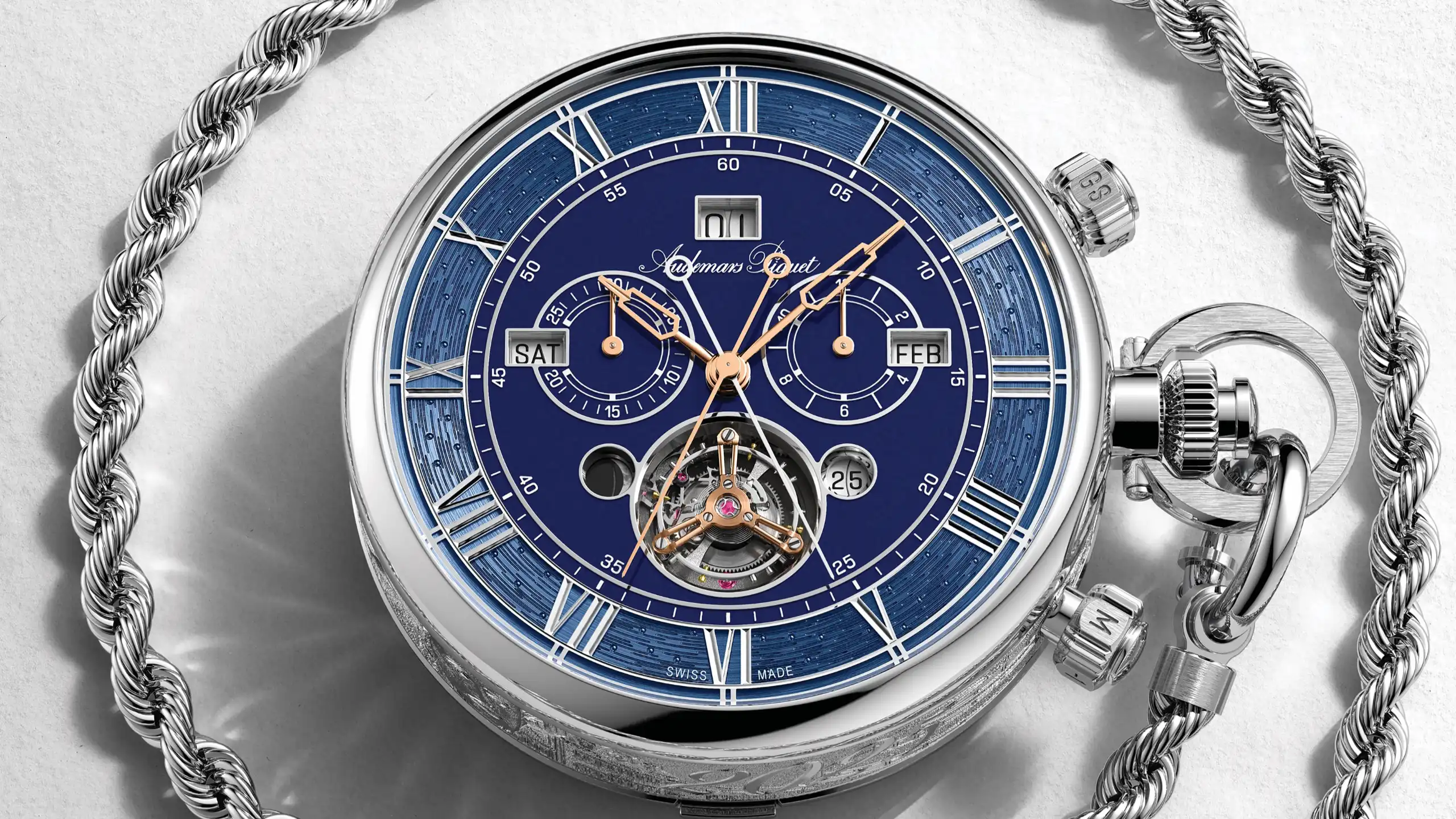
Enter the Audemars Piguet 50 mm Heritage Ultra-ComplicationComplicationAny function on a mechanical watch beyond telling the hours, minutes, and seconds, such as a calendar, chronograph, moon phase, or tourbillon. Complications demonstrate a watchmaker's technical skill, and moreGo to Complication Glossary Universal Calendar Ref. 75150PT.OO.01 pocket watch, created by the maison’s director of watch conception, Giulio Papi, to fit within the small secondary pocket commonly found on blue jeans.
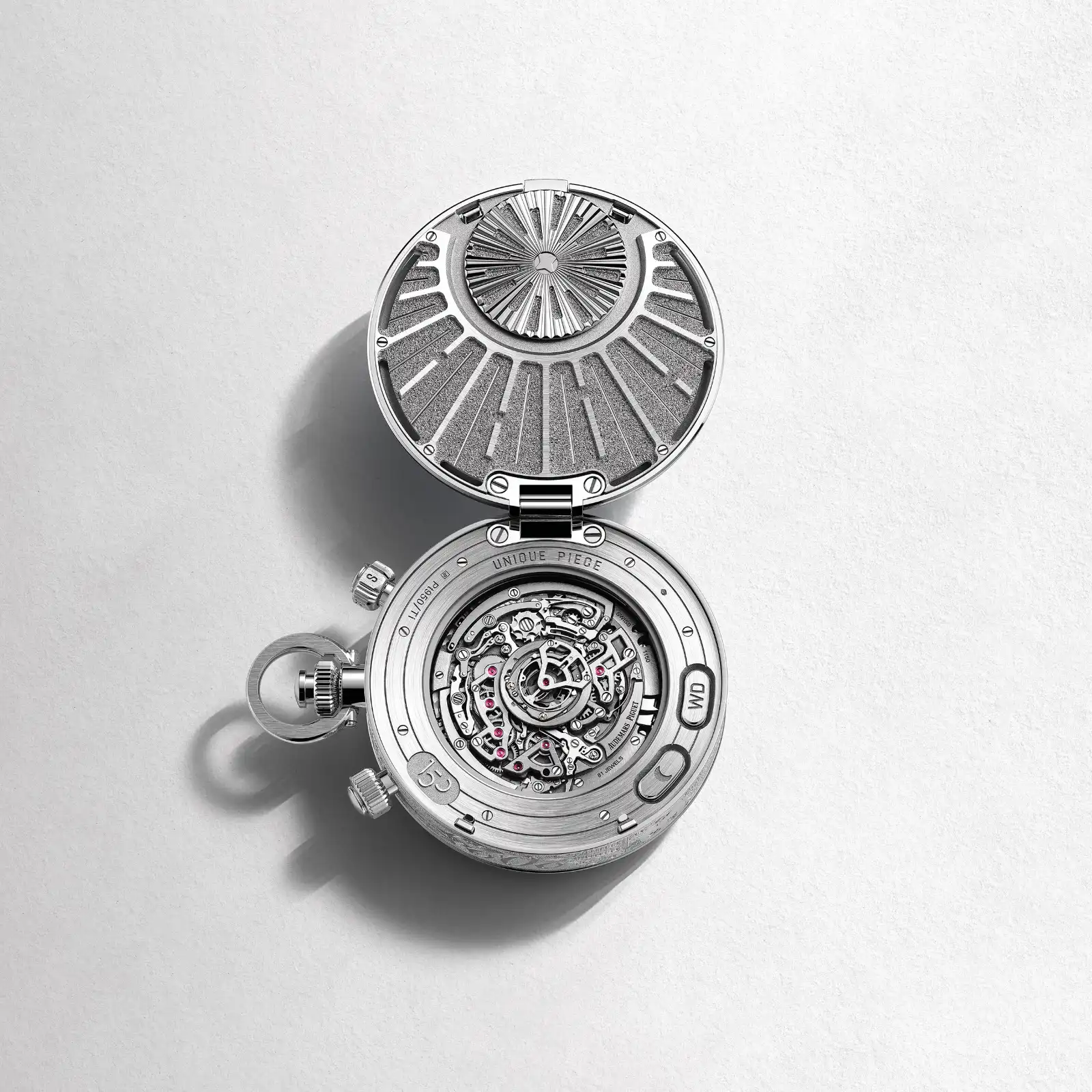
A timepiece housing 47 functions and 30 complications would normally be expected to challenge the confines of any pocket, yet its surprisingly compact proportions are the result of meticulous engineering. The new Calibre 1150 was developed using three-dimensional modeling, allowing nearly every function to be adjusted through three discreet pushers integrated into and flanking the crown. Calendar information is displayed through dedicated apertures, keeping the dial remarkably legible despite its extraordinary complexity.
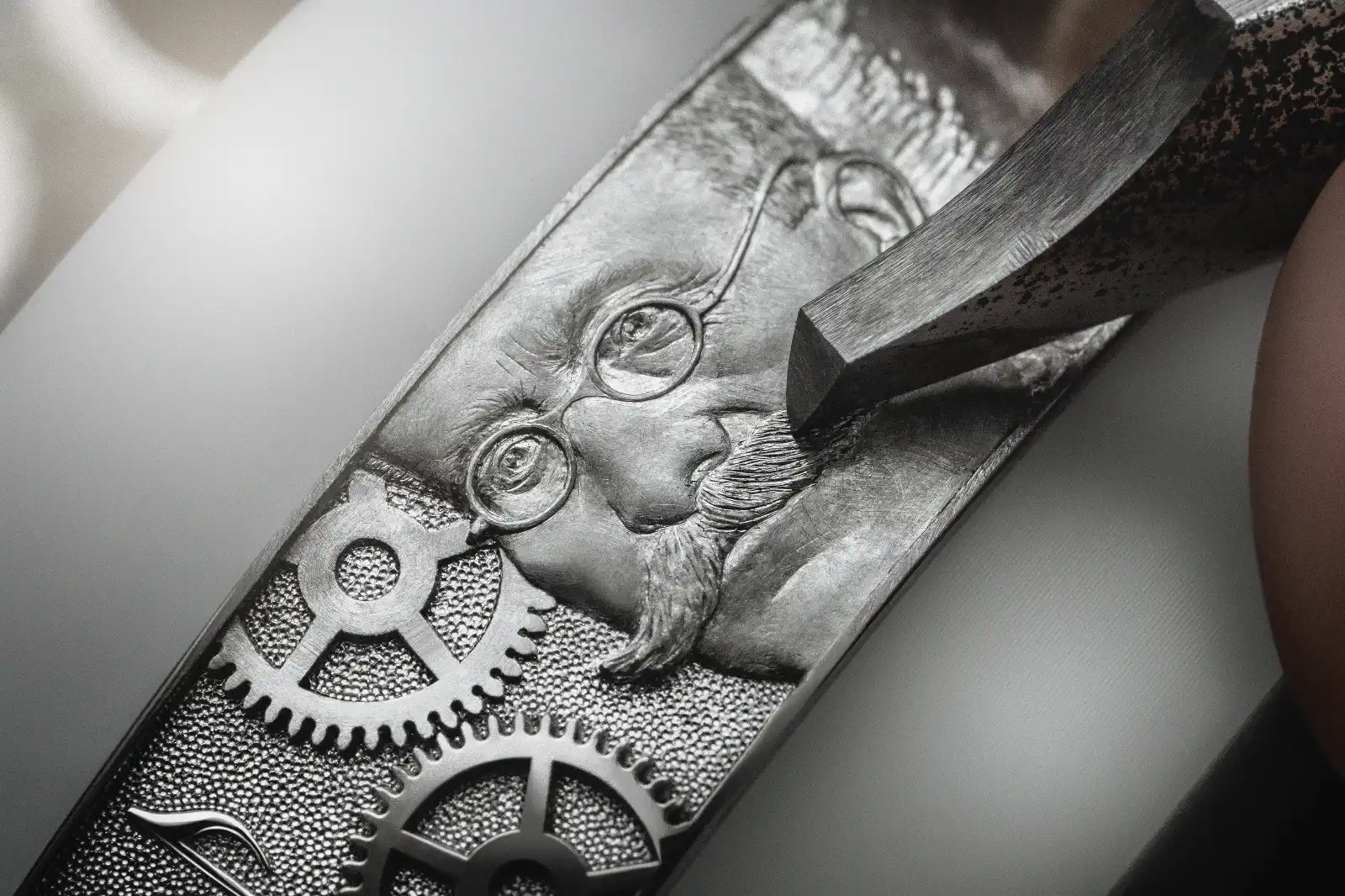
A fully hand-engraved case depicting portraits of the maison’s founders and a commemorative 150th anniversary motif frames an 18-karat white-gold dial coated in translucent blue grand feu enamel. Hand-engraved white-gold indexes and celestial star trails evoke the night sky, while pink-gold hands, a visible flying tourbillon, a split-seconds flyback chronograph, and a semi-Gregorian perpetual calendar occupy the front of the watch.
The reverse reveals an equally impressive spectacle. Opening the caseback exposes Audemars Piguet’s sapphire-crystal Supersonnerie soundboard, offering an unobstructed view of the movement while enhancing the acoustic performance of the minute repeater.
Hidden within the caseback is perhaps the watch’s most remarkable feature: the Universal Calendar.
Operating independently from the movement, this mechanical calculator uses the Gregorian calendar as its reference while coordinating solar, lunar, and lunisolar cycles. The system integrates eight major complications delivering 18 indications, including the year, leap year, month, date, week number, moon phaseMoon PhaseA watch complication that displays the current phase of the moon through a small aperture on the dial, usually accurate to within a day for years. Romantic, the moon phaseGo to Moon Phase Glossary, and seasonal markers such as the solstices and equinoxes.
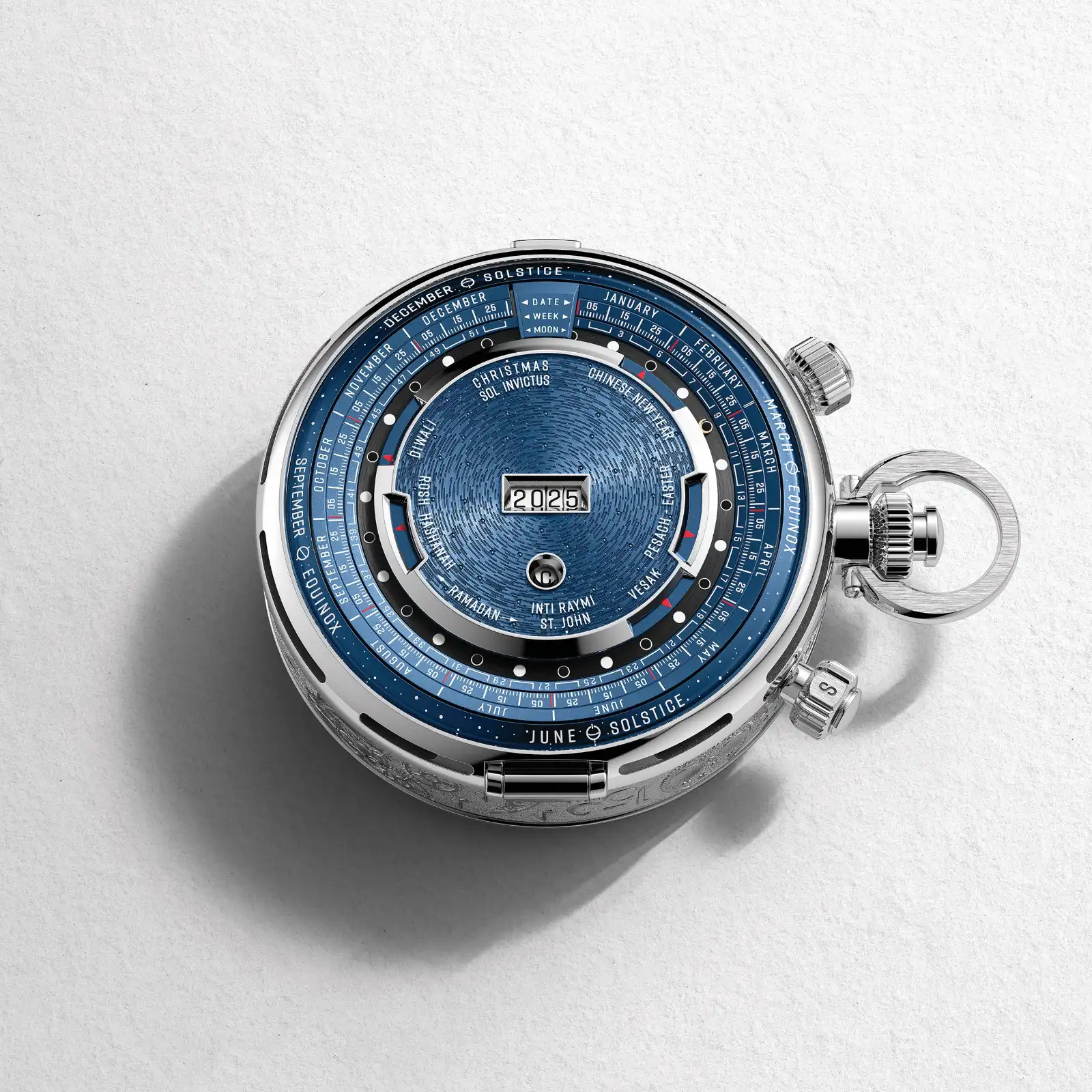
It also calculates the dates of nine cultural and religious celebrations: Christmas, Saint John’s Day, Ramadan, Diwali, Rosh Hashanah, Pesach, Vesak, Easter, and Chinese New Year. Every indication can be adjusted through a bidirectional wheel that instantly resets the entire mechanism while maintaining synchronization from 1900 through 2099.
The project began with a conversation in 2023 between Giulio Papi and Audemars Piguet CEO Ilaria Resta. Recognizing renewed collector interest in pocket watches, they envisioned a contemporary interpretation that would unite as many of the maison’s watchmaking disciplines as possible in celebration of its 150th anniversary.
Just 20 months after presenting his first sketch in January 2024, Papi completed a working prototype. By early 2026, two platinum examples had been produced—one destined for the Audemars Piguet museum and the other for an important private collector. Eight additional examples in 18-karat white gold, a material significantly easier to shape than platinum, will follow later this year.
The project also serves as a reminder that Audemars Piguet’s identity extends well beyond the Royal Oak.
“I think A.P. is much more multifaceted than it has been over the last few years,” says Resta. “There is an appetite for complexity, but wearable complexity—they don’t want a watch that goes in a drawer. They want to have a watch they can see, to live with every day, but that has mechanical interest for them. So that’s the avenue for us—a very livable, complicated watch with no constraint of shape.”
Perhaps that humble watch pocket still has a future. If nothing else, Audemars Piguet has demonstrated that one of fashion’s smallest details can discreetly house one of contemporary watchmaking’s greatest achievements.
This article originally appeared in Robb Report Philippines’ Design Issue, June 2026.
FAQs
It is a 50 mm pocket watch created for Audemars Piguet’s 150th anniversary, featuring 47 functions and 30 complications, including a newly developed Universal Calendar.
Unlike a conventional perpetual calendar, it simultaneously coordinates solar, lunar, and lunisolar calendars while calculating the dates of major cultural and religious celebrations.
Two platinum pieces have been made—one for the Audemars Piguet museum and one for a private collector—followed by eight examples in 18-karat white gold.
The project was conceived by Giulio Papi, Audemars Piguet’s director of watch conception, in collaboration with CEO Ilaria Resta.
The maison sees renewed interest among collectors while using the larger format to demonstrate the full extent of its watchmaking expertise in celebration of its 150th anniversary.