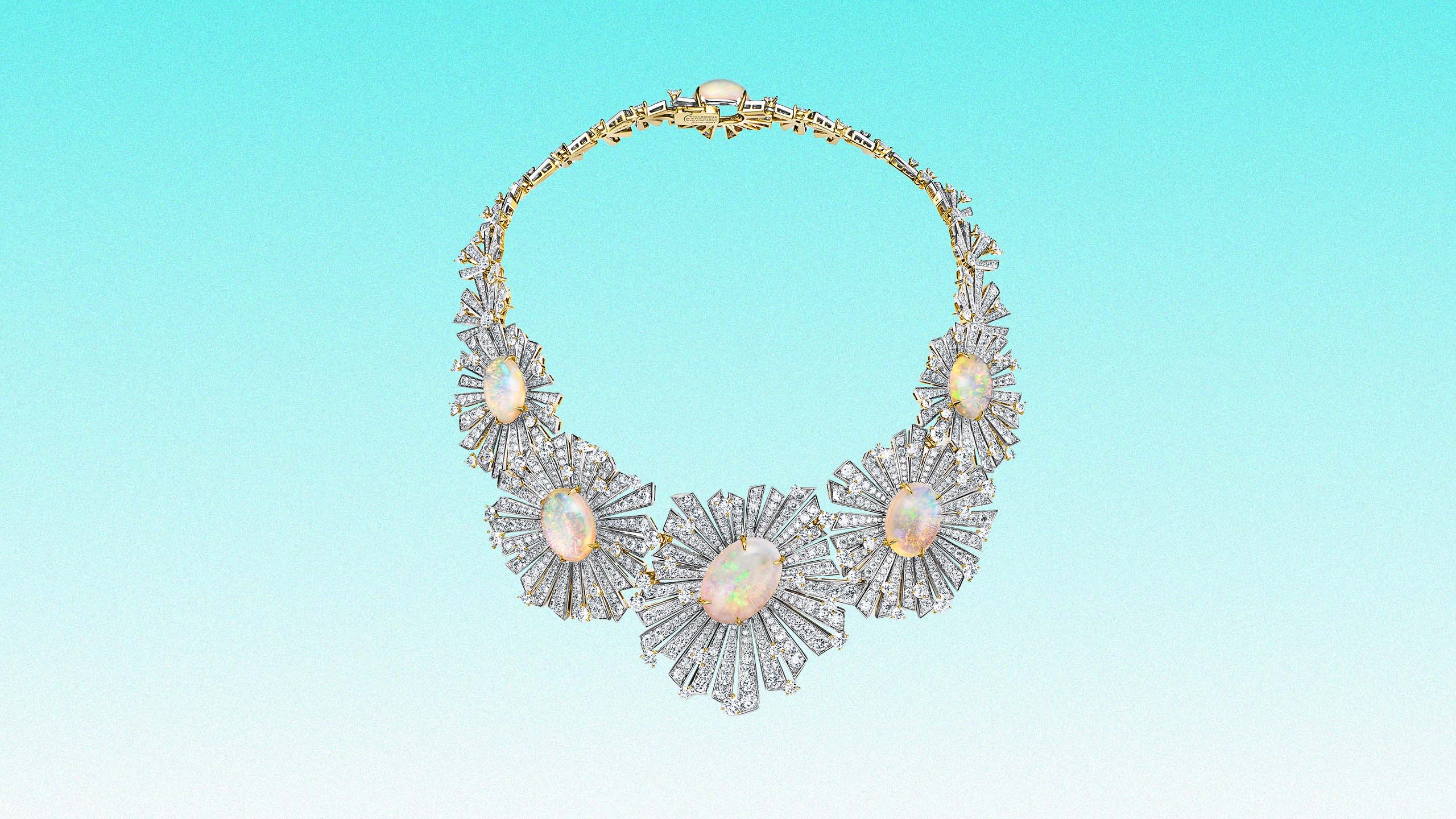
Tiffany & Co. and Its Search for the Best Diamonds in the World
The Tiffany Diamond is one of the most celebrated, storied diamonds of all time.
In 1877, the 287.42-carat rough yellow diamond, one of the largest ever discovered, was unearthed in South Africa. Charles Lewis Tiffany, the founder of Tiffany & Co., acquired it a year later. The stone was cut more than half to its final 128.54 carats in a cushion-shape design with 82 facets to bring out its brilliance, a stunning testament to the pursuit of beauty over size.
“Our stones are very important to us. They are our heritage,” says Anthony Ledru, Tiffany & Co. president and chief executive officer, in an exclusive online interview with Robb Report Philippines from his home in New York on a holiday morning. “They’re what drives us—our history of exceptional diamonds and legacy stones.”
In 1961, actress Audrey Hepburn, a woman of the zeitgeist, famously wore the Tiffany diamond—set in a ribbon rosette necklace designed by Jean Schlumberger—in publicity photographs for the film “Breakfast at Tiffany’s.” Over 30 years later, at Schlumberger’s posthumous Paris retrospective at the Musée des Arts Décoratifs in 1995, the house mounted the yellow diamond on the late designer’s classic piece, Bird on a Rock. The bird, designed in 1965, was inspired by a yellow cockatoo Schlumberger had spotted back home in his native Guadalupe. Quirky with its plume of yellow feathers, the little bird evoked a sense of wonderment and captured the world’s imagination.
“The bird is exactly what Tiffany stands for, and Bird on a Rock has been the single, fastest growing icon,” says Ledru, referring to a full suite of designs inspired by the brooch, released in 2023, that are very popular in Asia. It takes at least eight craftsmen and over 50 hours of work to create each piece.
“I think that in Southeast Asia, and in the Philippines in particular, the bird resonates because it’s a bit tropical, it’s a bit surreal. It’s fun; it’s a bit like a bird on steroids. With Schlumberger, there was always a bit of a twist; he was friends with Salvador Dali. It’s joyful, it’s fun, it’s elevated, and you cannot copy it. That’s our business. I need to offer something to you that you cannot find somewhere else,” says Ledru.
From the time Ledru came on board with Tiffany & Co. in 2021, he’s been passionately traveling the world in search of the most glorious, most fabulous stones he can acquire for the heritage brand.
“We’re going for extraordinary stones, not just the exceptional or very good. We’re going after the truly one-of-a-kind. We’re selecting the best stones in the world,” says Ledru, who has always been a wanderer, leaving France at the age of 22 to make his mark on the other side of the world, in Argentina.
“All my colleagues wanted to go to London, to New York. I wanted something completely different. South America was my absolute dream,” he says.
The southern hemisphere continues to be a source of magic for him.
In 2023, Tiffany & Co. announced it had acquired an extraordinary emerald sourced from the Muzo mines of Colombia. Weighing over 10 carats, the Tiffany Muzo Emerald has been labelled “a miracle of nature” because of its large size, perfectly saturated green color, and exceptional crystal quality.
From elsewhere in the world, last year, Tiffany& Co. was entrusted with a selection of exceedingly rare Argyle Pink diamonds after the closure of the Argyle mine in Western Australia. The stones colors range from a Fancy Intense Pink to a Fancy Red diamond, the rarest of all.
“The Argyle Mine closed in 2020. They’re worth so much because there is no more mine; they came to us because they knew we were chasing these kinds of stones. We bought the lot,” says Ledru. “You have to be bold, you have to have the passion. You have to be patient, which, in our business, I believe is the key.”
Ledru’s exuberance is magnetic.
“I have energy. I’m very passionate. The French term for it is “l’envie.” It’s different from drive. It’s life! L’envie, for me, is the number one quality to succeed. If you have that, nothing can stop you,” he says.
“High jewelry creates a culture of excellence. It’s pushing the whole company at all levels to get to the highest levels,” Ledru says. “You want to remove any point of comparison. You keep clients constantly amazed by finding these extraordinary stones, and then you give them extraordinary design. You need an extraordinary venue, you need extraordinary stars. You’ve got offer something that they have not seen yet.
“You should forget about the day-to-day and jump into the extraordinary. That’s our job: to create that emotion,” Ledru says. “Our high jewelry ambassadors are there to tell stories, they’re there to create the dream. A dream is usually perfect, and it’s very hard to create perfection. You need to get very close to that.”