The Galleries We Love at Art Basel Hong Kong 2026


At Art Basel, you have three days, perhaps four if you skip the VIP dinners where the wine is excellent but the conversation is about shipping logistics. You will walk miles, develop opinions about lighting, and at some point stand before a work of genuine significance while thinking only about where to find those elusive water dispensers.
There are two ways to “do” Basel weekend. The first is through the laminated floor plan and military pace that leaves you seeing nothing; or the second, admitting you cannot see everything and deciding, with surgical precision, where to aim your attention. So consider this a field guide for the time-pressed and the aesthetically overstimulated—the booths and programs where the work actually rewards the looking, and where you might, if you’re lucky, forget to check your phone!
Max Hertzler: Andre Butzer, Eleanor Swordy, and Albert Oelen
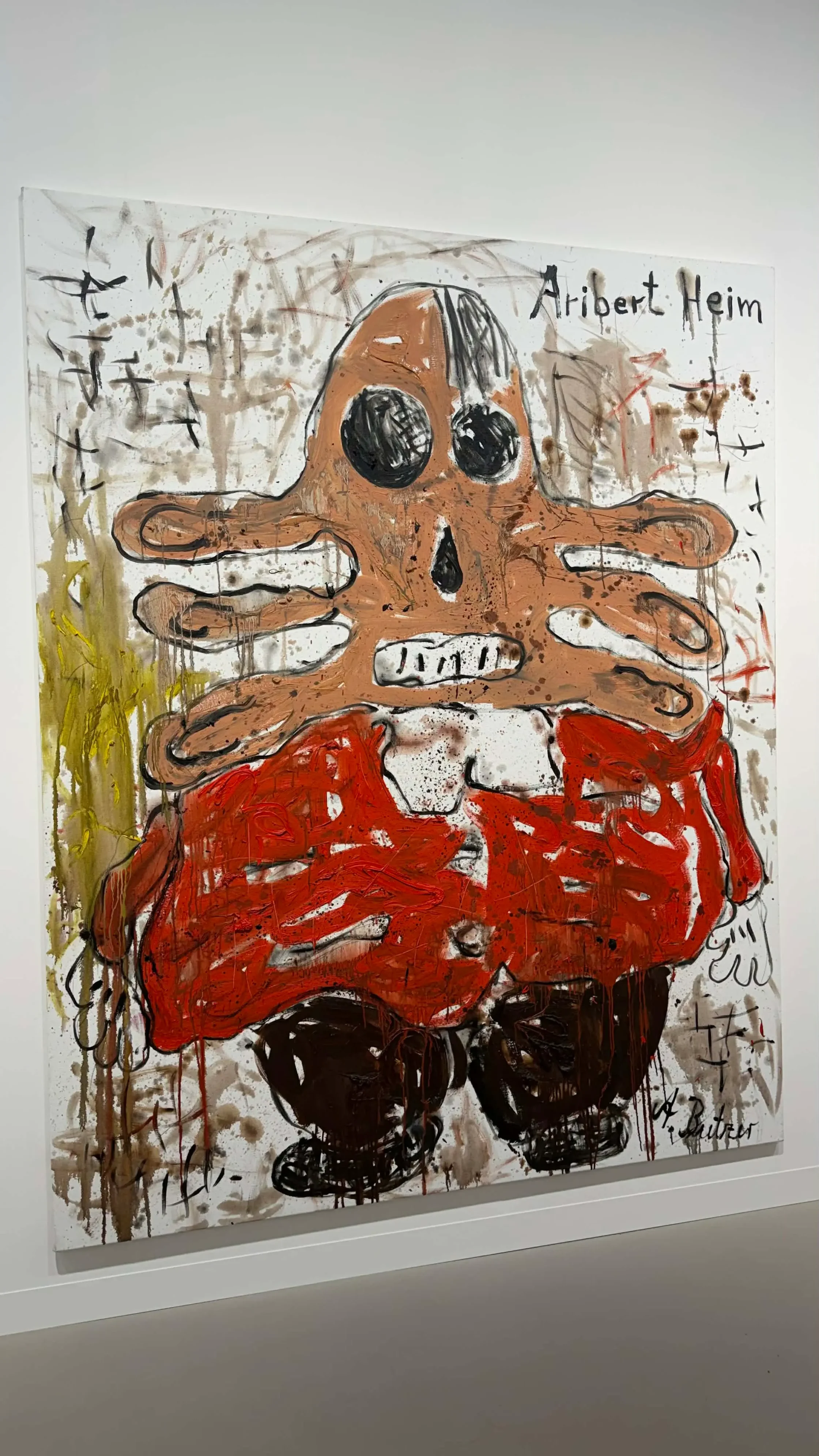
When we think of Andre Butzer, we think of someone who invented “Science-Fiction Expressionism” to fuse Munch’s angst with Disney’s utopia, his NASAHEIM universe oscillating between despair and hope. Complementing him are Eleanor Swordy’s structured paintings like musical compositions, as her figures mediate through tools—bowstrings, hoses—that mirror the painter’s own implements.
Albert Oelen, whose hallucinatory ceramics sort of defy the medium’s decorum with their grotesque, polychrome, and gleefully unhinged forms, punctuate the showcase. Together, they form a triad united by a shared and audacious refusal of polite taste.
Flowers: Movana Chen, Jakkai Sirbutr, and Luka Yuanyuan Yang
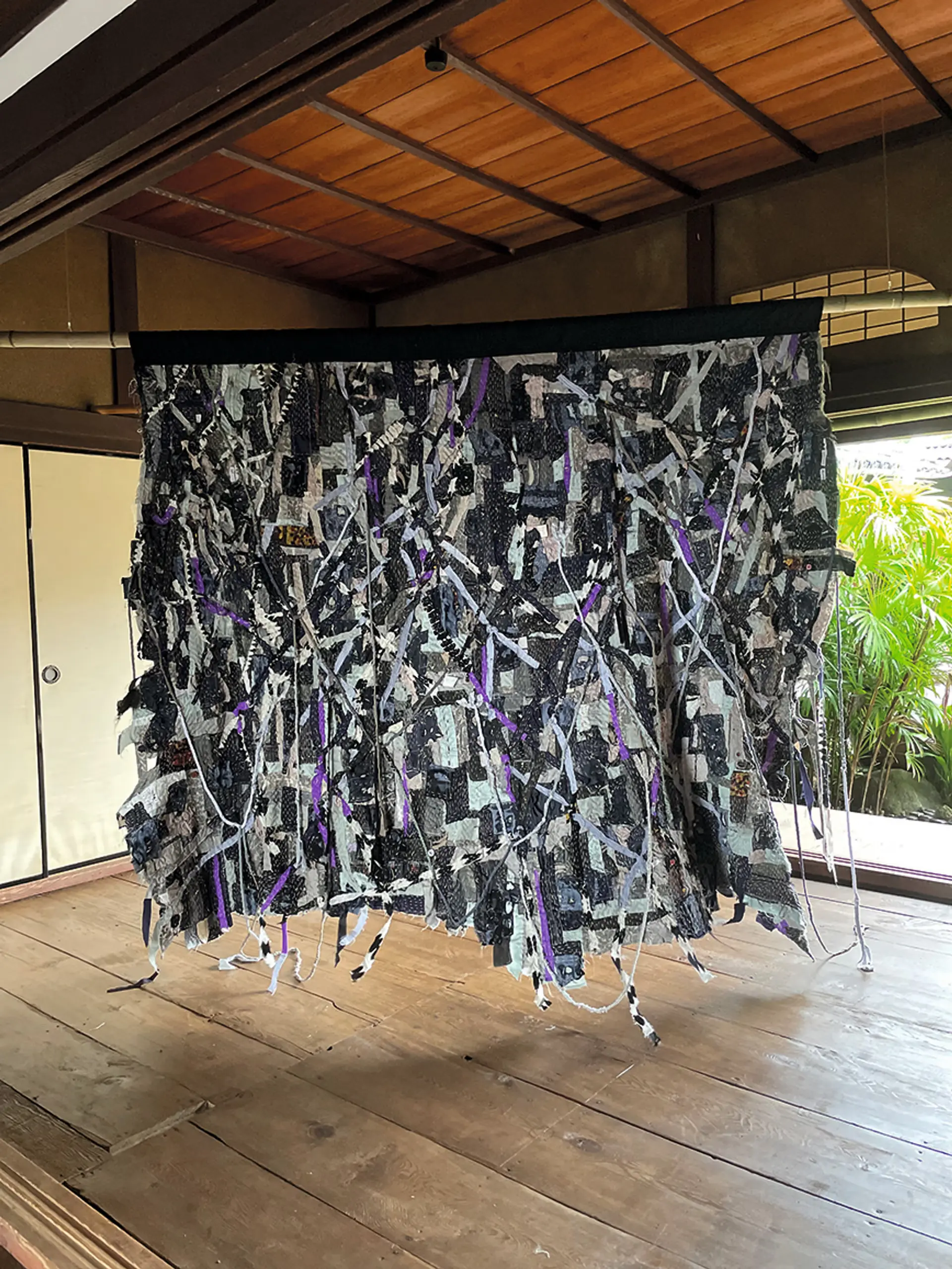
Flowers titled their booth Tapestries of Togetherness, a fitting description for three artists who treat textiles as testimony. Movana Chen’s “KNITerature” shreds books and maps into woven installations, transforming language into fabric. Jakkai Sirbutr embroiders intricate tapestries narrating Thailand’s difficult history, often collaborating with displaced Shan communities.
Meanwhile, Luka Yuanyuan Yang excavates forgotten histories of Chinese women performers in 20th-century America, recovering voices erased by the Chinese Exclusion Act. All three practice what a not-to-be-named curator calls “palimpsestic approaches.”
Ora-Ora: Henry Chu, Krista Kim, and Huang Yulong
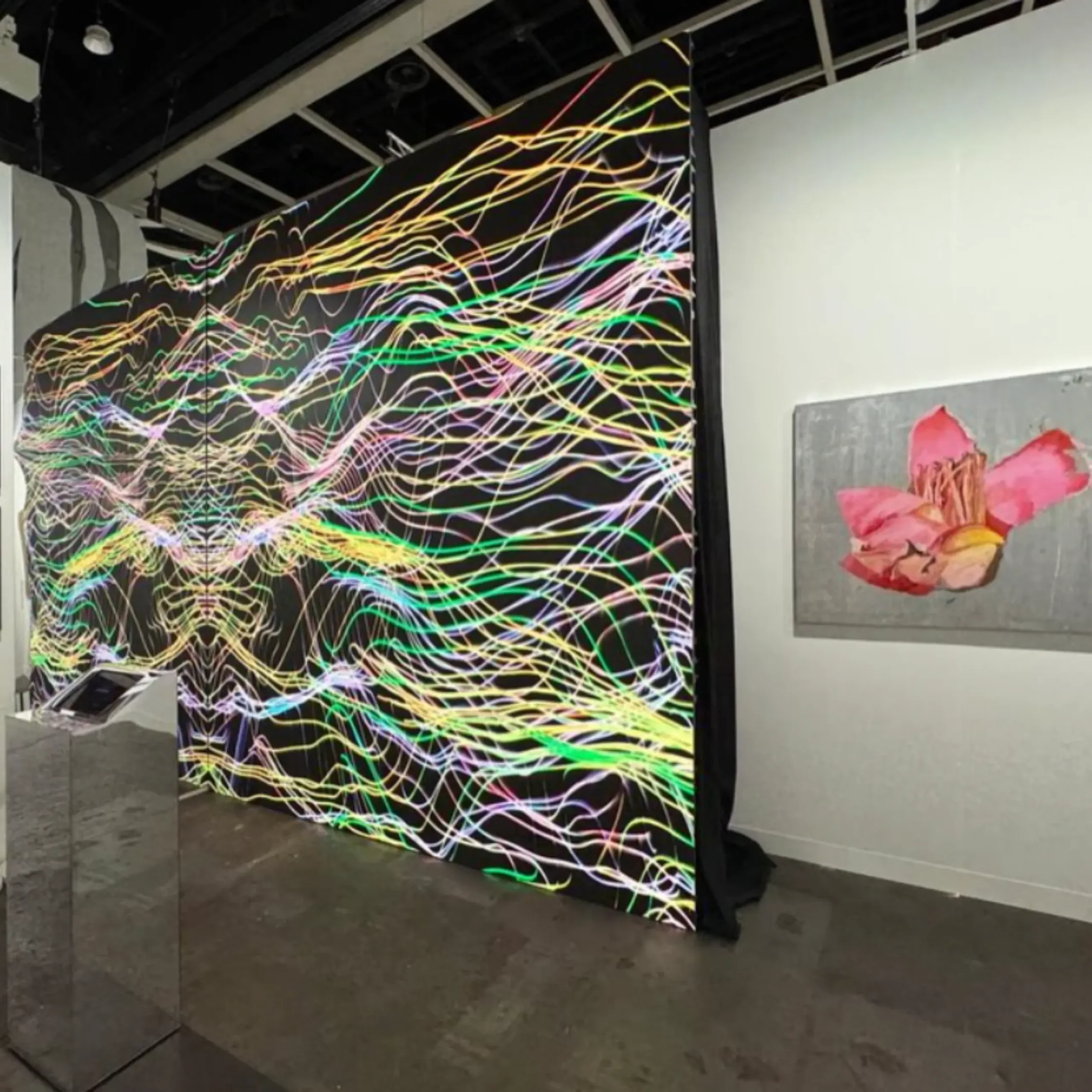
Ora-Ora’s twentieth-anniversary booth, HalluciNation, is a maximalist proposition. Krista Kim, pioneer of the “Techism Manifesto,” debuts HeartSpace, an immersive screen translating visitors’ heartbeats into waves of light. Henry Chu, the engineer-turned-tech artist, counters with A(bsurd) and D(istortion), where geopolitical news feeds corrupt Bach’s harmonies, rendering listeners powerless in real time.
Huang Yulong’s bronze centaur, On My Way, marries Jingdezhen craftsmanship with streetwear swagger, while ink masters Huang Dan, Nina Pryde, and Xiao Xu remind us that classical materials remain astonishingly elastic. Technology and tradition here are not opposing forces but collaborators in the hallucinatory present.
Drawing Room Manila: Gerry Tan, Soler Santos, and Ged Unson Merino
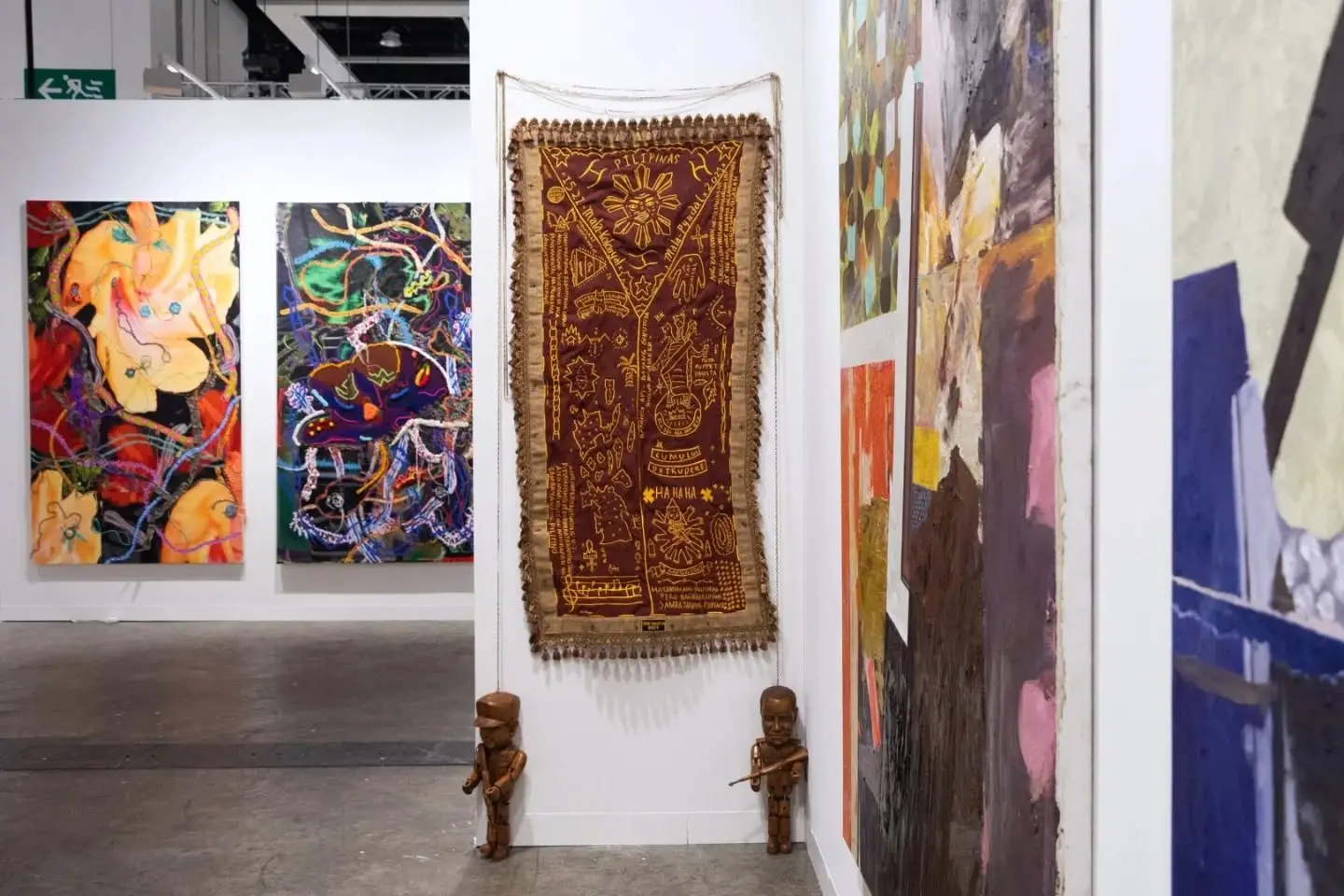
Drawing Room Manila assembled four generations of Philippine practice around a single proposition: materials remember what history chooses to forget. Ged Unson Merino’s monumental textiles—printed, stitched, embroidered—function as living archives of his migration between Manila, Bogotá, and New York.
Next to them, Cian Dayrit reworks tapestry’s aristocratic lineage into banners of political critique, subverting a medium once reserved for territorial power. Soler Santos merges painting with photography and found materials, transforming urban decay into a quiet elegy. And of course, Gerry Tan, the conceptual trickster, anchors the booth with his deadpan inquiries into how images accumulate and erode. The thread is material. The argument is memory.
Catinca Tabacaru and Nome: Cian Dayrit, Terrence Musekiwa, Youssra Raouchi
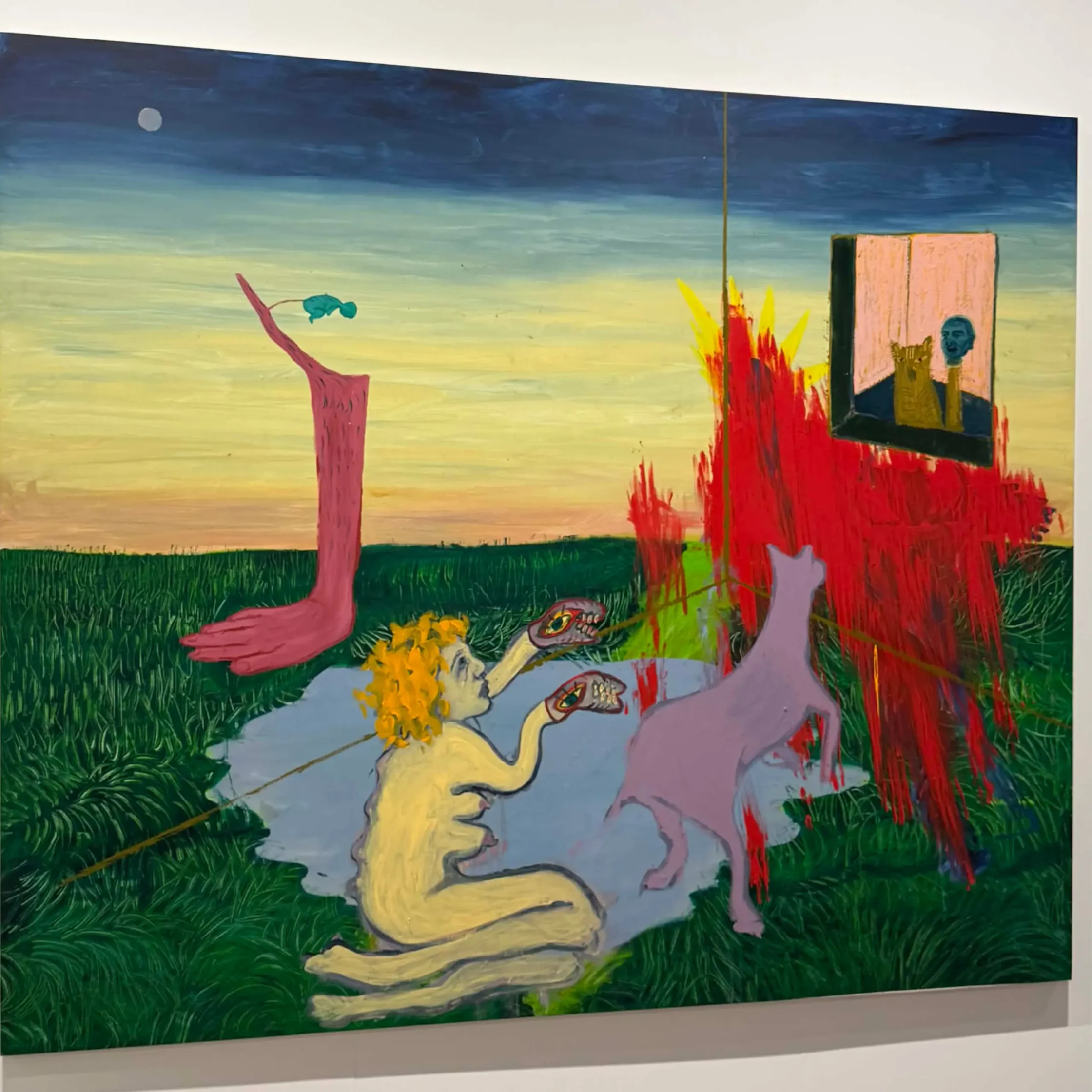
Dayrit, the Filipino multidisciplinary artist, works with a cartographer’s precision and a revisionist’s agenda—his maps and tapestries overlay colonial infrastructures with contemporary political borders, revealing how power has merely changed uniforms.
Musekiwa, a Zimbabwean sculptor based in South Africa, transforms salvaged industrial materials—think rusted barrel lids, discarded piping—into figurative works that seem to exhume. Then there’s Raouchi, the Egyptian-French artist whose textile-based practice involves painstakingly unraveling and re-stitching found garments, effectively unmaking and remaking personal histories.
Mizuma: Tasaki Taro, Ari Bayuaji, and Yamamoto Ryuki
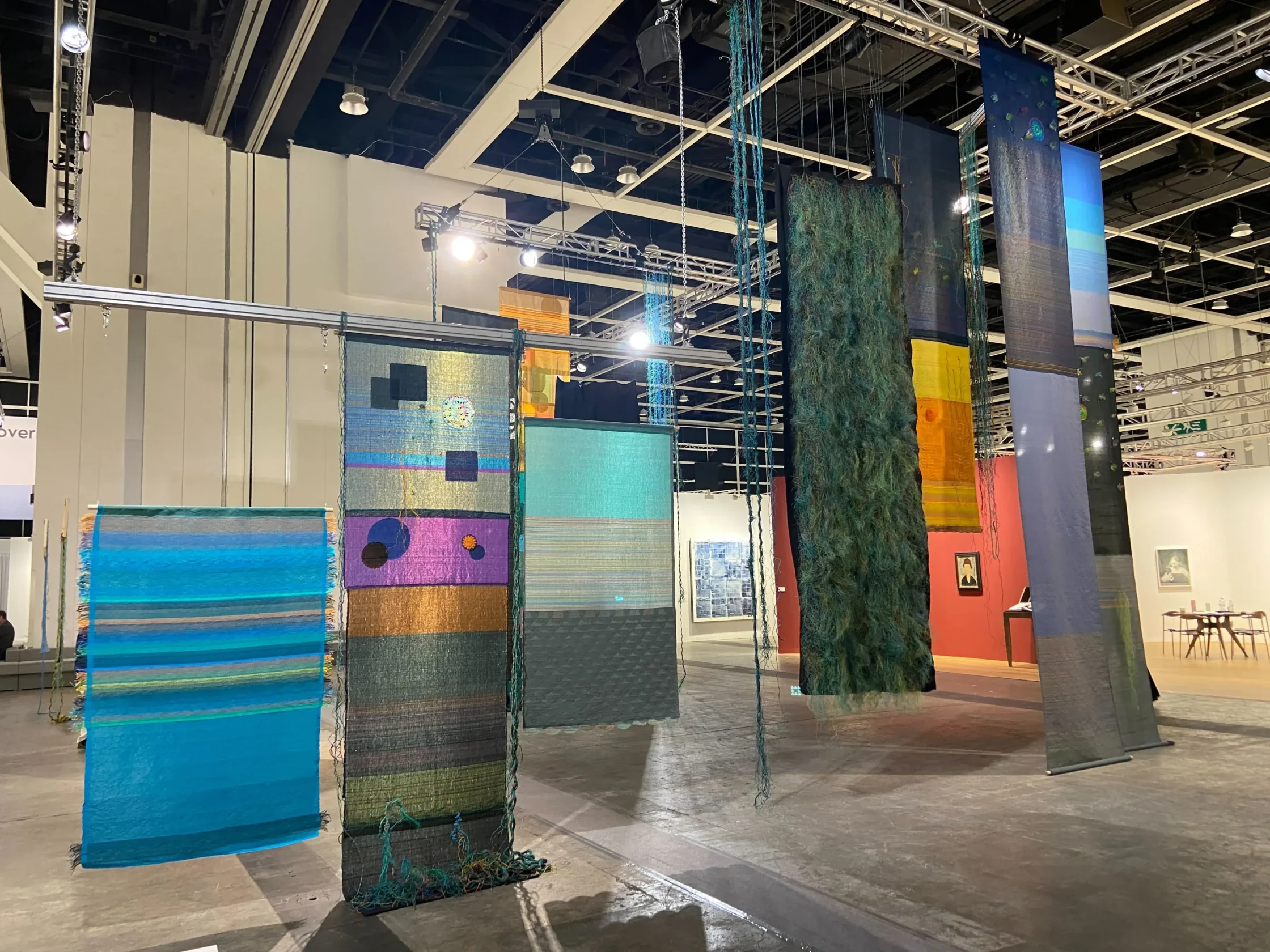
Ari Bayuaji transforms discarded fishing nets from Bali into luminous tapestries through Weaving the Ocean, a community-driven project also featured in Encounters. Alongside him is Tasaki Taro, who crafts ceramic figures where mechanical forms meet biological softness, their awkward charm quietly meditating on peace.
Yamamoto Ryuki, meanwhile, renders Shiba dogs, Angora rabbits, Buddhist symbols, and more with the same monumental hyperreal devotion he once reserved for self-portraits. Process—weaving, firing, observing—inevitably unites them.
COHJU: Shinya Azuma
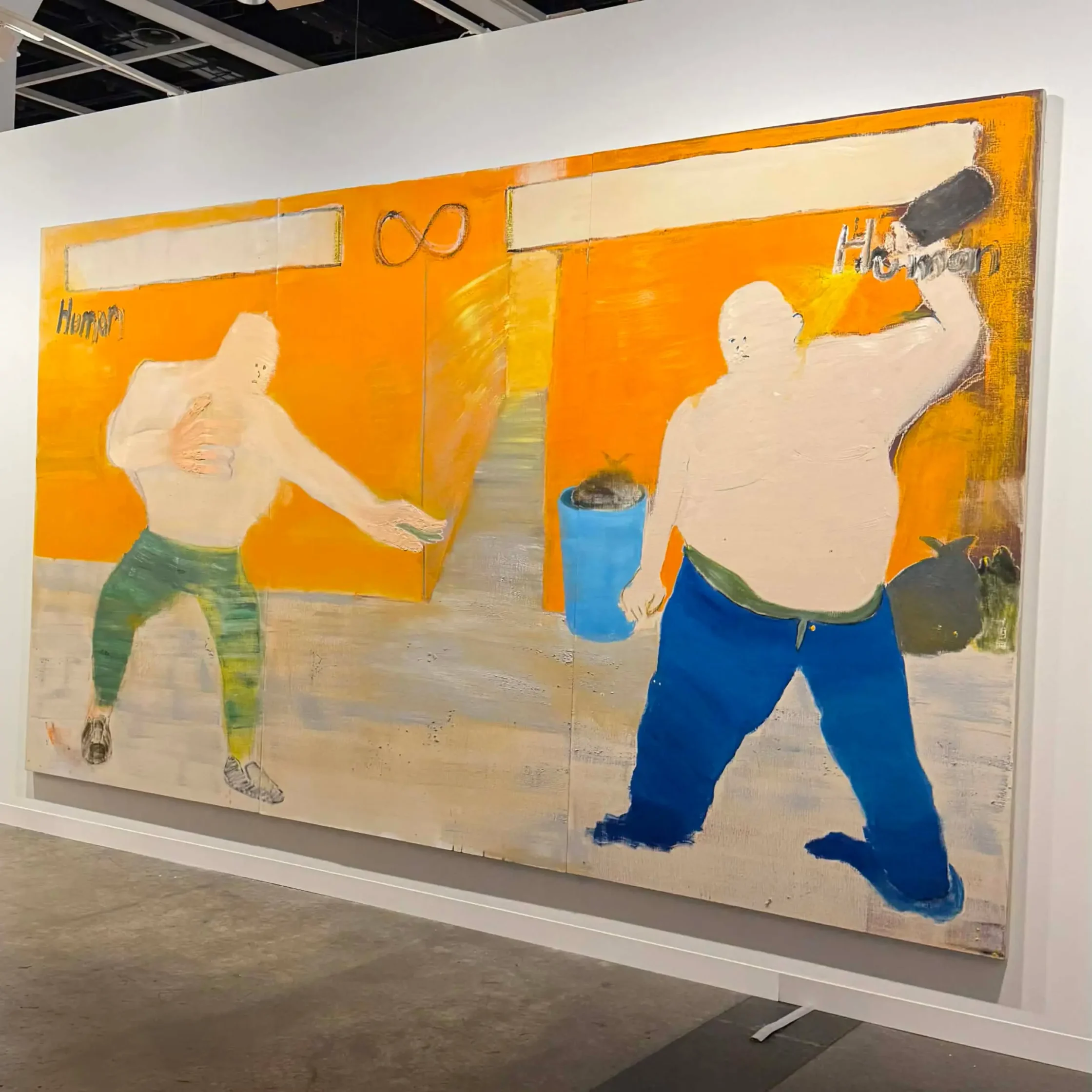
Shinya Azuma draws ironically from news broadcasts, social media, and daily life, then translates these images to canvas with aggressive, unpretentious, and rather (un)serious brushwork.
His peculiar color sense—clashing primaries, synthetic pinks—and chunky paint texture create a visual language somewhere between meme and manifesto. The subjects range from wealth inequality to sexual intimacy, rendered with satirical, self-deprecating humor that stops you cold.
Gallery Baton: Yuchi Hirako
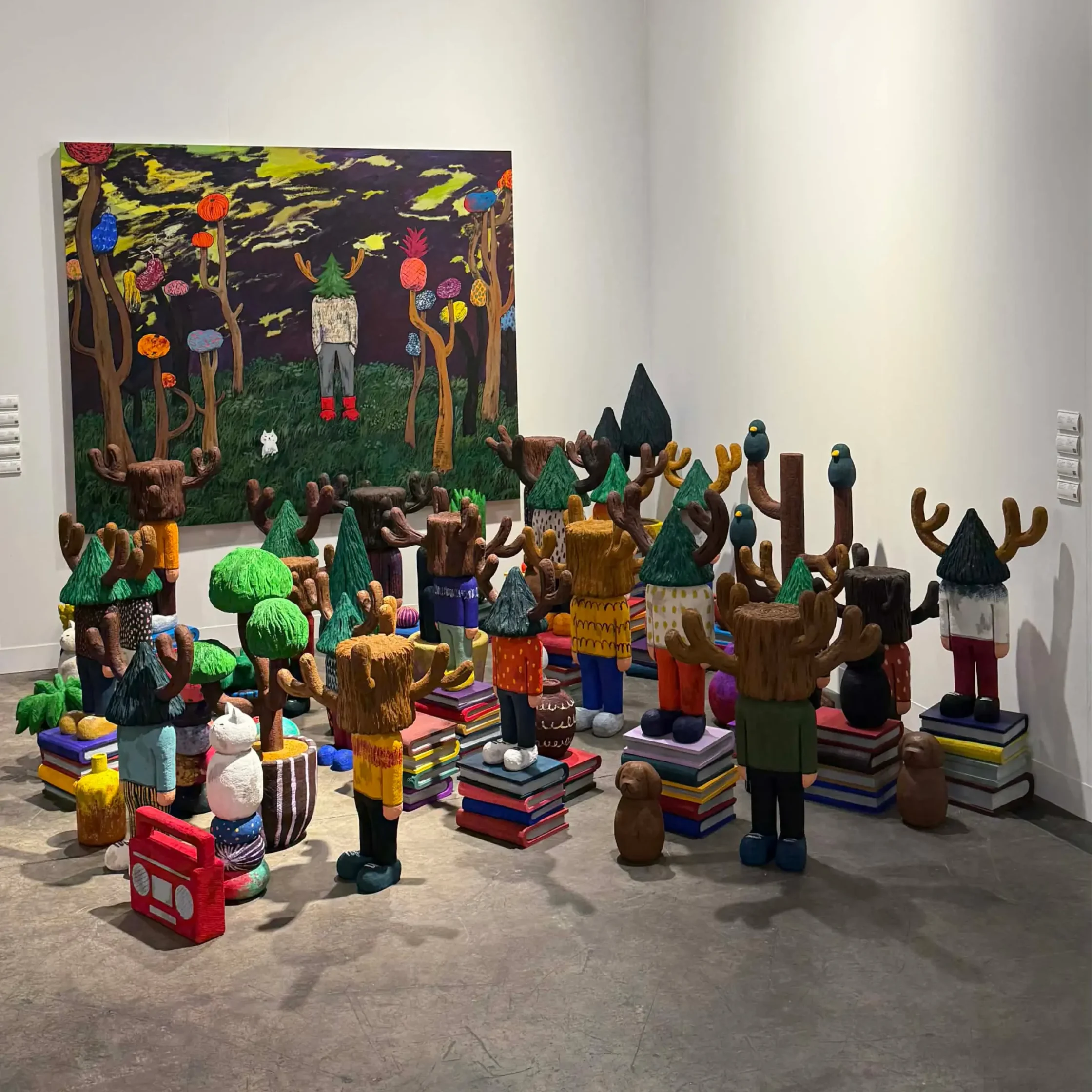
Hirako’s recurring “tree-man” (that uncanny human body topped with pine or fir, antlers included) functions as his surrogate, evolved from Japanese kodama folklore. Working across painting and sculpture, he stages domestic scenes where these figures read, lounge with cats, or tend houseplants.
The effect is neither whimsy nor environmental sermon, but something more interesting: an open-ended inquiry into how nature becomes “indefinitely mediated and domesticated in contemporary culture.
Encounters-Specific: Steph Huang, Hu Yijnping, and Geraldine Javier
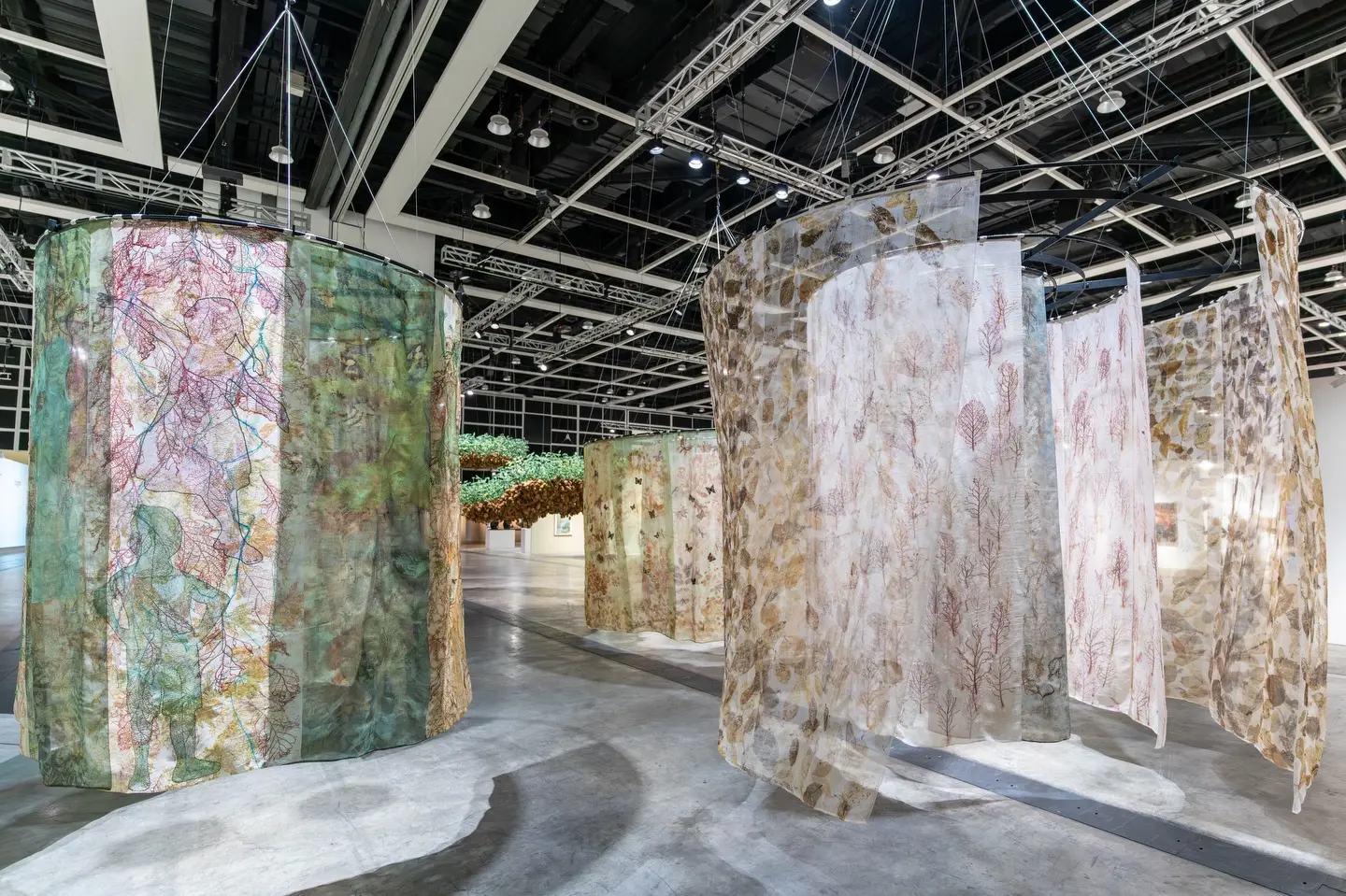
Steph Huang, a Taiwanese-British artist, transforms everyday objects like bamboo steamers, fluorescent tubes, and broken glass into sculptural puzzles about labor, migration, and the overlooked poetry of the quotidian. Hu Yinping’s decade-long “Hu Xiaofang” project commissions knitted works from rural Sichuan women, paying fair wages to subvert the devaluation of “women’s craft” and “women’s time.”
Geraldine Javier, the Filipina multidisciplinary artist represented by Silverlens, presents monumental eco-printed fabric columns resembling trees—her signature technique using rust, leaves, and natural dyes to embed the landscape itself into the work. All three use humble materials to assert that making is also a form of witnessing.
Victoria Miro: Grayson Perry, Mario Berio, Milton Avery, and Hernan Bas
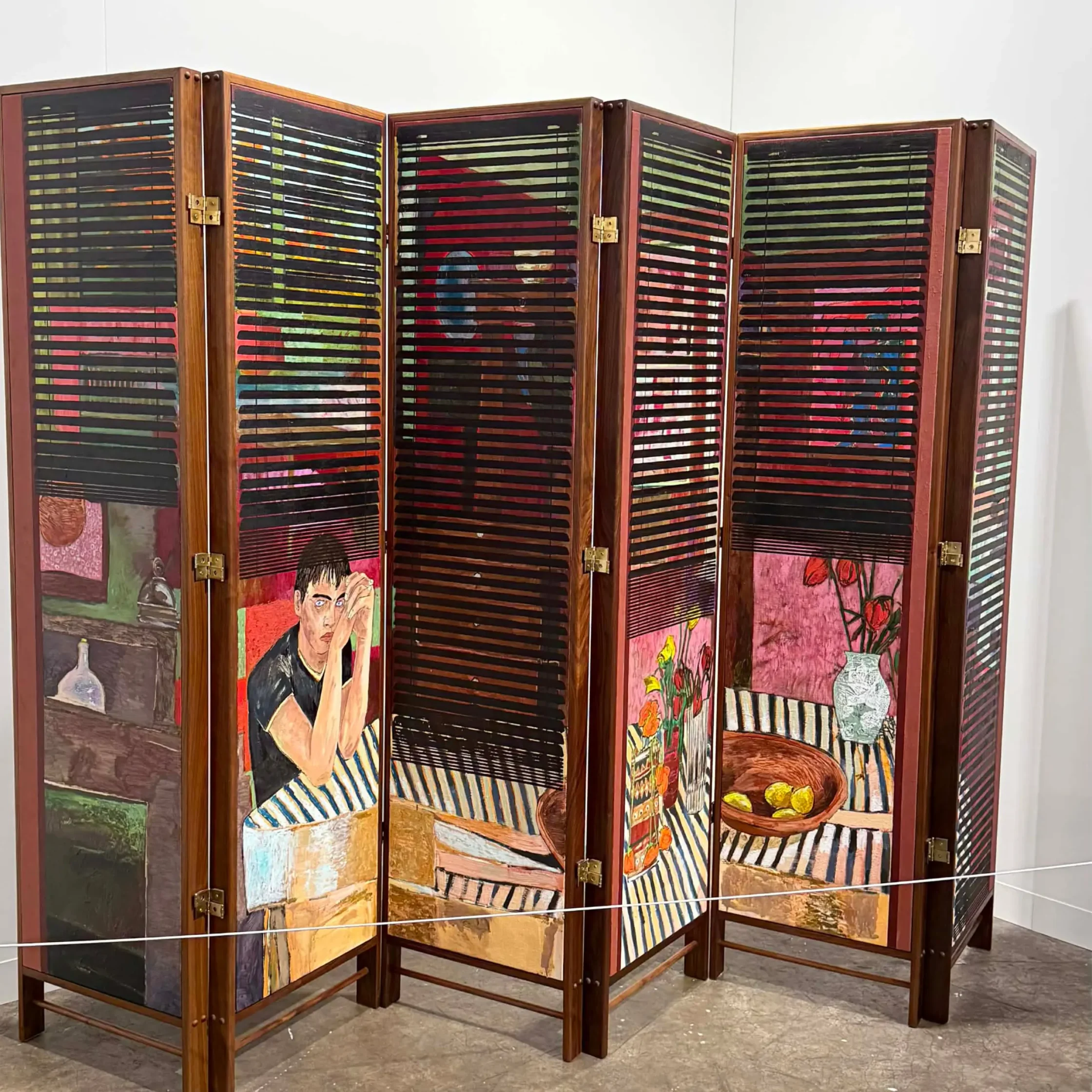
Turner Prize winner Grayson Perry’s ceramic pots deliver social critique with the wit of a satirist and the craft of a master, observations disguised as vessels. Mario Berio’s vibrant abstractions, on the other hand, channel postwar Italian energy through swaths of unprimed canvas soaked in dye.
Milton Avery, the quiet American colorist, anchors the showcase with flattened forms that anticipated Rothko. Hernan Bas then contributes his signature melancholic dandies, which are figures suspended in narratives of longing and decadence. An improbable quartet whose conversation transcends generations.
P21: Yaerium Ryu
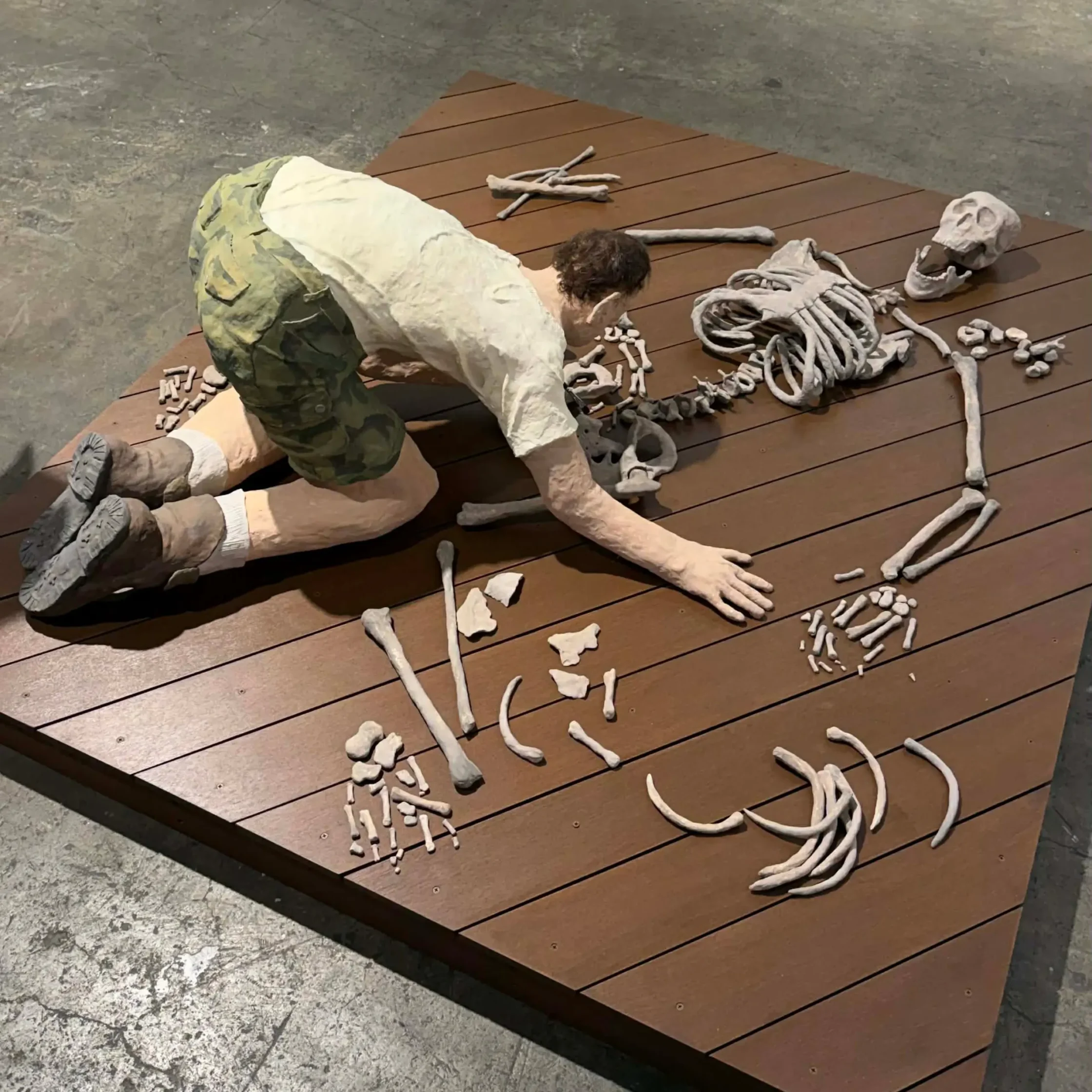
Yaerium Ryu presents Peter, a solo project centered on a fictional Neanderthal man whose imagined excavation becomes a meditation on painting itself. Through archaeological and museological imagery—fossil-like forms, vitrine-like displays, surfaces that mimic stone or sediment—Ryu examines how images can become physical records of time. Here, the canvas is a dig site.
Gesture, labor, and surface memory accumulate like geological strata. The conceit is clever but never gimmicky: by inventing an ancient subject, Ryu asks what it means for contemporary painting to leave traces worth unearthing.