Since 1969, Every Crewed Lunar Mission Has Carried Omega—Artemis II Included





As Artemis II returns to Earth, it’s clear that the mission has already done what it set out to prove: humans can travel farther than they have in half a century—and come back on a trajectory propelled by physics and engineering. It looped around the Moon’s far side for a full systems test: launch, navigation, life support, communications blackout, and high-speed re-entry, all with astronauts onboard. If the next mission is meant to return humans to the lunar surface, Artemis II is the proof that the machinery—and the people—can get there and back reliably, a reminder that deep space is once again within operational reach.
Inside the Orion capsule, the environment is unmistakably modern—digital displays, automated systems, layers of redundancy. And yet, one object on each astronaut’s wrist was visibly strapped outside their orange suits while they boarded—on Reid Wiseman, Victor Glover, Christina Koch, and Jeremy Hansen—connecting the mission directly to its predecessors: the Omega Speedmaster X-33.
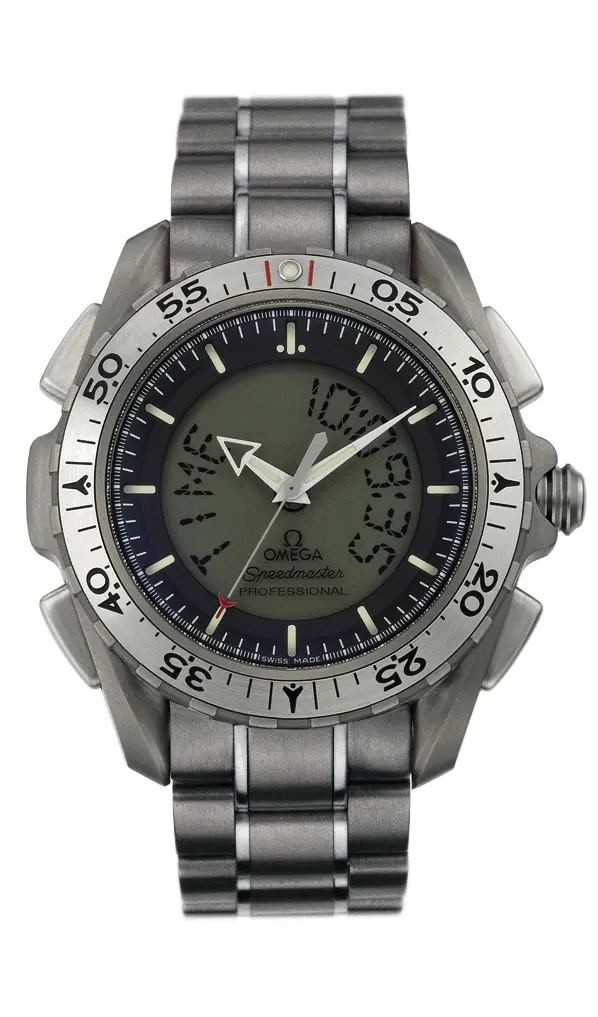
Issued from NASA’s inventory of flight-qualified hardware, the X-33 is the latest evolution of a watch lineage that dates back to the 1960s, when the Speedmaster was certified for manned spaceflight and went on to accompany astronauts through lunar missions since 1969.
While the original mechanical Speedmaster remains qualified for Extra Vehicular Activity (EVA—walking on the moon), the X-33 has become the standard issue instrument for use inside the spacecraft.
Unlike its mechanical predecessors, the X-33 is a quartz, multifunction instrument developed with astronaut input. The Artemis II version features a lightweight grade 2 titanium case and bracelet, designed to remain unobtrusive in zero gravity, along with a sapphire crystalSapphire CrystalAn extremely scratch-resistant, clear, transparent material used to cover luxury watch dials, produced synthetically from aluminum oxide. Sapphire crystal ranks near diamond in hardness, and it keeps a watch faceGo to Sapphire Crystal Glossary designed for clarity under varying light conditions. Its digital interface supports mission timing functions including elapsed time tracking, phase monitoring, and programmable alarms. These are obviously not decorative, although we earthlings have to admit that all in all, just like the successful mission, it’s all pretty cool.