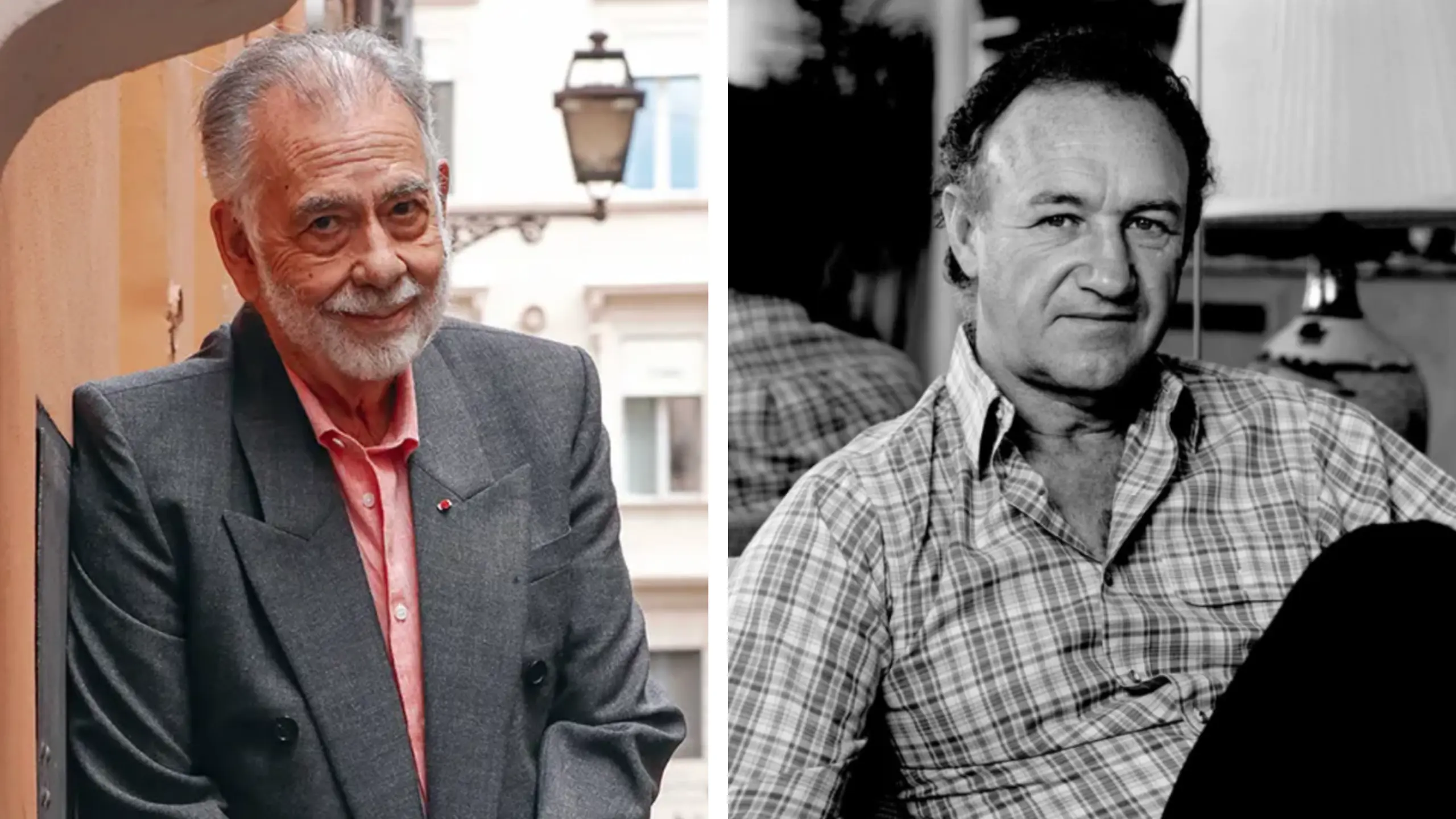
The Luxe Dispatch: Two Titans of Cinema, Two Stunning Collections on Auction
We turn our gaze toward New York this week, as two cinematic icons’ collectibles are put on the auction block. At Bonhams and Phillips, the private worlds of Gene Hackman and Francis Ford Coppola are unveiled through the objects that defined their creative lives, from paintings and sculptures to beautiful timepieces that blur the line between art and autobiography.
At Bonhams, The Gene Hackman Collection: A Life in Art reveals the actor’s quiet reverence for form and feeling. Thirteen works by modern masters, including those of Rodin, Avery, and Diebenkorn mirror the Oscar winner’s own gravitas and restraint. Across town, Phillips presents Coppola’s visionary collaboration with F.P. Journe. The FFC Prototype is a one-of-one mechanical marvel conceived from a single, brilliant question: Can a human hand tell time?
Interestingly, the duo had actually collaborated together on Coppola’s Oscar-winning 1974 ouvre, The Conversation. Together, these auctions distill a century’s worth of creative ambition. Each piece has become a witness to the discipline, curiosity, and genius of two of Hollywood’s most enduring figures.
Gene Hackman’s Final Curtain
This coming November, Bonhams New York unveils a deeply intimate portrait of one of cinema’s most enigmatic figures. The Gene Hackman Collection: A Life in Art collection features 13 works by masters such as Auguste Rodin, Milton Avery, and Richard Diebenkorn. Best known for his Oscar-winning performances in The French Connection and Unforgiven, the actor’s artistry extended well beyond the big screen. The collection reveals quite an eye for tension, composition, and emotional restraint.
Notably leading the November 19 live auction is Avery’s “Figure on the Jetty” (estimated at around $500,000 to 700,000), a luminous meditation on solitude that once hung in Hackman’s very own Santa Fe home. This is complemented only by Diebenkorn’s “Green” (1986), an etching from his famed Ocean Park series, and a monumental Rodin bronze, to name a few.
Hackman’s collecting was said to have begun in earnest after his retirement. During this time, he would turn to painting, writing, and sculpture himself. His studio notebooks, annotated catalogues, and personal artworks (even offered in two accompanying online sales) suggest a man perpetually in search of form and meaning, as he explored various media.
Together, these offerings chart the contours of a private life shaped by artistic rigor and cinematic gravitas. Bonhams’ Andrew Huber adds, “Hackman’s approach to collecting mirrors his craft—measured, instinctive, and profoundly human.” In death as in life, Gene Hackman remains the consummate storyteller, even when the medium is canvas instead of celluloid.
More information here.
Francis Ford Coppola’s Horological Epic
In filmmaking, Francis Ford Coppola transformed the language by marrying operatic grandeur with intimate psychology. It was with his narrative ambition that he redefined how time unfolded on the screen. Now, time itself takes on a new form in The New York Watch Auction: XIII, as Phillips, in association with Bacs & Russo, unveils Coppola’s personal F.P. Journe FFC Prototype.
Expected to fetch over $1 million, the FFC Prototype began as a question posed by Coppola to François-Paul Journe at the filmmaker’s Inglenook estate in 2012: “Has a human hand ever been used to tell time?” From that spark emerged a watch unlike any other. A kinetic sculpture powered by Journe’s Octa 1300.3 movement, its articulated hand is inspired by Ambroise Paré’s 16th-century prosthetic “Le Petit Lorrain.” The fingers unfurl to indicate each hour, blending anatomy, invention, and poetry.
Made in only two examples (one for Coppola, one retained by Journe), the prototype represents the sole instance of an F.P. Journe design conceived by someone other than the master himself. Its provenance, engraved with Coppola’s name, reads like a script written in gears and steel.
Alongside the FFC, six timepieces from Coppola’s private collection, including his platinum Chronomètre à Résonance gifted by his late wife Eleanor, and rarities from Patek Philippe, Blancpain, and IWC. For collectors, this is no mere auction but a convergence of art forms: where horology meets auteurship, and where Coppola and Journe turn the measure of hours into the cinema itself.
More information here.